Reliable, authoritative, and designed to ease grammar anxiety! Words are the currency of every business transaction. They persuade, inspire, educate, and clarify. Essential Grammar for Business offers guidance to professionals perplexed by proper comma placement, dangling modifiers, or the difference between who and whom. With a better understanding of the building blocks, readers will be better equipped to focus on the other ingredients of good business writing such as content, clarity, and style. This book is fun, fast-paced, and easy to use.
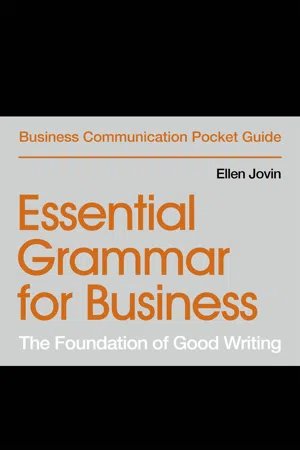
- 192 pages
- English
- ePUB (mobile friendly)
- Available on iOS & Android
eBook - ePub
About this book
Information
Chapter 1
Parts of Speech
A basic knowledge of the parts of speech makes it easier to follow discussions of English grammar and to understand the conventions of standard English grammar. This first chapter introduces the fundamental characteristics of these eight word categories: nouns, pronouns, verbs, adjectives, adverbs, prepositions, conjunctions, and interjections. If you already know this information, skip ahead to Chapter 2 and use this chapter for reference when you need it.
The Eight Parts of Speech
•nouns
•pronouns
•verbs
•adjectives
•adverbs
•prepositions
•conjunctions
•interjections
As you read through these descriptions, keep in mind that the same word can be a different part of speech depending on how it is used. For example, the word well can function as a noun, adverb, adjective, verb, or interjection. To determine part of speech, you will often need to examine how a word is functioning in a particular sentence.
Noun
The well ran dry.
Adverb
Ramón did well in his TV interview.
Adjective
Laila is not well today.
Verb
When I criticize Robin’s work, tears well up in his eyes.
Interjection
Well! I’ve never been called that before.
1.1 Nouns
A noun refers to a person, place, thing, or idea. If you can perceive something through one of your five senses—sight, sound, smell, taste, or touch—it is probably a noun. Examples include:
| thinker | desk | noodle |
| notebook | stapler | medal |
| thunder | radish | car |
| courtroom | table | sushi |
| office | elevator | sandpaper |
Other nouns describe abstract ideas that cannot be perceived through the five senses. The word idea is an abstract noun! Here are some other examples:
| integrity | arrogance |
| belief | reason |
| reputation | information |
| justice | culture |
| creativity | motivation |
There are two special types of nouns worth noting here. The first is the collective noun, which describes a plural concept but is singular in form. Examples include:
| crowd | team |
| staff | board |
| faculty | couple |
| panel | group |
| committee | jury |
Collective nouns create challenges with subject-verb agreement, which you will read about in 6.1.
Another special noun type is the proper noun, which refers to a specific person, place, thing, or idea. Joan Didion, New York City, and the American Bar Association are all examples of proper nouns.
1.2 Pronouns
A pronoun usually refers back to or replaces a noun or another pronoun. In the following sentence, for instance, the pronoun it refers back to the noun report.
Rochelle gave the report to Axel, who read it during lunch.
The word report is the antecedent for it. You can think of the pronoun in part as a tool for convenience; after all, without it we would have to write:
Rochelle gave the report to Axel, who read the report during lunch.
Pronouns don’t always act as surrogates for other words, however. If you think of pronouns as vague versions of nouns, that may help you recognize them. Listed here are some common pronouns:
| I | which | no one |
| you | who | anybody |
| he | that | anyone |
| she | these | something |
| it | those | whoever |
| we | some | one |
| they | each | whom |
| me | everyone | neither |
| us | everybody | themselves |
| ours | nothing | either |
1.3 Verbs
Verbs usually describe existence or action and can be divided into three broad categories: action, linking, and auxiliary (o...
Table of contents
- Cover
- Title Page
- Copyright
- Contents
- Introduction. The Foundation of Good Writing
- Chapter 1. Parts of Speech
- Chapter 2. Sentence Structure
- Chapter 3. Punctuation
- Chapter 4. Minding the Details
- Chapter 5. Special Topics in Formatting
- Chapter 6. Common Verb Errors and Problems
- Chapter 7. Common Pronoun Errors and Problems
- Chapter 8. Sticky Structures
- Chapter 9. Picking the Right Words and Forms
- Chapter 10. Chronic Sources of Grammar Confusion
- Chapter 11. Grammar Superstitions
- Conclusion
- Appendix: Parts of Speech
- About the Author
- About Syntaxis
- Index
Trusted by 375,005 students
Access to over 1.5 million titles for a fair monthly price.
Study more efficiently using our study tools.
Frequently asked questions
Yes, you can cancel anytime from the Subscription tab in your account settings on the Perlego website. Your subscription will stay active until the end of your current billing period. Learn how to cancel your subscription
No, books cannot be downloaded as external files, such as PDFs, for use outside of Perlego. However, you can download books within the Perlego app for offline reading on mobile or tablet. Learn how to download books offline
We are an online textbook subscription service, where you can get access to an entire online library for less than the price of a single book per month. With over 1.5 million books across 990+ topics, we’ve got you covered! Learn about our mission
Look out for the read-aloud symbol on your next book to see if you can listen to it. The read-aloud tool reads text aloud for you, highlighting the text as it is being read. You can pause it, speed it up and slow it down. Learn more about Read Aloud
Yes! You can use the Perlego app on both iOS and Android devices to read anytime, anywhere — even offline. Perfect for commutes or when you’re on the go.
Please note we cannot support devices running on iOS 13 and Android 7 or earlier. Learn more about using the app
Please note we cannot support devices running on iOS 13 and Android 7 or earlier. Learn more about using the app
Yes, you can access Essential Grammar for Business by Ellen Jovin in PDF and/or ePUB format, as well as other popular books in Business & Business Communication. We have over 1.5 million books available in our catalogue for you to explore.