This new edition of a popular guide to Neuro-Linguistic Programming draws on the latest neuroscience findings to give you a better understanding of NLP, and what it can do for you both professionally and personally. It introduces the foundations of NLP and the key principles of the technique, explaining the theory behind submodalities, the power of beliefs and values, and the importance of well-formed outcomes. Written in a jargon-free and accessible style, it will help you to use rapport, modelling and other effective strategies to achieve your goals at work - and to bring the principles of NLP to other areas in your life, making you an effective leader, partner and negotiator.
eBook - ePub
Essential NLP
An introduction to neurolinguistic programming
- 336 pages
- English
- ePUB (mobile friendly)
- Available on iOS & Android
eBook - ePub
About this book
Information
1
What is NLP?

In this chapter you will learn:
• different definitions of NLP
• what the N, L and P stand for
• how NLP originated and how you can apply it
• what you’ll gain from learning NLP
• how to get the most from this book.
Defining NLP
‘It makes a strange, loud sound, like a trumpet crossed with a factory siren.’
‘It’s enormous – about the size of a truck!’
‘It can suck in water through its long, flexible nose – and even pick things up with it.’
‘It can run at up to 15 miles an hour.’
‘It’s got thick white sticks coming out of its face.’
‘It must weigh at least four tons.’
‘It’s grey and wrinkly.’
Describing an elephant so that someone who has never seen one can understand what it looks, sounds and acts like can be a challenge. All the descriptions above are true, but none on its own begins to give a sense of what a magnificent creature the elephant really is.
And it’s the same with NLP. It has so many different facets that the best we can do at this stage is to give you a glimpse of it from some of the ways it has been defined or described over the years:
• ‘The science of how the brain codes learning and experience.’
• ‘A process that analyses excellence in human behaviour in such a way that the results created by that behaviour can be duplicated by almost anyone.’
• ‘The study of the structure of subjective experience.’
• ‘A model of communication that focuses on identifying and using patterns of thought that influence a person’s behaviour as a means of improving the quality and effectiveness of their lives.’
• ‘An attitude and a methodology that leaves behind a trail of techniques.’
• ‘A model of how we receive information, store information and retrieve it.’
• ‘A revolutionary approach to human communication and development.’
• ‘The difference that makes the difference.’
• ‘A modelling technology whose specific subject matter is the set of differences that make the difference between the performance of geniuses and that of average performers in the same field of activity.’
• ‘A system for describing, restructuring and transforming a person’s meaning and cognitive understanding of the world they live in.’
• ‘A set of procedures whose usefulness not truthfulness is the measure of its worth.’
• ‘An accelerated learning strategy for the detection and utilization of patterns in the world.’
• ‘A user’s manual for the brain.’
Understanding NLP
NLP may be described as a science, a process, a study, a model, a set of procedures, a manual, a system, an attitude, a strategy, a technology…no wonder some people initially struggle to get a perspective on what NLP is or grasp its essence. The absence of any agreed definition or description means that everyone comes up with their own – and, as you’ve seen, they’re very different.
As you ‘walked around the elephant’ by reading the descriptions above, you will have started to get a sense of what NLP is all about. And it’s our intention that by the time you’ve finished reading this book you will have a clear understanding of the key principles, models and patterns, along with the ability to put them into practice.
UNPACKING THE N, THE L AND THE P
Perhaps the easiest way of explaining NLP is to say it is a form of applied psychology. That’s not the whole story, but it’s how many people use it – as a means of achieving more for themselves and being more fulfilled in their personal and professional lives.
Another problem for NLP is the technical nature of the name. Happily, these days it is better known, but the reaction when you mention neuro-linguistic programming from people who have never heard of it is still to ask, ‘What on earth is that?’ Although many of us wish the founders had come up with a name that was snappier, clearer and – for those of us who earn a living from NLP – sexier, in fact ‘neuro-linguistic programming’ is simply an accurate description of what it is. Let’s take a look at why each of the terms came to be used.
• Neuro
The ‘neuro’ part relates to neurology, to the ways in which we process information from our five senses through our brain and nervous system.
• Linguistic
‘Linguistic’ relates to the use of language systems – not just words but all symbol systems including gestures and postures – to code, organize and attribute meanings to our internal representations of the world, and to communicate internally and externally.
• Programming
The idea of ‘programming’ comes from information processing and computing science, on the premise that the way in which experience is stored, coded and transformed is similar to how software runs on a PC. By deleting, upgrading or installing our mental software, we can change how we think and, as a result, how we act.
When you link all the words up you have neuro-linguistic programming, which is essentially concerned with the processes by which we create an internal representation – our experience – of the external world of ‘reality’ through language and our neurology.
The NLP model
We experience the world through our five senses: sight, hearing, touch, smell and taste. Because there is so much continuous information coming in our direction, we consciously and unconsciously delete what we don’t want to pay attention to. We filter the remaining data based on our past experiences, values and beliefs. What we end up with is incomplete and inaccurate because some of the original input has been deleted altogether and the rest has been generalized or distorted. The filtered information forms our internal map, which influences our physiology and ‘state of being’. This in turn affects our behaviour.
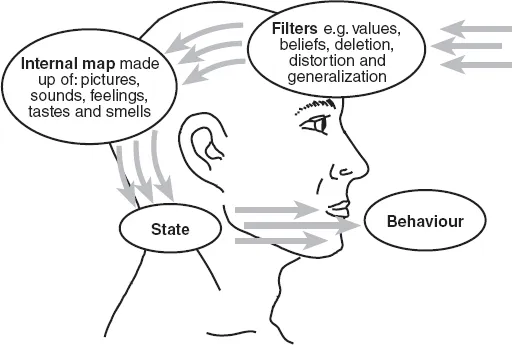
The NLP model
THE STORY OF NLP
At the heart of NLP, though, is the ‘modelling’ of human excellence – and that is where the story of NLP begins in the early 1970s, with the collaboration of Richard Bandler and John Grinder at the University of California.
Bandler, a student of mathematics with a particular interest in computer science, got involved in transcribing some audio and video seminar tapes of Fritz Perls, the father of Gestalt therapy, and Virginia Satir, the founder of family therapy. He found that by copying certain aspects of their behaviour and language he could achieve similar results, and began running a Gestalt therapy group on the campus.
John Grinder, an associate professor of linguistics at the university, was intrigued by Bandler’s abilities, and reputedly said to him: ‘If you teach me how to do what you do, I’ll tell you what you do.’
It wasn’t long before Grinder, too, could get the same kind of therapeu...
Table of contents
- Cover
- Title
- Contents
- About the authors
- 1 What is NLP?
- 2 The foundations of NLP
- 3 Representational systems
- 4 Submodalities
- 5 Meta programs
- 6 Values and beliefs
- 7 Well-formed outcomes
- 8 States and emotions
- 9 Anchoring
- 10 Sensory acuity and calibration
- 11 Rapport
- 12 Perceptual positions
- 13 The Meta Model
- 14 Frames, framing, reframing and parts
- 15 Other key NLP techniques
- 16 Modelling
- 17 Timelines
- 18 Strategies
- 19 The Milton Model
- 20 NLP and neuroscience
- 21 NLP in action
- Taking it further
- Glossary
- Copyright
Trusted by 375,005 students
Access to over 1.5 million titles for a fair monthly price.
Study more efficiently using our study tools.
Frequently asked questions
Yes, you can cancel anytime from the Subscription tab in your account settings on the Perlego website. Your subscription will stay active until the end of your current billing period. Learn how to cancel your subscription
No, books cannot be downloaded as external files, such as PDFs, for use outside of Perlego. However, you can download books within the Perlego app for offline reading on mobile or tablet. Learn how to download books offline
Perlego offers two plans: Essential and Complete
- Essential is ideal for learners and professionals who enjoy exploring a wide range of subjects. Access the Essential Library with 800,000+ trusted titles and best-sellers across business, personal growth, and the humanities. Includes unlimited reading time and Standard Read Aloud voice.
- Complete: Perfect for advanced learners and researchers needing full, unrestricted access. Unlock 1.5M+ books across hundreds of subjects, including academic and specialized titles. The Complete Plan also includes advanced features like Premium Read Aloud and Research Assistant.
We are an online textbook subscription service, where you can get access to an entire online library for less than the price of a single book per month. With over 1.5 million books across 990+ topics, we’ve got you covered! Learn about our mission
Look out for the read-aloud symbol on your next book to see if you can listen to it. The read-aloud tool reads text aloud for you, highlighting the text as it is being read. You can pause it, speed it up and slow it down. Learn more about Read Aloud
Yes! You can use the Perlego app on both iOS and Android devices to read anytime, anywhere — even offline. Perfect for commutes or when you’re on the go.
Please note we cannot support devices running on iOS 13 and Android 7 or earlier. Learn more about using the app
Please note we cannot support devices running on iOS 13 and Android 7 or earlier. Learn more about using the app
Yes, you can access Essential NLP by Amanda Vickers,Steve Bavister in PDF and/or ePUB format, as well as other popular books in Psychology & History & Theory in Psychology. We have over 1.5 million books available in our catalogue for you to explore.