Finance For Non-Financial Managers In A Week is a simple and straightforward training course in finance, giving you everything you need to know in just seven short chapters. From the profit statement and the balance sheet through to costing and budgets, it will help you deal confidently with questions such as 'What is the return on investment?', 'Do we have the resources?' and 'What are the cash implications?' You'll also find exercises to help you put it all into action.This book introduces you to the main themes and ideas finance and accounting, giving you a basic knowledge and understanding of the key concepts, together with practical and thought-provoking exercises. Whether you choose to read it in a week or in a single sitting, Finance For Non-Financial Managers In A Week is your fastest route to success: - Sunday: An introduction to the profit statement
- Monday: An introduction to the balance sheet
- Tuesday: Understanding published accounts
- Wednesday: Accounting ratios and investment decisions
- Thursday: Cash and the management of working capital
- Friday: Costing
- Saturday: Budgets ABOUT THE SERIES
In A Week books are for managers, leaders, and business executives who want to succeed at work. From negotiating and content marketing to finance and social media, the In A Week series covers the business topics that really matter and that will help you make a difference today. Written in straightforward English, each book is structured as a seven-day course so that with just a little work each day, you will quickly master the subject. In a fast-changing world, this series enables readers not just to get up to speed, but to get ahead.
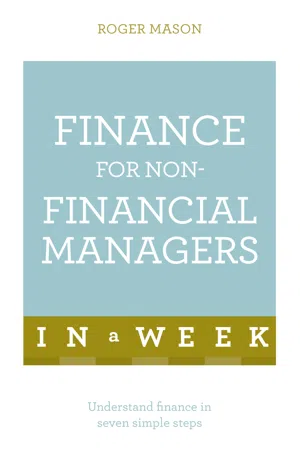
eBook - ePub
Finance For Non-Financial Managers In A Week
Understand Finance In Seven Simple Steps
- 128 pages
- English
- ePUB (mobile friendly)
- Available on iOS & Android
eBook - ePub
Finance For Non-Financial Managers In A Week
Understand Finance In Seven Simple Steps
About this book
Information
So far we have studied accounts and what they mean. Now we will devote a day to the active use of financial information. First we will take a look at ratios in the accounts, and then move on to investment decisions. Today is far from the easiest day but, provided that you have mastered the basics, it should be one of the most interesting and rewarding.
The programme for today covers:
• accounting ratios
• four key questions
• testing our understanding of accounting ratios
• investment decisions.
Accounting ratios
There are many useful ratios that can be taken from accounts. The following are among the most important but there are many others. It is a good idea to have a set of accounts with you as you work through this section. Pick out relevant figures, work out the ratios, and try to draw conclusions.
Profit to turnover
For example:
| Annual turnover | £10,000,000 |
| Annual profit before tax | £1,000,000 |
| Profit to turnover | 10% |
This uses Profit before Tax but it may be more useful to use Profit after Tax. Perhaps you want to define profit as excluding the charge for bank interest. You should select the definition most relevant to your circumstances. The ratio may be expressed in different ways (e.g. 1 to 10 instead of 10%).
Return on capital employed
For example:
| Capital employed | £5,000,000 |
| Annual profit after tax | £1,000,000 |
| Return on capital employed | 20% |
Again the profit may be expressed before or after tax.
Capital employed is the net amount invested in the business by the owners and is taken from the Balance Sheet. Many people consider this the most important ratio of all. It is useful to compare the result with a return that can be obtained outside the business. If a building society is paying a higher rate, perhaps the business should be closed down and the money put in the building society.
Note that there are two ways of improving the return. In the example, the return on capital employed would be 25% if the profit was increased to £1,250,000. It would also be 25% if the capital employed was reduced to £4,000,000.
Stock turn
For example:
| Annual turnover | £10,000,000 |
| Annual cost of sales (60%) | £6,000,000 |
| Stock value | £1,500,000 |
| Stock turn | 4 |
As the name implies, this measures the number of times that total stock is used (turned over) in the course of a year. The higher the stock turn the more efficiently the business is be...
Table of contents
- Cover
- Title
- Contents
- Introduction
- Sunday An introduction to the Profit Statement
- Monday An introduction to the Balance Sheet
- Tuesday Understanding published accounts
- Wednesday Accounting ratios and investment decisions
- Thursday Cash and the management of working capital
- Friday Costing
- Saturday Budgets
- 7 × 7
- Answers
- Glossary
- Copyright
Trusted by 375,005 students
Access to over 1.5 million titles for a fair monthly price.
Study more efficiently using our study tools.
Frequently asked questions
Yes, you can cancel anytime from the Subscription tab in your account settings on the Perlego website. Your subscription will stay active until the end of your current billing period. Learn how to cancel your subscription
No, books cannot be downloaded as external files, such as PDFs, for use outside of Perlego. However, you can download books within the Perlego app for offline reading on mobile or tablet. Learn how to download books offline
Perlego offers two plans: Essential and Complete
- Essential is ideal for learners and professionals who enjoy exploring a wide range of subjects. Access the Essential Library with 800,000+ trusted titles and best-sellers across business, personal growth, and the humanities. Includes unlimited reading time and Standard Read Aloud voice.
- Complete: Perfect for advanced learners and researchers needing full, unrestricted access. Unlock 1.5M+ books across hundreds of subjects, including academic and specialized titles. The Complete Plan also includes advanced features like Premium Read Aloud and Research Assistant.
We are an online textbook subscription service, where you can get access to an entire online library for less than the price of a single book per month. With over 1.5 million books across 990+ topics, we’ve got you covered! Learn about our mission
Look out for the read-aloud symbol on your next book to see if you can listen to it. The read-aloud tool reads text aloud for you, highlighting the text as it is being read. You can pause it, speed it up and slow it down. Learn more about Read Aloud
Yes! You can use the Perlego app on both iOS and Android devices to read anytime, anywhere — even offline. Perfect for commutes or when you’re on the go.
Please note we cannot support devices running on iOS 13 and Android 7 or earlier. Learn more about using the app
Please note we cannot support devices running on iOS 13 and Android 7 or earlier. Learn more about using the app
Yes, you can access Finance For Non-Financial Managers In A Week by Roger Mason,Roger Mason Ltd in PDF and/or ePUB format, as well as other popular books in Business & Bookkeeping & Budgets. We have over 1.5 million books available in our catalogue for you to explore.