This is the perfect introduction for beginners who want to learn the essential principles behind Tai Chi without overcomplicated instructions or confusing detail. You will learn the basic ideas and get into the Tai Chi way of thinking before picking up the 'form' and exercises through a series of simple illustrations designed for all abilities, leaving you with the perfect antidote to the stresses of 21st-century life.
NOT GOT MUCH TIME?One, five and ten-minute introductions to key principles to get you started.
AUTHOR INSIGHTSLots of instant help with common problems and quick tips for success, based on
the author's many years of experience.
TEST YOURSELFTests in the book and online to keep track of your progress.
EXTEND YOUR KNOWLEDGEExtra online articles at www.teachyourself.com to give you a richer understanding of tai chi.
FIVE THINGS TO REMEMBERQuick refreshers to help you remember the key facts.
TRY THISInnovative exercises illustrate what you've learnt and how to use it.
eBook - ePub
Find Peace With Tai Chi
A beginner's guide to the ideas and essential principles of Tai Chi
- 224 pages
- English
- ePUB (mobile friendly)
- Available on iOS & Android
eBook - ePub
Find Peace With Tai Chi
A beginner's guide to the ideas and essential principles of Tai Chi
About this book
Information
Topic
Personal DevelopmentSubtopic
Self Improvement1
Background
Tai chi is many things to different people. The beautiful, controlled and yet freely flowing movements have for centuries inspired men and women from all walks of life, people of all ages and all levels of fitness. Vitality, relaxation, tranquillity, enhanced personal creativity and a sense of purpose – these are just some of tai chi’s enduring gifts to the world.
In my work, I often meet people seeking a means of relaxation or of managing stress. Sadly, it soon becomes apparent that many have never known what it feels like to be relaxed in any meaningful way. This interference through tension and stress with the body’s natural healing process is perhaps one of the greatest misfortunes of our times and it is in a bid to help combat this situation – in no matter how small a way – that this book has been written.
In these pages we will be looking exclusively at the health and relaxation aspects of this ancient and yet thoroughly modern art, with step-by-step instructions on how to learn and perform the basic sequence of the Short Yang Form of tai chi. Don’t worry if you have only limited leisure time. Your study can easily be integrated into a normal lifestyle. All it takes is ten minutes each day to get results. And it really is worth it. In the East, exercise systems like tai chi are very popular; they are undertaken in a spirit of moderation and realism and this book urges you to do likewise. Simply do what you can, with the time available – then go ahead and enjoy it!
Tai chi is much more than just a physical exercise, and to a great extent many of its inner qualities can be ‘self-taught’ through continuous practice and observation. It is hoped that this book will help you in this endeavour – making, therefore, a useful companion to any practical work you might undertake in classes or with teachers. Allowing the magic of tai chi to enter your life means being open to the currents and forces of nature, within yourself and within the world around you. And if it is true that tai chi is a journey of a kind, then there has to be a beginning somewhere. Why not here?
In this chapter you will learn:
- the nature of ch’i
- the origins of tai chi
- the energy pathways of the body.
What does ‘tai chi’ mean?
When talking about tai chi today, we usually refer to a system of gentle physical exercise (the subject of this book) or to the martial art of that name – more properly termed ‘Tai Chi Ch’uan’. However, the term ‘tai chi’ appears to pre-date both these activities by many centuries and has its roots in ancient Chinese culture and philosophy. ‘Tai’ in translation into English means ‘great’ or ‘supreme’, while the word ‘chi’ (also written as Ji) means something like ‘ultimate’. So tai chi is often referred to as ‘the supreme ultimate’. It was, in a sense, the goal of the early Taoist philosophers – the state of oneness and inner peace that could be reached through contemplation of nature and by working in harmony with its energies.
Insight
There are two ways of transcribing Chinese characters into Western writing: one is called the Wade–Giles method (e.g. the capital city of China is written as Peking) and another more recent method is called Pinyin (e.g. the capital city of China is written as Beijing). This is why you see different renderings of tai chi – sometimes written as tai ji, for instance, or as t’ai chi. In this book, we stick to the popular Western rendering of tai chi.
Nevertheless, it is important at this stage to understand that the word ‘ch’i’ – which is used to describe the concept of vital energy, and is found in all manner of diverse areas of Chinese culture such as medicine, feng shui, calligraphy or martial arts – is a different word (different Chinese character) from the ‘chi’ in tai chi. This is an important distinction.
In classical Chinese literature such as the I Ching, sections of which can be dated back confidently to at least the eighth century BC, we are told of a special state of harmony that exists in all of nature, and this is called the Tai Chi – the Supreme Ultimate. It is also often pictured as a symbol called the ‘Tai Chi T’u’ (see Figure 1.1).
Sometimes also called the ‘double-fish diagram’ because it looks a little like two fishes chasing each other’s tails, what we have here is clearly a circle divided equally into a light and a dark sector. These are called the ‘Yang’ and the ‘Yin’ respectively. You will have noticed that the division between Yang and Yin is not just a straight line, it is a graceful curve, suggesting movement and the interplay of opposites. Light (or Yang) changes into darkness (Yin) and then changes back to light again. Note, also, the eye or seed of each opposite located deep within each sector, indicating still further the possibilities of change and transformation.
You can probably think of other examples of Yang and Yin in the world around you: day and night; summer and winter; hot and cold; the positive and negative force of electricity; advancing and retreating armies; or the rise and fall of empires, both personal and global. All this is the tai chi in action. The philosophy that underlies it, therefore, views life as a kind of dance, an energetic interplay of opposites. When these opposites are brought together in a state of harmony, the goal of the ancient philosophers is achieved. In a similar way, in the field of oriental medicine, for example, a state of health and internal balance can also be reached through harmonizing the energies of the Yang and Yin of the body. When this state of harmony is reflected in physical movement, the result is the exercise system known as tai chi.
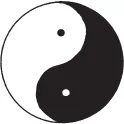
Figure 1.1 The Tai Chi T’u symbol.
Insight
The Yang and Yin within the tai chi are not only opposite in nature, they are also supportive of one another, interdependent in character and can also transform from one into the other. The one, therefore, cannot exist without the other and they are rarely in conflict. It is above all a relationship of harmony.
The tai chi form
The special arrangement of movements that you will find in these pages is collectively called a ‘form’. The form is made up of lots of separate movements that are eventually strung together to produce one continuous sequence lasting several minutes. The form has a beginning and an end, and the movements within it are always done in the same order, like the components of a specially choreographed dance. The idea is that you go through this sequence daily. This, in turn, can not only strengthen your health, but can also keep you free of stress and perhaps even ward off some of the ravages of time. All this just by keeping to a daily routine of gentle exercise.
The emphasis on daily practice is crucial here. The health benefits of tai chi show through only if regular practice is maintained. This is why tai chi is usually regarded as an ongoing preventive strategy for improving and maintaining health rather than as a ‘cure-all’ for illnesses. Just keep on doing it! That’s the simple message of tai chi.
The rest, especially once you have learned the form itself, is really very simple. There is no expensive equipment or clothing to buy, and you don’t have to belong to any special club or association (unless you really want to, of course). In fact you will soon discover that tai chi is in many ways very different, refreshingly so, from most other forms of exercise or recreation, not least because it is un-competitive. You don’t have to win or ‘beat’ anybody at this game. In fact, rather than making yet more unwelcome demands upon your time and energy, tai chi becomes something that you actually want to do each day, something that you really enjoy, not just something that you feel you ought to be doing because it’s good for you.
Moreover, because tai chi practice places such emphasis on developing a sense of inner peace, and on seeking external qualities such as fresh air and tranquillity for practice, it places you in harmony with your environment in a way that is quite unique. Tai chi is rooted in nature and consequently it helps you become closer to nature, as well. This is something that becomes apparent when you start to learn, and is a very good feeling. Perhaps this is because each of the movements has a Yang and a Yin aspect to it. So when you do tai chi you are also participating in the interplay of opposites: harmonizing yourself over and over again with the cyclical forces of nature. The individual ‘tao’ then becomes connected to the greater, universal Tao. Tai chi is a celebration of nature and of your place within it.
Origins of tai chi
There have been, and still are, many different kinds of tai chi, the origins going back very far indeed and, inevitably, cloaked in their fair share of mystery and legend. For example, Huang Ti, the legendary Yellow Emperor of China, was said to have practised special exercises for maintaining health, based on the observation of animals, as long ago as 2700 BC. This is the earliest reference we have to anything like tai chi. But, as with acupuncture and the many other branches of medicine and self-culture developed by the Chinese, activities of this kind probably have their origin in the days before recorded history. Incidentally, Huang Ti was said to have reigned for a hundred years and to have had over a hundred wives, so he must have been doing something right!
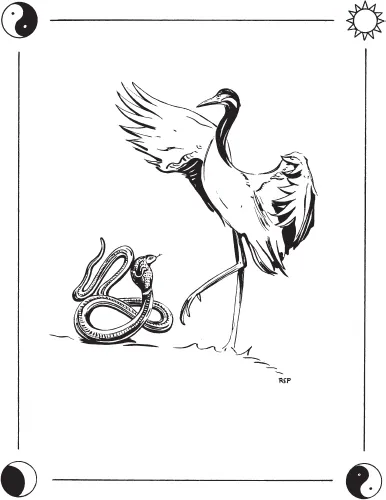
Figure 1.2 The Crane and the snake.
Around the thirteenth century, these exercises seem to have joined forces with the martial arts, or were at least developed by them to great effect. The martial arts in China were already at that time being practised to a very high standard by the Ch’an (Zen) Buddhist monks. And although no one really knows for sure how the process took place, the combination of all these diverse strands of thought and action eventually gave birth to the practice of T’ai Chi Ch’uan (the great way or system of tai chi) as we know it today.
All the historical confusion surrounding the subject has not in any way discouraged the spread of numerous stories concerning the origin of tai chi. One of the most interesting of these relates to the illusive ‘founder’ of the art, Chang San-feng, a Taoist priest, who most probably lived around the time of the Sung dynasty – thirteenth century or earlier.
The legend has it that one evening he had a particularly vivid dream in which he saw a great bird – a crane – and a snake engaged in combat over a morsel of food. Neither creature seemed to be able to overcome the other. Each time the snake attempted to sink his fangs into the crane, the bird would gracefully side-step and enfold the creature in its powerful wing and sweep it away. Each time the crane tried to crush the snake or pierce it with its sharp beak, the snake would recoil and twist, often launching a counter-attack of its own. The beauty and grace of this contest impressed Chang greatly. The next night he had the same dream. Once more, the crane would come down from the heavens and the snake up from the earth and the contest would begin again.
The Yang and Yin imagery here is very powerful and symbolic of an eternal contest, the eternal state of dynamic balance in nature, exemplified in the Tai Chi T’u.
It is probably because of stories of this kind, and the alliance with the fighting monks of medieval China, that tai chi often appears somewhat martial in character when compared with the numerous comparatively passive ch’i-generating exercises from which it originally sprang. Indeed, tai chi is still practised very much as a martial art, and a very effective one, too! Many of its greatest living exponents are martial artists of a very high calibre indeed. There is a common energy pattern used both for health and for martial skills, and what is good for one is invariably good for the other. Thus, these two often quite disparate applications of tai chi in the modern world still exist quite happily side by side.
The kind of tai chi we will be devoting ourselves to in this book is a somewhat more recent variation on this great tradition, called the Yang style. Although itself a development based on a long tradition of tai chi technique, this Yang style emerged as recently as the nineteenth century. Its founder was Yang Lu Chuan who lived from 1799 to 1872. His grandson, Yang Cheng-fu, taught tai chi into the twentieth century and it was one of his pupils, Cheng Man-ch’ing, who most helped to spread tai chi in the West – basically by shortening the form into a concise eight-minute sequence. This is called, naturally enough, the ‘Short Yang Form’ and is the form featured in this book.
Insight
Don’t worry if you encounter different renderings of some of these names. For instance, Yang Cheng-fu can also appear as Cheng-fu Yang. Cheng Man-ch’ing can also appear as Cheng Man Ching.
Cheng Man-ch’ing (1900–1975) was a remarkable individual, not only a superb exponent of tai chi, but also a professor of literature, an expert in the use of Chinese medicinal herbs, a calligrapher and a painter. He studied tai chi originally as a means of keeping at bay a serious illness, tuberculosis. He found that whenever he stopped doing his tai chi, he became ill again. This was possibly one of the reasons he believed so passionately in teaching tai chi for health purposes as well as for martial applications. This is also undoubtedly why his condensed version of the form has become so popular. It is clearly designed for relaxation and for strengthening the body’s own healing energy. There has, of course, also been a huge resurgence of interest in the original principles of energy flow that underlie tai chi in recent times, as more and more people, drawn by tai chi’s inherent grace and beauty, are once again setting out ...
Table of contents
- Cover
- Title
- Copyright
- Dedication
- Meet the author
- Only got a minute?
- Only got five minutes?
- Only got ten minutes?
- 1 Background
- 2 Gently does it
- 3 Tips and suggestions
- 4 The form – part one
- 5 The form – part two
- 6 In depth
- 7 Tai chi and health
- 8 Tai chi – the learning experience
- 9 Body, mind and spirit
- Composite illustration of the sequence
- Taking it further
- Glossary
- Answers to ‘Test your knowledge’ questions
- Index
Trusted by 375,005 students
Access to over 1.5 million titles for a fair monthly price.
Study more efficiently using our study tools.
Frequently asked questions
Yes, you can cancel anytime from the Subscription tab in your account settings on the Perlego website. Your subscription will stay active until the end of your current billing period. Learn how to cancel your subscription
No, books cannot be downloaded as external files, such as PDFs, for use outside of Perlego. However, you can download books within the Perlego app for offline reading on mobile or tablet. Learn how to download books offline
Perlego offers two plans: Essential and Complete
- Essential is ideal for learners and professionals who enjoy exploring a wide range of subjects. Access the Essential Library with 800,000+ trusted titles and best-sellers across business, personal growth, and the humanities. Includes unlimited reading time and Standard Read Aloud voice.
- Complete: Perfect for advanced learners and researchers needing full, unrestricted access. Unlock 1.5M+ books across hundreds of subjects, including academic and specialized titles. The Complete Plan also includes advanced features like Premium Read Aloud and Research Assistant.
We are an online textbook subscription service, where you can get access to an entire online library for less than the price of a single book per month. With over 1.5 million books across 990+ topics, we’ve got you covered! Learn about our mission
Look out for the read-aloud symbol on your next book to see if you can listen to it. The read-aloud tool reads text aloud for you, highlighting the text as it is being read. You can pause it, speed it up and slow it down. Learn more about Read Aloud
Yes! You can use the Perlego app on both iOS and Android devices to read anytime, anywhere — even offline. Perfect for commutes or when you’re on the go.
Please note we cannot support devices running on iOS 13 and Android 7 or earlier. Learn more about using the app
Please note we cannot support devices running on iOS 13 and Android 7 or earlier. Learn more about using the app
Yes, you can access Find Peace With Tai Chi by Robert Parry in PDF and/or ePUB format, as well as other popular books in Personal Development & Self Improvement. We have over 1.5 million books available in our catalogue for you to explore.