"I've had thousands of problems in my life, most of which never actually happened." Mark Twain. As never before, our lives are bombarded with daily events that stir fear - real or imagined - in both our individual and collective psyches. From financial worries to social anxiety, from public speaking to personal safety, "Free Yourself From Fears" show us how to 'unlearn' our unreal fears and find emotional freedom. Applying the power of psychology, O'Connor goes inside the mind and shows you how to deal not only with such common anxieties as fear of heights and flying but also fear of other people's opinions and even of our own success. This immensely practical, hands-on book will help you: know when to trust and when not to trust, develop your intuition to stay safe when there is real danger, defeat socially created fears in this age of anxiety, deal with change and worries about an uncertain future, and be in the here and now - true emotional freedom. One of the first books to address how to help children deal with fear and to deal with the all-pervasive and insidious feeling of "social anxiety, " "Free Yourself From Fears" includes dozens of helpful exercises and practical techniques to help you achieve your best without anxiety and live without worry.
eBook - ePub
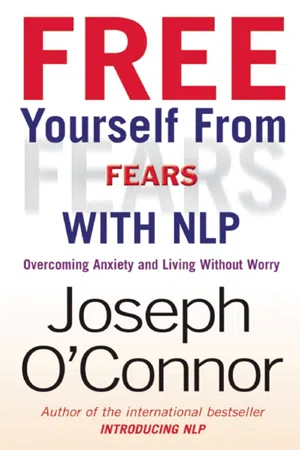
Free Yourself From Fears with NLP
Overcoming Anxiety and Living without Worry
- 224 pages
- English
- ePUB (mobile friendly)
- Available on iOS & Android
eBook - ePub
About this book
Information
Topic
Personal DevelopmentSubtopic
Mental Health & WellbeingPART I
Our Experience of Fear
The nine laws of fear
1 Fear is a basic human emotion that has evolved to protect us.
2 Fear is a reaction to a mixture of a real outside event or trigger and the meaning we make of it in our imagination.
3 Behind all fear is a fear of losing something we value.
4 There are two types of fear: authentic and unreal. Authentic fear is a natural reaction to real and present danger. Unreal fear comes from our imagination.
5 The feeling of fear is always real—whatever provokes it.
6 All fear has a positive intention.
7 We are born with two basic fears: falling and abandonment. We learn other fears by:
—Example.
—Trauma.
—Repetition.
—Information.
8 Fear can be enjoyable if:
—We believe that the situation is safe.
—We feel confident that there is no real danger.
—We know that the situation will end at a definite time.
9 We can talk ourselves into feeling afraid.
CHAPTER 1
What Is Fear?
Fear is that little darkroom where negatives are developed.
MICHAEL PRITCHARD
WHAT DO WE MEAN BY FEAR? What does it mean to be afraid? Fear is a basic emotion that protects us. Fear is undeniable, that unpleasant sensation that arises when we think we are in danger. The danger may be real or imaginary. The word “fear” comes from the old English root fer or fere, meaning “danger,” or “coming suddenly upon.” It is interesting that the root of the word suggests there is danger that we are not prepared for. If we are prepared, then we may not feel afraid.
The word “fear” itself is an abstraction. The feeling comes from a process in the body that is triggered by something we see, hear, feel, touch, taste, or smell. And these sights, sounds, and feelings can arise from the outside world or from our imagination. Whatever the origin, fear is not something we have, but something we do.
The first law of fear:
Fear is a basic human emotion that has evolved to protect us.
Fear is not a pleasant emotion. It can range from a mild apprehension to a gut-wrenching, heart-pumping jolt that rises like a fiery volcanic eruption before congealing in the pit of the stomach like cooling lava. It rises immediately when we hear a bump in the night, or see an open window that we didn’t leave open. It can ambush us and make us act without thinking. You may be happily relaxing when you suddenly realize that you left your private computer files in plain view at the office—before you know it, you have risen half out of your chair. Fear can also sneak up gradually, for example as that long-deferred visit to the dentist gets closer and closer, or that public speaking engagement that you agreed to in a moment of madness creeps up the calendar toward you like a snake.
As a rule, the more immediate the perceived danger, the more sharp, unpleasant and compelling the fear becomes. We move immediately. We act!
The two elements of fear
All fear has two elements. The first is a stimulus from the outside world. The second is the meaning we make of that stimulus and the imaginings we create about it.
The second law of fear:
The feeling of fear is a reaction to the mixture of:
1 A real outside event that acts as a trigger.
2 The meaning we make of it in our imagination.
These two elements can combine in myriad ways. Here are some examples.
The power of gravity
Imagine for a moment that you are walking alone in the country, thinking about nothing in particular. Dusk is falling and you almost stumble into a deep pit. You pull back just in time, jolted back to the present moment, your heart thumping. It all happens in half a second. The outside stimuli were the pit and your stumble; you feel frightened, you were suddenly in danger of falling, perhaps of hurting yourself badly. Falling is an archetypal fear from infancy.
This is authentic fear. It is about a real, immediate danger and about something in the present moment. It is very useful: it saves you from immediate danger and possible injury.
You know the power of gravity, so you do not think twice: your body makes a decision to pull back before you are consciously aware of it. You do not wait, balancing with your foot poised over the blackness, intellectually debating the possibility of whether it is a good idea to fall down the hole or not—you act immediately. The imaginings come after you have taken action to avoid the danger. They usually follow too quickly to dwell on in detail—images of you falling into the blackness and hurting yourself. The meaning is: “Danger! Take care!” After that come other thoughts: perhaps you resolve to pay more attention to where you are going when you walk in unfamiliar country in the dark. Then you may get angry that someone left a dangerous pit uncovered without a warning sign. Anger and fear are close relatives. In this example you stumble into danger, but you stay safe. The fear comes from the immediate stimulus and only after that from your imaginings of what might have happened.
A deserted alley
Here is another example. You are walking down a dark alley late at night when you hear footsteps behind you. You take a quick look around and see a powerfully built stranger swathed in a large black coat gaining on you with long strides. His face is partially hidden in the shadows.
You quicken your pace. But so, it seems, does he.
Now you start to feel apprehensive, you wonder why you are walking down a dark, deserted alley late at night. The alternative route is longer but better lit and more frequently used.
Thoughts run swiftly through your mind as you briefly debate the possible scenarios.
“I was stupid. How far is the other end of the alley? … If I started running now would I make it? … Suppose I started yelling? … That’s stupid. … He’s just someone walking down the alley going home like me. … Then why is he speeding up when I do? … Have I got anything that I could use as a weapon?”
You cross the road.
So does he.
Then you run.
That is a real situation in the present moment. Nothing has happened, but the situation is potentially dangerous. The fear makes you run, you weigh up the evidence and decide to take action. Better to look stupid than to get hurt. This fear is genuine, it happens in the present moment: there may not be real danger but you don’t wait to find out. The fear is a mixture of the stimulus and your imaginings about it. If the stranger attacked you, then the fear would be strong, immediate, and authentic.
How do you decide if a situation is truly dangerous? Are you running from a real danger, or from a fantasy of what might happen? You may never know, and it is often safer that way. In this example the fear is useful: it makes you take action to get away from a potentially dangerous situation.
The parachute jump
Now a third circumstance. You decide to do a sponsored parachute jump to raise money for charity. You take the training, learn how to fall, discover how to operate the parachute (safely on the ground), and are excited about the whole idea. You and your companions feel a bond of friendship; you are all willing to put yourselves in danger to raise money for charity.
The fateful day approaches. You do not sleep so well the night before and wake up excited. Your apprehension grows as you travel to the airfield: maybe part of you hopes the car will break down or the plane will not be able to fly because of bad weather. You get on the airplane and watch the ground recede. If in the past you have been afraid of flying, this day you are not—now you are afraid of leaving the safety of the airplane. Of course, you laugh and joke and do not let people know what you are feeling.
At 7,000 feet up you get ready to jump, it’s your turn. You are terrified. Why? Because your imagination has constructed all sorts of scenarios ranging from falling to the ground like a stone if your parachute does not open, to breaking a leg when you land awkwardly, or drifting out to sea. You have never jumped out of an airplane before and now it seems like a crazy thing to do. However, you trust your training. You trust your instructor. You feel confident that you know what to do. You believe that parachutes work and that the odds against yours not working are very, very small. It is important to make the jump because you have been sponsored by many friends and relatives for a large amount of money. And of course your sense of pride won’t let you back out now. So you take a deep breath, commend your soul to your God, and jump…
The parachute opens, of course.
A few minutes later, you are safely on the ground feeling wonderful, all fears forgotten.
In this example, most of your fear comes before the jump, because of your imaginings of what might happen. Your fear is not about what is happening, but what might happen. It comes mostly from your imagination.
The jump could be dangerous. Parachuting is a dangerous sport and people are hurt and occasionally killed, so your fears are not groundless. However, you have the resources and the training and you believe it is possible to jump safely. Your values (raising money for charity and your pride) support you in going ahead. So while there is a small risk of danger, you believe you can handle it and you will be safe. The fear comes from your imagining of worst-case scenarios.
As you jump, the feeling is an adrenaline rush of excitement that is sometimes difficult to separate from fear. (If you pulled the release cord as you fell and the parachute did not open, then you would experience strong, authentic fear in that moment!)
The pay raise
A fourth example: A junior manager has been with his company a year and decides he needs a raise in salary. His work has been good. His wife is pregnant. They need extra money for their child. He must ask his boss for an increase. His boss is demanding, sarcastic, and not easy to talk to. He is also known to be unsympathetic to requests for a higher salary and he can be very unpleasant if he does not like you. Our junior manager knows this and is frightened: frightened of rejection, frightened of being shouted at, frightened that he will not get the raise. None of these things has happened—yet—but his imagination makes them real. They are all imaginary scenarios, constructed in his mind as he tosses and turns in bed the night before, trying to get a good night’s sleep to be ready for the day of the fateful meeting.
This is an example of unreal fear. The manager fears a future that exists only in his mind, like the parachutist in the last example, but in this case the danger is not to his life or health (his boss is not going to attack him), but to his values, self-esteem, and pride. His fear is about what might happen, not what has happened. He does not know what will happen, but the result is important to him—and his imagination rises up to fill the void.
He will feel afraid immediately before and during the meeting, and this may make him less effective at persuading his boss to give him the raise. So his fear may bring about his worst imagining. All he can do is prepare as best he can with all the facts and persuasive arguments that he can muster. He also needs to make sure he is in a good emotional state. If he did not care about getting the raise, then he would not be frightened. He cares about the raise because he cares about his family. There is an important value behind this fear.
Fear of snakes
A fifth and final example: A man with a phobia of snakes goes to watch the film Raiders of the Lost Ark. He is enjoying it immensely (except the scene when Indiana Jones has a snake as an unwelcome flying companion at the beginning of the film), until Indy is trapped in a pit of poisonous snakes. Then, he feels ill. He can’t look. The screen is full of snakes. His mind is slithering. He can’t stand it and he gets up hurriedly, pushes along the row of seats, and leaves the cinema as quickly as possible.
This is an example of unreal fear. This man is in no real and present danger. There are no snakes in the cinema. But the images are real and terrifying and have tremendous meaning for him. The environment has supplied a trigger for a fear that already existed and was probably built in his childhood. Perhaps he had a very frightening experience with a snake when he was young and has never forgotten it.
These examples show how two elements combine to create fear. Sometimes the fear comes completely from the stimulus in the present moment. Sometimes it comes completely from our imagination about what might happen. Most fear is a mixture of the two.
What these examples have in common is fear of loss: loss of life, loss of health, loss of something you value, loss of wellbeing, loss of self-esteem. Loss is a fundamental driver of fear.
The third law of fear:
Behind all fear is a fear of losing something we value.
The NLP approach to fear
NLP is about how we create our experiences and how we represent them in our minds, in our bodies, and in words.
The neuro of neuro-linguistic progra...
Table of contents
- Cover Page
- Title Page
- Copyright Page
- Contents
- Introduction
- Part I Our Experience of Fear
- Part II Unreal Fear—Fear as Foe
- Part III Authentic Fear—Fear as Friend
- Part IV Finding Freedom—Techniques to Overcome Your Fears
- Appendix I: Thinking about Thinking with NLP
- Appendix II: Summary of Skills for Freedom
- References
- Bibliography
- About the author
Trusted by 375,005 students
Access to over 1.5 million titles for a fair monthly price.
Study more efficiently using our study tools.
Frequently asked questions
Yes, you can cancel anytime from the Subscription tab in your account settings on the Perlego website. Your subscription will stay active until the end of your current billing period. Learn how to cancel your subscription
No, books cannot be downloaded as external files, such as PDFs, for use outside of Perlego. However, you can download books within the Perlego app for offline reading on mobile or tablet. Learn how to download books offline
Perlego offers two plans: Essential and Complete
- Essential is ideal for learners and professionals who enjoy exploring a wide range of subjects. Access the Essential Library with 800,000+ trusted titles and best-sellers across business, personal growth, and the humanities. Includes unlimited reading time and Standard Read Aloud voice.
- Complete: Perfect for advanced learners and researchers needing full, unrestricted access. Unlock 1.5M+ books across hundreds of subjects, including academic and specialized titles. The Complete Plan also includes advanced features like Premium Read Aloud and Research Assistant.
We are an online textbook subscription service, where you can get access to an entire online library for less than the price of a single book per month. With over 1.5 million books across 990+ topics, we’ve got you covered! Learn about our mission
Look out for the read-aloud symbol on your next book to see if you can listen to it. The read-aloud tool reads text aloud for you, highlighting the text as it is being read. You can pause it, speed it up and slow it down. Learn more about Read Aloud
Yes! You can use the Perlego app on both iOS and Android devices to read anytime, anywhere — even offline. Perfect for commutes or when you’re on the go.
Please note we cannot support devices running on iOS 13 and Android 7 or earlier. Learn more about using the app
Please note we cannot support devices running on iOS 13 and Android 7 or earlier. Learn more about using the app
Yes, you can access Free Yourself From Fears with NLP by Joseph O'Connor in PDF and/or ePUB format, as well as other popular books in Personal Development & Mental Health & Wellbeing. We have over 1.5 million books available in our catalogue for you to explore.