'An inspiring success story.' Baroness Rona Fairhead, CBE
A RINGSIDE SEAT ON SOME OF THE BIGGEST DEALS AND BIGGEST PERSONALITIES IN BUSINESS AND GLOBAL POLITICS.
They are just four letters on an electronic ticker tape, but FTSE has become a byword for money, power, influence and - crucially, after numerous financial crises - trust.
How this organisation, FTSE International, brought order to the financial system over several decades, is a story of how capitalism globalized and a data revolution transformed the investment industry. It is a story of how a team of innovators seized an opportunity to build a business that today leads its field and guides the fortunes of an astonishing $16 trillion of funds. It is a story that Mark Makepeace, founding Chief Executive of FTSE International, knows better than anybody.
FTSE is a ringside seat on some of the biggest deals and biggest personalities in business and global politics, chronicling how the FTSE 100 was born, behind-the-scenes rows with chief executives of some of the world's largest companies, political in-fighting, diplomatic incidents, and the ferocious dealmaking that followed over 35 years of market boom and bust.
'FTSE is a story which should inform and fascinate anyone interested in capital markets.' Sir Donald Brydon, CBE
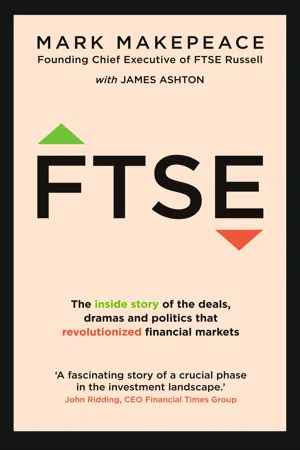
eBook - ePub
FTSE
The inside story of the deals, dramas and politics that revolutionized financial markets
- 304 pages
- English
- ePUB (mobile friendly)
- Available on iOS & Android
eBook - ePub
FTSE
The inside story of the deals, dramas and politics that revolutionized financial markets
About this book
Information
1
World vision
When television networks cut to the Oval Office on the evening of 11 March 2020, America was expectant. US presidents through history have reserved live, primetime addresses to the nation for the gravest of circumstances. John F. Kennedy spoke of the Cuban Missile Crisis, George W. Bush of the 9/11 terror attacks on New York’s World Trade Center and Barack Obama of BP’s Deepwater Horizon oil spill.
Designed to convey reassurance and solidity, the trans mission format sees the Leader of the Free World sitting behind the Resolute Desk, a present from Queen Victoria hewn from English oak, and before two further familiar emblems, the Stars and Stripes and the President’s flag.
It was Donald Trump’s only second such address. US networks are reluctant to hand over so much airtime for political reasons these days, and, in any case, the 45th President favours the immediacy of Twitter to communicate with citizens. But the USA was facing a national emergency because of COVID-19, the novel coronavirus that had spread around the world since first being detected in the Chinese city of Wuhan in late December 2019. On the day that the World Health Organization designated the outbreak as a global pandemic, Trump decided to speak out.
What is traditionally a careful, heavily scripted and statesmanlike broadcast quickly went wrong. ‘Smart action today will prevent the spread of the virus tomorrow,’ Trump said halfway through the nine-minute address, but by then the damage had been done. His stumbling delivery as he strayed from the autocue did little to allay American fears that the US government was not on top of things. The shock announcement of a 30-day ban on European travellers coming to the USA was muddled when Trump stated it would affect cargo arrivals and trade, which it would not.
The reaction was instant. After a 10-week build-up, rising fear solidified into panic over the following 24 hours. With fresh impetus, countries closed borders and schools. Sports bodies including the National Basketball Association suspended tournaments. Pictures of deserted tourist destinations, from Rome’s Colosseum to the Broadway theatre district, were beamed around the world. Call it a slowdown, a lockdown, whatever: the world was pulling down the shutters for perhaps its greatest peacetime crisis.
The severity of the situation was measured nowhere better than on the world’s stock markets, which fell like dominoes as alarm at Trump’s outburst rolled around the globe. Airlines, tourism, the global supply chain and day-to-day business was under threat from drastically reduced demand. But most frantic traders glued to their desktop screens and fevered workers and homeowners scrolling through the news on their smartphones did not immediately clock how far individual shares had fallen. For them the story of this sharply deteriorating economic environment was told first through one or two numbers that in modern society and fast-moving money markets have come to codify confidence – or a lack of it.
Those single values are distilled from a miasma of data, the product of stock indices which are calculated many times per second from the average of a basket of prices. That is how Japan’s Nikkei, which dived while Trump was still talking, put a value on what one asset manager quickly dubbed ‘the most expensive speech in history’. It is how, later that same day, billions of dollars were sliced from the value of the Dow Jones Industrial Average, which entered bear market territory as it slid 10 per cent, and the S&P 500, which fell almost as far. And bang in the middle, where East meets West, tumbled one of the world’s most famous share indices: the FTSE 100.
A British institution
The FTSE 100 is a modern British brand recognized the world over, like the Royal Family, the BBC or Sir Richard Branson’s Virgin empire. They are just four letters on an electronic ticker tape, trading screen or radio bulletin. Yet in the space of a few decades FTSE – or Footsie, as it is commonly known – has become a byword for money, power, influence and – crucially after numerous financial crises – confidence.
On a daily basis, from when trading begins in London’s Square Mile at 8am every morning, the value of the FTSE 100 is used as a shorthand for prosperity or hardship, part of the visual language of how well the world is doing. Green is for good, the colour of prices on the rise, and traders punching the air. Red is for decline and sometimes danger and heads clasped in hands, shaking in disbelief as trading concludes at 4.30pm.
In both the short and long term, FTSE read-outs spark a multitude of investment decisions and political manoeuvres. Its reach extends far beyond the high-pressure trading rooms of London, New York and Hong Kong to impact the wealth of nations and how much almost every worker will have to live on when they retire.
The flagship FTSE 100 Index has since 1984 compiled the performance of the UK’s 100 largest listed companies into a single figure for all to see. It takes the price of each share – every one a small slice of ownership that is valued according to the company’s prospects and how much dividend it is expected to pay out to its owners – and weights them according to the market value of their outstanding shares. As a capitalization-weighted – or cap-weighted – index, the giants of the FTSE 100 such as HSBC in banking and GlaxoSmithKline in pharma-ceuticals have greater impact on its value than firms that are fellow members but could be 5 per cent of their size. What began life with an arbitrary value of 1,000 points has so far peaked at 7,903.50 points during trading on 22 May 2018 after a long bull run of rising equity values. The FTSE 100 ended that day at 7,877.45 points, to date the highest close.
From its birth in Thatcherite Britain, it has kept pace with the changing financial markets better than the fashion for bowler hats and pinstripe suits that dominated the City at the time. Latterly, those 100 constituents – which face promotion or relegation once a quarter to ensure only the biggest remain as members – have taken on a more international flavour. The Footsie is now a global indicator.
It is one of many indices that have been housed within FTSE International, the company I founded in 1995 to capitalize on the FTSE 100’s appeal and an increasing appetite for financial data. FTSE has grown to become a vital piece of trusted financial infrastructure, and since 2011 it has been wholly owned by the London Stock Exchange (LSE), changing its corporate name to FTSE Russell in 2014 when we acquired the American index provider Russell. In 25 event-packed years, FTSE – the company – has gone from a start-up of just nine people to a company big enough to be a member of the FTSE 100 in its own right.
Operating at the heart of the City of London, the FTSE 100 has become a magnet for international businesses seeking deep pools of capital and a kitemark of respectability. FTSE Russell’s renown has travelled in the other direction, collating investments in emerging markets in every corner of the globe as well as the value of sovereign wealth. Today, this British start-up runs indices for everything – countries, asset classes, industries – by size and increasingly by investment style and strategy. FTSE can help investors measure the relative performance of Vietnam versus South Korea, energy stocks versus retail and equities versus bonds. Our indices help investors identify and manage risks within their portfolios, measure the performance and regulate the pay of fund managers, and keep track of the strategy they follow. Increasingly, indices are being used to replicate the work of ‘active’ managers in cheaper and more transparent ‘passive’ index funds. As capitalism has globalized and a data revolution has transformed the investment industry, FTSE leads its field and guides the fortunes of an astonishing $16 trillion of funds.
How – and why – FTSE works
An index is no more than a gauge of the value of the stock market. It tells us – every second – the stock market’s view of the collective value of companies. This market is a crowd of investors – buyers and sellers – all coming together trying to predict the value of their investments, both now and in the future. Fear sparks panic and pulls the market down. Greed spurs buying frenzies and pushes the market up. Investors who can judge when best to buy or sell shares are rare because they must be better than the crowd, which is complex, constantly changing and constantly learning. The crowd feeds on analysis, information and news – fake and real – and tries to interpret the impact on industries and companies. The role of the index provider is to ensure that the index represents the market accurately, truthfully and without bias. We observe, we try to understand the mood of the crowd, but we stay on the sidelines – most of the time.
FTSE works because humans gravitate to order, making sense of information by grouping it into families to rank and review. This process has taken place for centuries in libraries where information used to be organized manually by index cards and today by huge computer databases. At the Library of Congress in Washington, DC, the largest library in the world, a collection of more than 168 million items including more than 39 million catalogued books and other print materials in 470 languages are carefully catalogued so they can be searched and studied. As a handy navigational tool, this book is indexed too.
The Internet giant Google’s mission is to organize the world’s information to make it universally accessible. Its search function has become ubiquitous and is used an estimated 2 trillion times per day. Google ranks web pages based on their usefulness and the expertise of sources. It says: ‘The index is like a library, except that it contains more info than in all the world’s libraries put together.’ Google’s search index contains hundreds of billions of web pages and is well over 100,000,000 gigabytes in size.
Financial indexation is not so large, but has grown exponentially. At the last count, the Index Industry Association (IIA) found that there are 2.96 million indices globally. It is an astonishing number, given that there are only 60,000 stocks in the world. And, as the number of stocks listed on stock exchanges around the world shrinks each year, the number of indices continues to grow exponentially. Today nearly all of the $74 trillion total invested internationally will make some use of a benchmark.
The growth can be explained by the changing use of financial indices. They started life as confidence barometers that swung whenever a catalyst for buying or selling shares (the equivalent of a Donald Trump tweet) took place. Then they were adopted by the investment industry as performance benchmarks in particular for mutual funds that pool money from a large number of investors and pick a series of stocks to back. Fund managers whose investment decisions outpaced a particular index – hence were above average – were feted for their wisdom and rewarded with great personal wealth as well as fresh assets to steer. Underperformers had some explaining to do and faced an outflow of funds.
But mushrooming demand over the last two decades is thanks to the trend for tracking the index, not beating it. Rather than singling out stocks to invest in, money managers – or the algorithms they rely on – spread their risk today by picking trends or topics they think will prosper in the long term. Exchange-traded funds (ETFs) – of which more in Chapter 6 – are baskets of stocks created to replicate the FTSE 100 or others but trade on an exchange just like an individual stock and account for about 10 per cent of all funds invested.
Their popularity is behind the tectonic shift from active to passive investing, where assets follow indices at lower cost than paying for less predictable human intervention. The value of passive funds has swung from 9 to 27 per cent in 12 years to 2019 according to data from financial analysts Morningstar, led by equities which have gone from 16 to 43 per cent over the same period. Passive funds are on track to exceed active funds in less than a decade according to many stock market analysts, with the USA leading the way. This trend throws up questions about the ethics and regulation of index providers that I will address in this book. Three fund managers have grown to dominate passive investing – BlackRock, Vanguard and State Street – of which more later, too. For its part, FTSE creates new indices to stimulate or meet market demand across a melting pot of asset classes. With coverage in more than 70 countries, covering 98 per cent of the investable equity market globally, it also creates bespoke indices for particular clients.
This range can be simplified. FTSE manages around 200 index families but within each the permutations are vast. Take real estate as an example. The FTSE Epra/Nareit Global Real Estate Index Series is designed for property investors whether they are interested in office, industrial, retail or residential bricks and mortar. It is a project jointly run with the respective experts in their region, the National Association of Real Estate Investment Trusts (Nareit) of the USA and the Brussels-based European Public Real Estate Association (Epra) who supply in-depth data about company performance.
This industry category does not necessarily behave in the same way as the broader equity market but typically pays consistent dividends so may attract investors who favour reliable income over hopes of growth.
Choosing property is not the end of the decision making. There isn’t just one FTSE Epra/Nareit index: there are 17. Investors can select almost any property permutation, whether that is an index that tracks property in developed markets, in the Americas or across the globe excluding the USA. There is even an offshoot series of green property indices that upweights those stocks that score highly for green building certification and energy usage.
Revenues and rivals
Our business model has two strands. I liken it to the way copy-righting works in the music industry. On the one hand, you license the words of the song you have written. On the other, you take a small licensing fee every time the song is played or if someone records a new version.
First of all, we receive subscriptions fees from fund managers, asset owners, actuarial consultants and investment banks who use our data in the investment process, typically as a benchmark against which to measure investment performance or analyse risks to the investment portfolio. The world is increasingly data-driven so the volumes of information we provide have increased sharply. Renewal rates are extremely high, running at more than 90 per cent.
And then there is income from licensing the FTSE trademark for use in financial products. This is mainly to passive funds whose ETFs or mutual funds are linked to our indices. This activity builds on our reputation in data. Our cut is small, typically 0.01 per cent and rarely more than 10 per cent of the product issuer’s fees, but is linked to the volume of assets which has multiplied in recent years. We also take a transaction fee of a few pennies or cents on derivatives that trade on the indices – for example, from every FTSE 100 futures contract that is bought or sold based on expectations of which direction the index is predicted to turn next.
Taken together, FTSE revenues and profits have risen sharply. In 2019, FTSE Russell generated revenues of £649 million and the Information Services Division in which it is the largest component an operating profit of £449 million. FTSE alone accounted for just less than a third of LSE group revenues and our division contributed 42 per cent of the LSE’s entire operating profit. The profits of our division have gone up by one-third from 2016 to 2019 and, because of the benefits of scale enjoyed by all of the largest index providers, they all have healthy profit margins in excess of 50 per cent.
FTSE is not alone in this market. It competes with two large American rival index providers of roughly our size, plus a wide range of smaller competitors. The big three have also been growing at or close to 10 per cent per year. MSCI, once part-owned by the investment bank Morgan Stanley, disclosed $921 million of sales at its index division in 2019, which accounted for more than half the group. That converted into an underlying earnings contribution of $670 million and made for a chunky 73 per cent divisional profit margin. S&P Dow Jones Indices is majority owned by the data business S&P Global alongside the Standard & Poor’s credit ratings arm and Platts, the commodities and energy expert. It recorded $630 million of profit from sales of $918 million.
The worth of these companies can be seen on the stock market but is also reflected in analysis by Brand Finance. According to the independent brand valuation consultancy’s own Brand Strength Index, FTSE Russell had a brand value of £2.56 billion at the start of 2020. Brand Finance arrived at this figure by taking into account a range of metrics including financial data, marketing efforts, product development, online presence and perceptions among customers and the general public. Notably, the figure accounts for 80 per cent of the value of the LSE’s entire portfolio of brands, which underlines how important our name has become over the years. In the orbit of banks, brokers, stock exchanges, asset managers and data firms, index providers have become a valuable part of global financial markets. Taken together, over $40 trillion of investor funds are benchmarked against the largest three players.
The beating heart of the city
Compared to the nerve-shredding moments on trading floors around the world on 12 March 2020, one building in the centre of London maintained its steady calm. The location of the LSE in the heart of the Square Mile is truly where God meets Mammon. Its main entrance is on Paternoster Square where the clergy of nearby St Paul’s Cathedral used to process as they recited prayers. Now it is a pedestrian plaza bustling with City workers and decorated with a bronze sculpture by Elisabeth Frink depicting a shepherd driving his sheep over the site of what was once the Newgate meat market.
Through the revolving door past the security bag check lies the atrium where FTSE comes alive. Here, an upturned cube on a central pedestal pulses with the latest value of numerous indices and the telltale colours of red or green. On the surrounding walls a bank of world indices is constantly updated next to an electronic world map. A ticker of FTSE 100 share prices and company codes threads its way between the first and ground floors, with a CNBC newsfeed conveying to waiting visitors the latest headlines one floor above that.
Up on the fourth floor is FTSE’s London headquarters. It is a modern tech environment with hot desks, break-out areas, comfortable seating and probably the best coffee in London, influenced by our Italian colleagues in Milan. Glass meeting rooms are busy morning, noon and sometimes late into the evening with screens connecting the London staff to the operations and sales teams in all major financial centres around the world. Our day starts when the Australian market opens and closes when the US one closes. Analysts collect and sift through huge amounts of corporate and financial data published in numerous languages. Large data teams in Kuching in Malaysia, Taipei in Taiwan, and Charlotte and Buffalo in the USA update data to the cloud which is drawn down, vetted and updated by senior analysts around the world.
On days like this it is quite a show. But, up or down, the method by which the indices are managed varies little day to day. In the nerve centre, a...
Table of contents
- Cover
- Title
- Dedication
- Contents
- About the Author
- Foreword
- Abbreviations
- Timeline
- 1 World vision
- 2 Starting out
- 3 Coming together
- 4 Going global
- 5 In the club
- 6 Passive beats active
- 7 Countries not companies
- 8 Doing good
- 9 Rivalry and responsibility
- Glossary
- Bibliography
- Acknowledgements
- Copyright
Trusted by 375,005 students
Access to over 1.5 million titles for a fair monthly price.
Study more efficiently using our study tools.
Frequently asked questions
Yes, you can cancel anytime from the Subscription tab in your account settings on the Perlego website. Your subscription will stay active until the end of your current billing period. Learn how to cancel your subscription
No, books cannot be downloaded as external files, such as PDFs, for use outside of Perlego. However, you can download books within the Perlego app for offline reading on mobile or tablet. Learn how to download books offline
Perlego offers two plans: Essential and Complete
- Essential is ideal for learners and professionals who enjoy exploring a wide range of subjects. Access the Essential Library with 800,000+ trusted titles and best-sellers across business, personal growth, and the humanities. Includes unlimited reading time and Standard Read Aloud voice.
- Complete: Perfect for advanced learners and researchers needing full, unrestricted access. Unlock 1.5M+ books across hundreds of subjects, including academic and specialized titles. The Complete Plan also includes advanced features like Premium Read Aloud and Research Assistant.
We are an online textbook subscription service, where you can get access to an entire online library for less than the price of a single book per month. With over 1.5 million books across 990+ topics, we’ve got you covered! Learn about our mission
Look out for the read-aloud symbol on your next book to see if you can listen to it. The read-aloud tool reads text aloud for you, highlighting the text as it is being read. You can pause it, speed it up and slow it down. Learn more about Read Aloud
Yes! You can use the Perlego app on both iOS and Android devices to read anytime, anywhere — even offline. Perfect for commutes or when you’re on the go.
Please note we cannot support devices running on iOS 13 and Android 7 or earlier. Learn more about using the app
Please note we cannot support devices running on iOS 13 and Android 7 or earlier. Learn more about using the app
Yes, you can access FTSE by Mark Makepeace,James Ashton in PDF and/or ePUB format, as well as other popular books in Business & Business Biographies. We have over 1.5 million books available in our catalogue for you to explore.