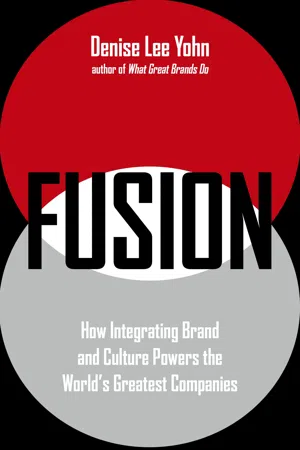
'Leaders everywhere are trying to build great brands, but few realise how powerfully brands are shaped by the cultures of their organizations. This compelling book shows how.' -Adam Grant, New York Times bestselling author of Originals and Give and Take In FUSION, Denise Lee Yohn examines some of the world's greatest organizations and reverse-engineers their greatness - specifically how they've integrated what's on the inside (culture) with what's on the outside (brand) for remarkable results. Through detailed case studies, interviews with industry leaders, findings from respected academic research and drawing on her own experience working with extraordinary brands across a broad range of sectors, Denise shows how great companies achieve the brand-culture fusion that creates extraordinary results and growth. FUSION is for those with responsibility and oversight for the core operations of their business (C-Suite and line managers) who also set the tone and direction for their companies. The book includes access to Denise's proprietary online assessment for determining how close to or how far from brand/culture integration a company is and a blueprint for achieving brand-culture fusion.
eBook - ePub
FUSION
How Integrating Brand and Culture Powers the World's Greatest Companies
- 240 pages
- English
- ePUB (mobile friendly)
- Available on iOS & Android
eBook - ePub
About this book
Information
PART 1
THE FOUNDATIONS OF BRAND-CULTURE FUSION
Just as you can’t build a great building on a weak foundation, you can’t build a great organization without a strong foundation that’s established by setting your purpose and values, understanding the current state of brand-culture fusion in your company, and taking charge.
CHAPTER 1
SET YOUR SOLE PURPOSE AND CORE VALUES
Read this chapter to learn:
• Why your organization needs an overarching purpose and how to develop a powerful one
• Why your organization needs one set of core values for its internal culture and external brand identity
• How to evaluate and activate your core values
Why do we exist? This is the most important question an organization must ask itself—and the question that got Phil Knight through some of his darkest days when he started the company that would become Nike. Faced with mortgaging his house, making a “deal with a devil” (a hostile supplier), and begging for yet another loan from his bank, Knight kept coming back to why he was willing to sacrifice so much. “I believed in running,” he writes in his memoir, Shoe Dog. “I believed that if people got out and ran a few miles every day, the world would be a better place, and I believed these shoes were better to run in.”1
Even as a young, scrappy entrepreneur selling shoes out of his parents’ basement, Knight understood the importance of having a compelling purpose that would not only sustain him through Nike’s early days but eventually inspire millions of Nike’s customers and employees. Today that purpose continues to inform what Nike calls its “mission,” the driving force behind its brand and corporate culture: “Bring inspiration and innovation to every athlete* in the world. *If you have a body, you are an athlete.”*2
Nike’s renowned advertising tagline, “Just Do It,” translated that mission into a brand message that has bonded customers to the Nike brand for years. Just as important, the mission—and the company’s “11 Maxims,” which include guiding principles such as “simplify and go” and “evolve immediately”3—have served as the core of the organization’s internal culture through the years as well.
Today Nike executives use its mission and maxims to set the tone within the organization. When issues of race, violence, and policing rocked the U.S. in 2016, for instance, CEO Mark Parker referenced the company’s mission in a letter he penned to employees to explain Nike’s response to the events. He wrote, “To serve every [emphasis mine] athlete individually and completely, across hundreds of countries where we do business, we need teams that reflect the diversity of our consumers and a culture of inclusivity that respects the communities in which we live and work.”4
Nike’s mission and maxims also pervade its designers’ thinking. Tinker Hatfield, one of Nike’s most influential and esteemed shoe designers, explains, “Our future really revolves around how we can improve the lives of athletes and just people running around in the streets. So we’re asking ourselves all the time: What can we do to improve what we’ve done in the past?”5 And Nike’s innovating and inspiring spirit isn’t only embraced by people working on its products. “We’ve consciously tried to be innovative in all areas of the business,” Knight once said, “and right now that means advertising. We need a way of making sure people hear our message through all the clutter . . . that means innovative advertising—but innovative in a way that captures the athletes’ true nature.”6
Just as Nike’s mission is to bring inspiration and innovation to every athlete, Andre Martin, the company’s chief learning officer, says his mission is to bring inspiration and innovation to every employee. He wants “to unleash human potential and help employees own their own career and get them ready for key transitions so everyone in the organization can do more work that matters.” To achieve this goal, training at the company is designed around Nike’s mission and maxims, not only to reaffirm them to every employee but also to ensure the training develops employees who keep them—and therefore the culture—alive.7
Nike has used its unifying purpose (its mission) and its motivating core values (its maxims) to grow from Phil Knight’s fledgling business on the brink of bankruptcy into a $100 billion global enterprise8 and the world’s most valuable sports brand.9 They are the foundation of both Nike’s brand identity and its organizational culture—the crux of Nike’s brand-culture fusion—and the key to its success.
While Nike’s example shows the power of having one overarching purpose and one set of values that inform both the organization’s culture and its brand identity, few organizations have achieved this level of alignment and integration. In fact, most business leaders often separate their business and organization’s purpose and values from those of their brand. The result is a disconnect between how the organization behaves on the inside and how it is perceived on the outside.
To make brand-culture fusion happen, you must articulate a single overarching purpose and one set of core values to drive, align, and guide everything your company does internally and externally. In this chapter, I’ll show you how to develop them the right way.
OVERARCHING PURPOSE: YOUR “WHY”
A company’s purpose is its why—why it does what it does, why it exists. Having a meaningful purpose or being a “purpose-driven” company has become a popular notion in business today, and with good reason. In today’s cluttered, ultracompetitive, choice-overloaded world, each company must have a clear reason for being. You need to play an invaluable, irreplaceable role in people’s lives, and you must live out that purpose convincingly or your customers can easily be lured away by any one of your more deliberate competitors.
Likewise, many employees—especially millennials, who comprise the largest group of workers today—want to work for companies that have a strong sense of purpose beyond making money.10 When explaining why her company has been included on Fortune’s 100 Best Companies to Work For list, Autodesk’s human resources chief Jan Becker, says people usually praise her company for the employee benefits it offers, such as six-week paid sabbaticals and its extraordinary office designs. But when she meets with Autodesk employees, she says, “I commonly hear that they’re most excited about having meaningful impact on the world around us, the innovation occurring every day in our offices around the world, and how they are developing technology that is helping everybody imagine, design, and create a better world.”11
When articulated and implemented well, a compelling purpose shapes culture by engaging employees, even those prone to be skeptical or apathetic, and making their work more meaningful. And purpose can unite even the most diverse and distributed workforce by serving as a driving force that transcends the silos and divisions that inevitably form in organizations. Virgin Group founder Richard Branson believes purpose is essential to engaging employees who are expected to work longer hours and with greater commitment. “Purpose is no longer a buzzword. It’s a must-have,” he says. “Passion and purpose will keep people focused on the job at hand, and ultimately separate the successful from the unsuccessful.”12
Most business leaders know they should promote a purpose for their organization, but most also go about it the wrong way. The typical mission statement outlines the scope of the business—what the organization does, produces, or sells—and sets a goal to achieve certain financial targets or create value for shareholders. For example, a typical mission statement might read, “To build shareholder value by delivering pharmaceutical and healthcare products, services, and solutions in innovative and cost-effective ways.” Often these same organizations will express a separate purpose or essence for their brand that describes what they want it to be known for. For example, that same company might want their brand identity to stand for safety and trustworthiness. Both purposes describe worthy aspirations but they don’t seem to have anything to do with each other.
Another example: A bookstore chain claims, “Our mission is to operate the best specialty retail business in America, regardless of the product we sell,” but its brand purpose “to promote a love for books and reading” reveals a narrower interest. Or consider a company that aspires to industry-leading profitability as a business and yet promises generous service to all customers as a brand. These disconnects between business and brand purpose often cause confusion for people in the organization, especially when they seem at odds.
Setting financial targets and clarifying your business footprint are necessary to set the expectations of investors, business partners, and other stakeholders, but you shouldn’t separate them from the way you engage and motivate your primary ones: customers and employees. The purpose of your business and the purpose of your brand should be seamlessly integrated, tightly aligned, and articulated as a single overarching purpose.
Traditional management theory differentiates between an organization’s purpose (its reason for being), vision (its desired future), and mission (how it achieves its vision or fulfills its purpose). But it’s not necessary to articulate all three of them in separate statements, which can be quite confusing to your employees. A single statement that articulates a single purpose for your business and brand works best. It’s clear, simple, and easy to remember.*
One way to arrive at a sole overarching purpose is by examining your company’s higher purpose—its purpose beyond making money. Sometimes this might lead you to articulate a socially- or environmentally-conscious purpose, as has been the case with the new generation of leaders who have taken the helm of some of today’s leading companies. For example, in a 2016 Fast Company article about the role of business in society, Facebook founder and CEO Mark Zuckerberg explains, for example, that his company “was built to accomplish a social mission—to make the world more open and connected.”13
But a higher purpose doesn’t necessarily have to be a socially-responsible one. Nike’s purpose to “bring innovation and inspiration to every athlete” and Amazon’s purpose to become “Earth’s most customer-centric company”14 transcend their profit-making goals without claiming to create a benefit for society in general.
Note that embracing a higher purpose doesn’t dull your organization’s ability to create a high-performing, profitable business. In fact, several companies with a higher purpose prove just the opposite: Amazon’s market value increased 1,934 percent between 2006 and 2016, while every other major retailer’s value declined.15 Starbucks, whose purpose reads “to inspire and nurture the human spirit—one person, one cup, and one neighborhood at a time,”16 is one of the most profitable companies in its industry. “Caring for the world, one person at a time”17 has guided Johnson & Johnson’s business and brand through...
Table of contents
- COVER
- TITLE PAGE
- COPYRIGHT PAGE
- CONTENTS
- PRAISE FOR FUSION
- ACKNOWLEDGMENTS
- INTRODUCTION. Great Companies Are Powered by Brand-Culture Fusion
- PART 1: THE FOUNDATIONS OF BRAND-CULTURE FUSION
- PART 2: FIVE STRATEGIES TO ACHIEVE FUSION
- CONCLUSION. The Journey to Brand-Culture Fusion
- END NOTES
- ABOUT THE AUTHOR
- INDEX
Trusted by 375,005 students
Access to over 1.5 million titles for a fair monthly price.
Study more efficiently using our study tools.
Frequently asked questions
Yes, you can cancel anytime from the Subscription tab in your account settings on the Perlego website. Your subscription will stay active until the end of your current billing period. Learn how to cancel your subscription
No, books cannot be downloaded as external files, such as PDFs, for use outside of Perlego. However, you can download books within the Perlego app for offline reading on mobile or tablet. Learn how to download books offline
Perlego offers two plans: Essential and Complete
- Essential is ideal for learners and professionals who enjoy exploring a wide range of subjects. Access the Essential Library with 800,000+ trusted titles and best-sellers across business, personal growth, and the humanities. Includes unlimited reading time and Standard Read Aloud voice.
- Complete: Perfect for advanced learners and researchers needing full, unrestricted access. Unlock 1.5M+ books across hundreds of subjects, including academic and specialized titles. The Complete Plan also includes advanced features like Premium Read Aloud and Research Assistant.
We are an online textbook subscription service, where you can get access to an entire online library for less than the price of a single book per month. With over 1.5 million books across 990+ topics, we’ve got you covered! Learn about our mission
Look out for the read-aloud symbol on your next book to see if you can listen to it. The read-aloud tool reads text aloud for you, highlighting the text as it is being read. You can pause it, speed it up and slow it down. Learn more about Read Aloud
Yes! You can use the Perlego app on both iOS and Android devices to read anytime, anywhere — even offline. Perfect for commutes or when you’re on the go.
Please note we cannot support devices running on iOS 13 and Android 7 or earlier. Learn more about using the app
Please note we cannot support devices running on iOS 13 and Android 7 or earlier. Learn more about using the app
Yes, you can access FUSION by Denise Lee Yohn in PDF and/or ePUB format, as well as other popular books in Business & Leadership. We have over 1.5 million books available in our catalogue for you to explore.