LEARN HOW TO WRITE YOUR FIRST NOVEL WITH THIS COMPREHENSIVE GUIDE.This new edition of an acclaimed guide to writing a novel helps you if you are just at the very beginning of your writing journey, showing you how to gain confidence and find inspiration. A classic book that has supported thousands of authors over the years, it contains a wealth of information on how to structure, craft and develop your writing, how to edit and redraft, and how to take the first steps towards publication. Each chapter contains a long and several shorter writing exercises, while key quotes, ideas and focus points will be clearly signposted and will summarise important concepts and advice. At the heart of each chapter is the 'Workshop'. The Workshop is a key exercise, in which you will gain a deeper insight into the craft of writingThis new edition also includes an expanded section on self- and digital-publishing, to reflect recent advances in technology and practice. ABOUT THE SERIES
The Teach Yourself Creative Writing series helps aspiring authors tell their story. Covering a range of genres from science fiction and romantic novels, to illustrated children's books and comedy, this series is packed with advice, exercises and tips for unlocking creativity and improving your writing. And because we know how daunting the blank page can be, we set up the Just Write online community at tyjustwrite, for budding authors and successful writers to connect and share.
eBook - ePub
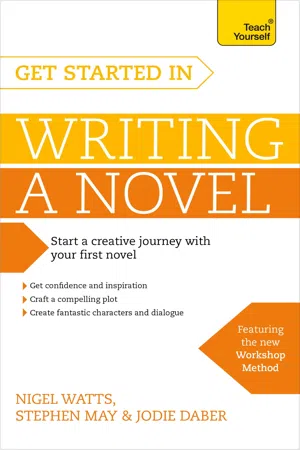
Get Started in Writing a Novel
How to write your first novel and create fantastic characters, dialogues and plot
- 224 pages
- English
- ePUB (mobile friendly)
- Available on iOS & Android
eBook - ePub
Get Started in Writing a Novel
How to write your first novel and create fantastic characters, dialogues and plot
About this book
Information
1

Beginnings
You want to write a novel, so where do you start? Let’s first of all dismiss the topic of technology. A computer is helpful: it makes editing easy, likewise printing out copies. Some people find that having, in effect, a neat top copy always in front of their eyes helps them keep their thoughts ordered. A spell checker and word counter are also helpful features.
On a humbler level, paper and pen or pencil have been used, and are still used. Their advantages? They are portable (try using a computer in the bath), cheap, and have sensory appeal to some writers (yellow legal pads and 2B pencils are a particular favourite). Roald Dahl worked with pencil and paper in his garden shed, a plank of wood for a desk. A novelist friend of mine writes in longhand in bed between midnight and 3 a.m. I am typing this straight on to a computer, using notes from my trusty red exercise books.
The hardware of writing is largely irrelevant: it is the software (or what in modern computer jargon is being called ‘wetware’ – the human brain) that counts. An expensive desk and computer won’t help you write (as the best-selling author Sue Townsend discovered when she still found herself drawn back to the kitchen table). Don’t be misled by technology – a writer is someone who writes. Experiment by all means, find a medium that suits you, and then get on with the task of writing your novel.
 | Key idea |
Whether you prefer to write by hand or on a computer, the most important thing to do is just sit down and write.
A writer in search of an idea
So, you have cleared a space on the table, bought your paper or polished the screen of your computer. Now what? There are two ways of looking at this. If you want to be a writer, but have nothing to write about, you’ll be like a knight in armour searching for a damsel in distress to rescue. Good luck – there is no guarantee you’ll find one. There was a six-month gap between finishing my second novel and starting my third novel during which time I had no ideas at all. In desperation, I scraped around in the department of my brain marked ‘good ideas’, and eventually came up with a scenario anyone who has read Crime and Punishment will recognize. And so I filled a notebook with storylines, flogging this dead horse with diminishing enthusiasm, until one day I forgot to pick up the notebook. About time, too.
It’s a frustrating fact of the creative life that motivation alone isn’t enough to produce a work of art. We need a spark, a germ, a seed. A novel is not a machine – you can’t build one. A novel is more like a bonfire: you can lay as much firewood as you please, but without a spark you’ll get no heat. Henry James called this spark a donnée, a gift, something that you receive.
On the other hand, if you are a person who has an urge to bring into existence an idea which has been bothering you, somebody who has a particular story to tell, thank your lucky stars – you have received your donnée, your subject has chosen you.
 | Focus point |
Keep writing something while you’re looking for your idea – your diary, personal letters, character studies, plot outlines – nothing is ever wasted, and you never know, the idea might emerge from one of them.
TAKE WHAT YOU GET
Don’t resist being chosen. I see it a lot with my students: an idea tugs at their sleeve, but they ignore it because they want to write something more noble, or exciting or intellectual. And generally the results are what you would expect: strained and artificial. But when students recognize the wealth of material they already possess, they can access their greatest asset as writers: their uniqueness. Nobody has lived your story, nobody has had your combination of experiences. Use your life experiences. If you’re lucky, you may find you don’t have any choice – hopefully your story is demanding to be written.
 | Bruce Duffy |
‘You know, you don’t always have a choice what you’re going to write. You’re not like a cow that can give cream with one udder and milk with another.’
HOPING, WAITING AND LOOKING
What can be done if you have an urge to write, but have yet to be chosen by your subject? You can hope, and you can wait, and you can look. There is no shortage of material out there, it’s just a matter of adjusting your story antennae to ‘ultrasensitive’. We are inundated with story stimulus, perhaps the richest source being life itself: real things happening to real people. Form the habit of watching events through a novelist’s eye, listening to dialogue through a novelist’s ear.
Trawl through your past for story fodder. Particularly if you are writing for children, think back to the events which were important for you at that time of life. The chances are, if they were important for you, they would be relevant to a young reader.
Newspapers and magazines are often a rich source of material. Rather than storing this material away in your memory, or building a stack of newspapers, or files of unsifted clippings, try keeping a scrapbook. Cut out interesting items from newspapers, or photographs of people and scenery that catch your eye. Much of it may never be used, but what you do use can be invaluable.
When I was writing my first novel I looked out for faces in magazines which fitted my protagonists. The pictures I settled on – the actors Trevor Howard and Meryl Streep – not only helped me in my characterization, but also provided me with the harmless fantasy of casting these actors in the film version of the book!
 | Snapshot |
If you are looking for an idea, trawl though newspapers. Although the news they usually report is grim, there is little doubt that the stories often have dramatic potential. See what you can make of one of the following, all of which are real examples:
• A six-year-old girl threw herself in front of a train and killed herself because she wanted to become an angel and look after her sick mother.
• A man kidnapped the son of a millionaire friend because he was missing his own children.
• A man and a woman who met as strangers discussed their separate domestic problems and decided to kill themselves.
A less unwieldy tool in the writer’s kit is the notebook – no need for scissors and paste here, just a pen and paper. Jot down snatches of dialogue – both heard and imagined. Write down story ideas and fresh twists in the plot. Sketch maps of the imagined landscape, draw pictures of the house your hero lives in. Some novelists always have a notebook handy, just in case an idea comes when they’re away...
Table of contents
- Cover
- Title
- Contents
- Introduction
- 1 Beginnings
- 2 Plot
- 3 The eight-point arc
- 4 Subplot and symbolism
- 5 Character
- 6 Dialogue
- 7 Viewpoint
- 8 Setting the scene
- 9 Style
- 10 Theme
- 11 The difficult business of second drafts
- 12 Writer’s block
- 13 Support
- 14 Marketing your manuscript
- Resources
- Copyright
Trusted by 375,005 students
Access to over 1.5 million titles for a fair monthly price.
Study more efficiently using our study tools.
Frequently asked questions
Yes, you can cancel anytime from the Subscription tab in your account settings on the Perlego website. Your subscription will stay active until the end of your current billing period. Learn how to cancel your subscription
No, books cannot be downloaded as external files, such as PDFs, for use outside of Perlego. However, you can download books within the Perlego app for offline reading on mobile or tablet. Learn how to download books offline
Perlego offers two plans: Essential and Complete
- Essential is ideal for learners and professionals who enjoy exploring a wide range of subjects. Access the Essential Library with 800,000+ trusted titles and best-sellers across business, personal growth, and the humanities. Includes unlimited reading time and Standard Read Aloud voice.
- Complete: Perfect for advanced learners and researchers needing full, unrestricted access. Unlock 1.5M+ books across hundreds of subjects, including academic and specialized titles. The Complete Plan also includes advanced features like Premium Read Aloud and Research Assistant.
We are an online textbook subscription service, where you can get access to an entire online library for less than the price of a single book per month. With over 1.5 million books across 990+ topics, we’ve got you covered! Learn about our mission
Look out for the read-aloud symbol on your next book to see if you can listen to it. The read-aloud tool reads text aloud for you, highlighting the text as it is being read. You can pause it, speed it up and slow it down. Learn more about Read Aloud
Yes! You can use the Perlego app on both iOS and Android devices to read anytime, anywhere — even offline. Perfect for commutes or when you’re on the go.
Please note we cannot support devices running on iOS 13 and Android 7 or earlier. Learn more about using the app
Please note we cannot support devices running on iOS 13 and Android 7 or earlier. Learn more about using the app
Yes, you can access Get Started in Writing a Novel by Nigel Watts,Stephen May,Jodie Daber in PDF and/or ePUB format, as well as other popular books in Languages & Linguistics & Creative Writing. We have over 1.5 million books available in our catalogue for you to explore.