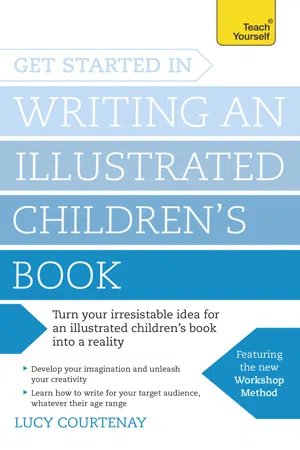
Do you have an irresistible idea for a children's book with pictures? Are you inspired by writers like Julia Donaldson and Lauren Child? Get Started in Writing and Illustrating A Children's Book is designed for anyone who wants to write in this genre of fiction, whatever the category or age range. Designed to build confidence and help fire up creativity, it is also an essential guide to mastering the practicalities of working with illustrators and illustrated concepts, from creating ideas for toddler board books to writing high concept middle grade projects. It carries the distinctive learning features of the flagship Teach Yourself Creative Writing series, with Snapshots designed to get you writing quickly, Key Idea to help crystallize thought, and a wealth of supplementary material, including insights into the publishing world and the role of the agent.
eBook - ePub
Get Started in Writing an Illustrated Children's Book
Design, develop and write illustrated children's books for kids of all ages
- 224 pages
- English
- ePUB (mobile friendly)
- Available on iOS & Android
eBook - ePub
Get Started in Writing an Illustrated Children's Book
Design, develop and write illustrated children's books for kids of all ages
About this book
Information
1

Starting out
Why have you picked this book? We all have a trigger point before we decide to try writing a children’s book. A book we read as a child that made a deep impression on us. An image we can’t get out of our minds. A story we read in later years, to our own children perhaps, that reminded us of that book that we loved. A deep enjoyment of children’s stories and the variety of worlds and genres they offer, regardless of the age at which we discover them. These are all great triggers. There is no need to question them.
What we do need to question, however, is why we want to have a go. It’s important to be clear about our motives. That way, we know where we are going before we begin.
 | Hugh MacLeod, Ignore Everybody: And 39 Other Keys to Creativity |
‘Everyone is born creative; everyone is given a box of crayons in kindergarten. Then when you hit puberty they take the crayons away and replace them with dry, uninspiring books on algebra, history, etc. Being suddenly hit years later with the “creative bug” is just a wee voice telling you, “I'd like my crayons back, please.” ’
Why, oh why?
So, to come back to the question posed: why have you picked up this book? Let’s dig into your psyche and see what we can find.
‘I HAVE A GREAT IDEA’
This is an excellent starting point. I applaud you for already putting your imagination to work. It’s exciting, isn’t it, that feeling when you have a little kernel of gold in your mind that you feel sure will turn into something wonderful?
I’m afraid that having the idea is the easy part. Building that idea into something takes work. As Honoré de Balzac wrote, ‘It is as easy to dream up a book as it is hard to write one.’ You’re prepared for that, right? You’ve picked up a 60,000-word book to help you get started on something that may end up 500 words long. That suggests the right kind of focus.
Ninety-nine times out of a hundred, an idea will wither on the vine, not because it’s a bad idea but because the writer doesn’t know how to nurture it. When the first flush of excitement passes, you can’t see where it goes next. You struggle to visualize the span of your book. You can’t make your characters sound the way you want, or look the way you imagined. Your story stretches to only one page and you don’t know how to fatten it up. This is as true for experienced writers as it is for those just starting out. I would hazard a guess that every published author in the field of children’s books has a drawer full of unfinished stories and half-sketched ideas that simply didn’t go anywhere. You are in good company.
But this book isn’t here to tell you to put your great idea away and go and do something more sensible instead. If you have an idea but don’t know how to build on it, don’t worry. Armed with the appropriate tools, it’s entirely possible to turn your idea into something more three-dimensional. Maybe your first attempt won’t work, but you will learn something by trying to make it happen. And you will apply what you have learned to the next great idea that you have. And then, a few years down the line, you may find yourself revisiting your original idea and crafting it into something better. I can’t promise it will ever be published, but if you set your mind to it, there’s no reason why it can’t be finished.
 | Snapshot |
Write down the idea that brought you to pick up this book. If you don’t have an idea yet, think of something and jot that down as a starting point. Now consider the following:
• Do you want to illustrate it yourself?
• What age do you think will enjoy it?
• Is there anything in the bookshops that compares to your idea?
‘MY IDEA HASN’T BEEN DONE BEFORE’
This feels different from ‘I have a great idea’. It implies that you’ve studied the market very hard and have found a space on the bookshelves that you intend to fill or die in the attempt. Your story is called Ernie the Line-dancing Earthworm. Scissor kicks, invertebrates: this baby has it all! You haven’t thought about the writing or illustrating part yet, but you feel confident that these are secondary to the originality of your concept.
You’re on dangerous ground. There are only a finite number of plots, and they’ve all been done. Anything that remains generally remains unwritten for a good reason.
Georges Polti states that there are 36 plots in his book Thirty-six Dramatic Situations (1916). Christopher Booker’s The Seven Basic Plots (2004) claims, unsurprisingly, that there are only seven. Other theorists have declared that there are just two stories: going on a journey, and a stranger coming to town. Which you could argue is the same plot really, just seen from the opposite direction. Anne Fine, prize-winning author and the UK’s Children’s Laureate 2001–3, has said that ‘plots are overrated’, and she may have a point.
Great children’s books can be about nothing at all, and yet everything at the same time. The story that will succeed is not the madly original idea; it’s the brilliantly well-constructed one.
Francesca Simon’s Horrid Henry series, illustrated by Tony Ross,...
Table of contents
- Cover
- Title
- Dedication
- Contents
- About the author
- Acknowledgements
- Introduction
- 1 Starting out
- 2 Be like your readers
- 3 Finding ideas
- 4 Genre
- 5 Picture books
- 6 Illustrated fiction
- 7 Character
- 8 Plotting
- 9 Setting the scene
- 10 Voice
- 11 Grammar
- 12 Dialogue
- 13 Editing
- 14 Beyond the book
- Copyright
Trusted by 375,005 students
Access to over 1.5 million titles for a fair monthly price.
Study more efficiently using our study tools.
Frequently asked questions
Yes, you can cancel anytime from the Subscription tab in your account settings on the Perlego website. Your subscription will stay active until the end of your current billing period. Learn how to cancel your subscription
No, books cannot be downloaded as external files, such as PDFs, for use outside of Perlego. However, you can download books within the Perlego app for offline reading on mobile or tablet. Learn how to download books offline
We are an online textbook subscription service, where you can get access to an entire online library for less than the price of a single book per month. With over 1.5 million books across 990+ topics, we’ve got you covered! Learn about our mission
Look out for the read-aloud symbol on your next book to see if you can listen to it. The read-aloud tool reads text aloud for you, highlighting the text as it is being read. You can pause it, speed it up and slow it down. Learn more about Read Aloud
Yes! You can use the Perlego app on both iOS and Android devices to read anytime, anywhere — even offline. Perfect for commutes or when you’re on the go.
Please note we cannot support devices running on iOS 13 and Android 7 or earlier. Learn more about using the app
Please note we cannot support devices running on iOS 13 and Android 7 or earlier. Learn more about using the app
Yes, you can access Get Started in Writing an Illustrated Children's Book by Lucy Courtenay in PDF and/or ePUB format, as well as other popular books in Languages & Linguistics & Graphic Design. We have over 1.5 million books available in our catalogue for you to explore.