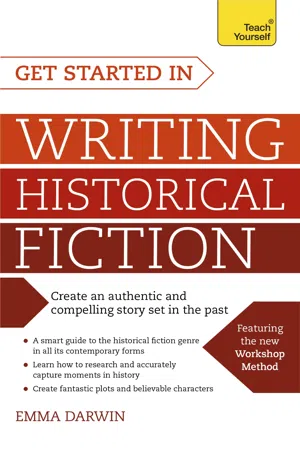
Do you have a compelling vision for a story set in the past? Are you inspired by novelists such as Alan Furst and Philippa Gregory? Get Started in Writing Historical Fiction is designed for anyone who wants to write in this exciting and wide-ranging genre of fiction, whatever your favorite style and era. Designed to build your confidence and help fire up creativity, this book is an essential guide to mastering the practicalities of writing historical fiction, showing you where to start with research, developing your plots, and convincingly and imaginatively capturing the voices of the past. Using Snapshots designed to get you writing quickly, Key Ideas to help crystallize thought, and a wealth of supplementary materials, this indispensable guide will have you telling amazing and rich historical stories in no time. You'll learn to research and plan your story, practice developing characters and settings, perfect your characters' voices, and transport the reader to another era. ABOUT THE SERIES
The Teach Yourself Creative Writing series helps aspiring authors tell their stories. Covering a range of genres from science fiction and romantic novels to illustrated children's books and comedy, this series is packed with advice, exercises, and tips for unlocking creativity and improving your writing. And because we know how daunting the blank page can be, we set up the Just Write online community, at tyjustwrite.com, for budding authors and successful writers to connect and share.
- 224 pages
- English
- ePUB (mobile friendly)
- Available on iOS & Android
eBook - ePub
Get Started in Writing Historical Fiction
About this book
Information
1

Why are you drawn to historical fiction?
Writers come to historical fiction for different reasons. This chapter explores what your reasons are, how you might therefore set about imagining and recreating places and times that you can’t have experienced directly, and how to get started on an actual story.
 | Sara Sheridan |
Sara Sheridan writes historical fiction based on real nineteenth-century explorers, and historical crime.
‘The best historical stories capture the modern imagination because they are, in many senses, still current – part of a continuum. … Writing historical fiction has many common traits with writing sci-fi or fantasy books. The past is another country – a very different world – and historical readers want to see, smell and touch what it was like living there.’
Why do you want to write fiction?
The most important thing about historical fiction is that it is fiction: a story of events that never happened, told ‘as if’ they did happen. Historians and biographers are bound by the constraints of what can be proved or assumed to have happened, but you have decided, already, that you don’t want to be bound that way. Fiction escapes from the confines of real life so that the reader can ‘come home’ with a new, wider sense of what it is to be human: to fear, laugh, cook, have sex, clean teeth, fight, go shopping, worship or dream. Fiction writers deal in the riches of what we imagine could have happened – what’s possible, or plausible, or even downright fantastical. So our job is to make our fiction so convincing that the reader ‘agrees to forget’ that none of this actually happened or, at least, we can’t know if it did.
 | Key idea: write what you want, and make us believe you know it |
Have you ever been told that you should ‘write what you know’? That command has probably depressed you or made you cross. Many of us aren’t interested in writing explicitly about our direct experience, but for a story to work on the reader it needs to have a similar smell of authenticity, a sense of ‘reality’. In other words, if you want to write historical fiction, or, indeed, speculative, fantasy or science fiction, then the motto has to be, ‘Write what you want, and make us believe – at least while we’re reading – that you know it.’
 | Snapshot: all six senses |
Settle yourself and, using a watch or a timer,
• spend one minute writing down everything that you can see
• then one minute writing down everything you can hear
• a minute of everything you can feel
• a minute of what you can smell
• a minute of taste
• and finally a minute of what’s called kinaesthesia: how your shoulder knows that you’ve got your head cocked to one side, the pressure between your knees where you’ve crossed them, the way the table-edge presses into your wrist.
It’s important that you do the senses in that order: sight – sound – touch – smell – taste – body sense, and that you don’t let yourself give up before each minute is up: patiently staying with not-knowing-what-to-write is important because that’s when the creative mind gets a chance to work.
Now, close your eyes and imagine your way back into the historical time and place of a story you want to write. Don’t worry if you feel you don’t know it very well yet, just let your imagination rip. Open your eyes and do exactly the same exercise for that time and place.
 | Focus point: we experience the world through our bodies, with all six senses |
Cognitive science explains that when we’re trying to decide whether something is true or not, we test it against our own physical and mental experience. So an important way of getting your reader to ‘agree to forget’ that this story isn’t actually ‘real’ is to engage their own sense-experience and use it to serve your story. You may not know, or need to know, the precise name of that rope far overhead at the top of the mizzen mast: you do need to evoke the scrubbed, salt-soaked deck-planks under our bare feet, and the way the ship’s movement keeps rolling us towards the side.
Why do you want to write historical fiction?
By definition you can’t have experienced the world you want to write, which makes it harder to imagine and recreate the lives in it. So why do you want to write historical fiction? To help you to make writerly choices, ask yourself what your reasons are:
• To explore lives that until recently weren’t recorded at all, or only by educated, white men: the lives of women, servants, children, immigrants, convicts, slaves, the marginal, the mad, the strange, the oppressed. (The Long Song by Andrea Levy)
• To explore the inner life and subjective experience of people whose outer life is well recorded: kings and queens, the rich and powerful, the famous and the infamous, men and women who shaped the worlds they knew, or discovered new ones. (Wolf Hall by Hilary Mantel)
• To evoke a famous event in history, and what it was like to live through it. (The Siege by Helen Dunmore)
• To explore the past lives you sense in old buildings and landscapes and bring them to full life. (Stone Angel by Barry Unsworth)
• To evoke a particular time in history which has a very strong atmosphere and dynamic which you want to capture. (Pure by Andrew Miller)
• To explore fundamental human drives, desires and dilemmas, by stepping away from the clutter and close-up familiarity of the modern world. (Rites of Passage by William Golding and its sequels in the ‘To the Ends of the Earth’ trilogy)
• To explore modern drives, desires and dilemmas, by stepping sideways from a specific modern world to look at how all humans are shaped by their circumstances. (Restoration by Rose Tremain)
• To write about sex and love with more at stake: with more barriers of law and custom before two people can get together; when there’s no contraception and no divorce; when everyone knows that Hell is waiting for sinners. (The Far Pavilions by M. M. Kaye)
• To write about violence and death when both are closer: when death is only a sword’s-length or witch’s curse away; when small wounds can kill you; when honour is sometimes more important than life; when you need a priest before you can die without fear. (Master and Command...
Table of contents
- Cover
- Title
- Dedication
- Acknowledgements
- Contents
- Introduction
- 1 Why are you drawn to historical fiction?
- 2 Characters-in-action
- 3 Imagining the past
- 4 Researching the past
- 5 Hearing the voices: prose (i)
- 6 Story and plot: structure
- 7 How might you tell your story? prose (ii)
- 8 Different shapes of story: form
- 9 Different kinds of story: genre
- 10 Bringing it all together: process
- 11 What next?: going further, getting published
- Appendices
- Copyright
Trusted by 375,005 students
Access to over 1.5 million titles for a fair monthly price.
Study more efficiently using our study tools.
Frequently asked questions
Yes, you can cancel anytime from the Subscription tab in your account settings on the Perlego website. Your subscription will stay active until the end of your current billing period. Learn how to cancel your subscription
No, books cannot be downloaded as external files, such as PDFs, for use outside of Perlego. However, you can download books within the Perlego app for offline reading on mobile or tablet. Learn how to download books offline
Perlego offers two plans: Essential and Complete
- Essential is ideal for learners and professionals who enjoy exploring a wide range of subjects. Access the Essential Library with 800,000+ trusted titles and best-sellers across business, personal growth, and the humanities. Includes unlimited reading time and Standard Read Aloud voice.
- Complete: Perfect for advanced learners and researchers needing full, unrestricted access. Unlock 1.5M+ books across hundreds of subjects, including academic and specialized titles. The Complete Plan also includes advanced features like Premium Read Aloud and Research Assistant.
We are an online textbook subscription service, where you can get access to an entire online library for less than the price of a single book per month. With over 1.5 million books across 990+ topics, we’ve got you covered! Learn about our mission
Look out for the read-aloud symbol on your next book to see if you can listen to it. The read-aloud tool reads text aloud for you, highlighting the text as it is being read. You can pause it, speed it up and slow it down. Learn more about Read Aloud
Yes! You can use the Perlego app on both iOS and Android devices to read anytime, anywhere — even offline. Perfect for commutes or when you’re on the go.
Please note we cannot support devices running on iOS 13 and Android 7 or earlier. Learn more about using the app
Please note we cannot support devices running on iOS 13 and Android 7 or earlier. Learn more about using the app
Yes, you can access Get Started in Writing Historical Fiction by Emma Darwin in PDF and/or ePUB format, as well as other popular books in Languages & Linguistics & Creative Writing. We have over 1.5 million books available in our catalogue for you to explore.