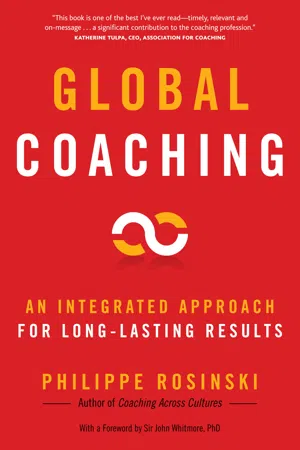
The need for a "master level" of coaching has never been greater in the global economy and interconnected world in which we live. Global Coaching inspires managers and coaches to find meaningful and long-lasting results through an integrated approach, combining coaching strategies from six perspectives—physical, managerial, psychological, cultural, political and spiritual. Philippe Rosinski's pioneering work in bringing the crucial intercultural dimension into the practice of coaching has won him worldwide acclaim. The first European to be designated Master Certified Coach by the International Coach Federation, he is a leading expert in executive coaching, team coaching and global leadership development. He is currently principal of Rosinski & Company, a global consulting firm that helps leaders, teams and organizations unleash their human potential to achieve sustainable high performance. He is an MBA professor for global managers at the Kenichi Ohmae Graduate School of Business in Tokyo, Japan. For more information, visit www.philrosinski.com and www.globalcoaching.pro.
- 288 pages
- English
- ePUB (mobile friendly)
- Available on iOS & Android
eBook - ePub
About this book
Information
The Global Coaching Approach
CHAPTER 1
The Multiple Perspectives Framework1
For as long as I can recall, I have been fascinated by multiple perspectives. As a 15-year old, I struggled to choose between the Latin-mathematics section (preparing for scientific and engineering studies) and the Latin-Greek section (preparing for the humanities). I wanted to study both! Later, after graduating from the Polytechnical Engineering School in Brussels, I studied electrical engineering at Stanford University and took all my electives in the humanities (with the exception of a windsurfing class!). I found these radically different perspectives inspiring and enriching. My fellow students usually preferred computer science, which they viewed as a more natural and practically applicable complement to electrical engineering.
Later on, this same inclination led me, as an executive coach, to introduce the concepts of global coaching and coaching from multiple perspectives. I wondered how to take advantage of new angles (notably political, cultural, and spiritual) that had not been part of traditional coaching. In my experience, such perspectives lead to more creative, powerful, and meaningful coaching.
In my view, the executive coach’s mission is to facilitate the coachee’s journey toward high performance and high fulfillment, toward sustainable and global success, for the benefit of the coachee herself and for others she can impact.
In practice, executive coaching often is reduced to its two traditional perspectives: psychological and managerial. Both are essential, but they usually are insufficient to unleash the coachee’s full potential.
However, as coaching establishes itself as a new discipline, many “scholars” who are contributing to the “institutionalization” of coaching are adopting the view that multiple perspectives make coaching more effective and relevant. In 2006, two books illustrated this shift: both Evidence Based Coaching Handbook and Excellence in Coaching promote diverse approaches in coaching. Linda Page (2006) summarized this evolution: “There is a growing consensus that the field of coaching studies should be cross-disciplinary, multi-disciplinary, or inter-disciplinary—that is, a hyphenated field rather than one that is “owned” by any one existing academic discipline.”
When it integrates multiple perspectives, coaching is a powerful vehicle for sustainable and global success (for oneself and for others). I use the term “global coaching” to refer to this broad and inclusive form of coaching. Coaching from multiple perspectives assumes an enlarged mission for the executive coach and implies readiness to engage in a lifelong journey of learning.
SIX ESSENTIAL PERSPECTIVES
I have found the perspectives in the following table particularly useful.
Multiple Perspectives for Coaching | ||
Perspective | Definition/explanation | Two essential qualities fostered by the perspective |
Spiritual | Spirituality is an increased awareness of a connection with oneself, others, nature, and with the immanent and transcendent “divine.” It is also the ability to find meaning, derive purpose, and appreciate life. | Meaning and Unity See comment in next section (“Cultural”). |
Cultural | A group’s culture is the set of unique characteristics that distinguishes its members from another group. External characteristics include behaviors, artifacts, and products. Internal characteristics include norms, values, and basic assumptions. | Diversity and Creativity In our complex, multicultural, and turbulent environment, we must learn to embrace diversity, bridge cultural gaps, learn from cultural differences for more creativity, live meaningfully, act responsibly, overcome divisions, and strive for unity (internally and externally). |
Political | Politics is an activity that builds and maintains your power so that you can achieve your goals. Power is the ability to achieve your meaningful, important goals. Politics is a process. Power is potential, and it comes from many sources. | Power and Service Politics is inherent to organizational life and is essential for leadership. Politics becomes constructive when it also works in the service of others. As power gives impact and leverage, service can guide your actions. |
Psychological | Psychology is the study of individual personality, behaviors, emotions, and mental processes. Psychology differs from culture in that its primary focus is the individual rather than the collective. | Emotional and Relational The psychological and managerial perspectives are the two pillars of traditional coaching. |
Managerial | “Management is a task that consists in focusing resources on the organization’s goals, and then monitoring and managing the use of these resources” (Campbell, 1991, 4). | Productivity and Results See comment in previous section. |
Physical | The physical is anything relating to the body. | Health and Fitness Health and fitness are fragile foundations that can easily be taken for granted but should be actively nurtured instead. “Mens sana in corpore sano,” a healthy mind in a healthy body, is a fundamental aspect of global coaching. |
Reality is multifaceted, and the various perspectives are interconnected. And each general perspective contains many specific perspectives. The Evidence Based Coaching Handbook (2006) clearly illustrates, for example, how various schools, theories, and models within psychology can contribute to coaching. These include adult development, cognitive psychology, psychoanalysis, and positive psychology.
Coaching is an art. In any given situation, a coach must choose an approach that is most likely to generate insights and foster progress. A coach needs to juggle multiple perspectives and seamlessly link and leverage alternative viewpoints to address the coachee’s challenges.
MARIE’S CASE
To make the abstract concrete, let’s see how these ideas apply to a case written by my friend and colleague Dr. Katrina Burrus, Master Certified Coach.2
CASE STUDY
Marie, the business developer for Asia of a prestigious, global, consumer-service company with headquarters in the UK, asks for your help. Marie’s boss suggested that she work with a coach, which is unusual; her company seldom invests much in ongoing training for its people. Marie is thus surprised, and feels privileged to benefit from a coaching program. You were highly recommended to her, but live in Europe; Marie, a U.S. citizen of Anglo-Saxon descent, asks you if you can coach her in Beijing, where she has lived for the last year.
Marie tells you that she wants to use the coaching to become more effective in developing the business in the region. In a few years, she wants to have established the Asian region as one of the main business centers for her company. She also mentions that she is constantly working, and can never relax enough to simply be; she always has to be doing something: work, reading, or study. She wants to share more time with her husband.
With Marie’s approval, you talk with her functional and regional bosses (she reports equally to both in a matrix format) to determine what they expect from a coaching program. Through these two direct supervisors, you are informed of the following:
Marie’s regional boss, Joe, a British citizen living in Beijing, describes Marie as an outstanding professional with an incredible workload capacity, dealing with multiple, complex situations. “Marie,” he says, “is devoted to the success of the business and obtains outstanding results. She has been sent to difficult, emerging markets in Eastern Europe to troubleshoot problems and has been able to get projects through, resolved, and in a timely manner. Socially, she is charming and pleasant, but at work she is very pushy when promoting her ideas. When she delegates, she relentlessly comes back to her direct reports to see what has been accomplished.” Joe reports that this, too, is perceived as pushy.
Joe continues, “Her Asian teams, from Japan, India, and Beijing, tend to shy away from working directly with her. She has been known to shout at her direct reports publicly and humiliate other colleagues in front of their bosses. Even clients have been subject to her wrath. She needs to create a team spirit and have people happy to work with her.”
Joe pauses to think and then continues, “After an argument, Marie might try to make amends with the person she has upset, but she cannot stop herself from competing to win the argument, even if it will cost her the relationship. Many of her colleagues think she has a need to compete and have the last word. What has surprised more than one of her colleagues is that Marie’s self-confidence at work contrasts noticeably with her submissive attitude with her (functional) boss, Jane.” Joe continues, “I have noticed that she walks briskly into the office. She looks tense. When she is annoyed with a discussion, she rolls her eyes and walks away.”
Marie’s functional boss, Jane, an American based in the U.S., summarizes Marie’s attitude as, “She lacks confidence. Marie remains silent in meetings.” She continues, “She wants to impress people and overcompensates. She tries to impress people that she is bright, and what would we do without her. When she encounters resistance with her direct reports, she becomes aggressive, hierarchical, very top-down. She has little to no empathy or social radar. She is perceived as having little sensitivity to what is required by others.” Jane pauses and says thoughtfully, “She does not know how to profile herself to engage people.”
Marie tells you that she is 42 years old, has been married for 12 years, and has no children. She was raised in the eastern U.S., and comes from a traditional, middle-class family. Her husband is a very successful Swiss banker who has been promoted every few years and changed countries with each promotion. Marie says that she has usually found a way to follow him while pursuing her career or studies. She also mentions that her husband admires her achievements but complains sometimes that she relies too much on him to make decisions.
When Marie gives some information on her background, you find out that she has an older brother who was the apple of their parents’ eyes. All hopes were focused on his career until he decided to quit the business life to live in a retreat. She was an average student at school, but once her brother left the business world, Marie began to have outstanding results at school.
Marie talks proudly about the results she has achieved and her constant travels. She confides in you that she is driven by her own agenda and gets upset when anything gets in her way. She knows that she is perceived as pushy, and she wants to learn how to inspire rather than impose. Her company has given her the opportunity to receive coaching to work on developing her emotional intelligence, which she understands as developing her interpersonal skills. With this background information from Marie and her two bosses, your assessment of the coaching situation begins.
During workshops, I ask participants these questions after they read the case.
• What is your understanding of the situation? What key challenges and issues need to be addressed?
• How would you tackle this case? What approach would you take with Marie?
I invite you to answer these questions as well. What is your take on this situation? What would you do to help Marie?
In my experience, the vast majority of coaches—professional coaches and leaders alike—suggest psychological approaches. Interculturalists will also suggest coaching from a cultural perspective. Most coaches ignore alternative approaches, missing valuable chances to help Marie.
It makes sense to help Marie by focusing primarily on the psychological perspective and taking into account the cross-cultural dimension. However, let me briefly discuss how other perspectives could open additional possibilities and growth opportunities for Marie.
Spiritual
Marie wants to learn how to inspire. The spiritual perspective is a useful avenue here, not just to help Marie cope with her stress but to help her d...
Table of contents
- Cover Page
- Title Page
- Copyright Page
- Dedication
- Contents
- Acknowledgments
- Foreword
- Introduction
- Part I The Global Coaching Approach
- Part II Exploring the Six Perspectives
- PART III Connecting the Six Perspectives
- Appendix: The Möbius ring model—unity and infinity
- Bibliography
- Index
- About the author
Trusted by 375,005 students
Access to over 1.5 million titles for a fair monthly price.
Study more efficiently using our study tools.
Frequently asked questions
Yes, you can cancel anytime from the Subscription tab in your account settings on the Perlego website. Your subscription will stay active until the end of your current billing period. Learn how to cancel your subscription
No, books cannot be downloaded as external files, such as PDFs, for use outside of Perlego. However, you can download books within the Perlego app for offline reading on mobile or tablet. Learn how to download books offline
Perlego offers two plans: Essential and Complete
- Essential is ideal for learners and professionals who enjoy exploring a wide range of subjects. Access the Essential Library with 800,000+ trusted titles and best-sellers across business, personal growth, and the humanities. Includes unlimited reading time and Standard Read Aloud voice.
- Complete: Perfect for advanced learners and researchers needing full, unrestricted access. Unlock 1.5M+ books across hundreds of subjects, including academic and specialized titles. The Complete Plan also includes advanced features like Premium Read Aloud and Research Assistant.
We are an online textbook subscription service, where you can get access to an entire online library for less than the price of a single book per month. With over 1.5 million books across 990+ topics, we’ve got you covered! Learn about our mission
Look out for the read-aloud symbol on your next book to see if you can listen to it. The read-aloud tool reads text aloud for you, highlighting the text as it is being read. You can pause it, speed it up and slow it down. Learn more about Read Aloud
Yes! You can use the Perlego app on both iOS and Android devices to read anytime, anywhere — even offline. Perfect for commutes or when you’re on the go.
Please note we cannot support devices running on iOS 13 and Android 7 or earlier. Learn more about using the app
Please note we cannot support devices running on iOS 13 and Android 7 or earlier. Learn more about using the app
Yes, you can access Global Coaching by Philippe Rosinski in PDF and/or ePUB format, as well as other popular books in Business & Management. We have over 1.5 million books available in our catalogue for you to explore.