Distilling the wisdom of the past with an eye toward the future, Great Leadership cuts through the complexity of leading organizations, operations, and people to make leadership development manageable and greatness attainable. Whether you are looking to lay a solid foundation for a lifetime of great leadership or searching for a curriculum to guide your self-development, Antony Bell has mapped out a journey of discovery to help you uncover what drives your leadership style and do what it takes to practice leadership that is both noble and competent.
- 232 pages
- English
- ePUB (mobile friendly)
- Available on iOS & Android
eBook - ePub
About this book
Information
THE FOUNDATIONS FOR GREAT LEADERSHIP
Clarity from Confusion
1
THE IMPORTANCE OF A LEADERSHIP FRAMEWORK
Understanding What’s at Stake
Great careers are built on great leadership. At the end of your career—whether you retire as a CEO, a senior executive, a project manager, a department head, or a team leader, it makes no difference—you will be remembered by the quality of your leadership.
Not only will you be remembered by your leadership, but you will also judge yourself by it. If you could right now fast-forward to the conclusion of your career and look back at your leadership, you’d most likely focus on the major decisions that shaped your professional path—the Rubicons you crossed and the ones you didn’t, the Alamos you fought and the ones you didn’t. And you would be right to do so, because those decisions would all be significant—both the good choices and the poor choices that reflect great leadership and poor leadership.
And as you looked back over the decades, you would probably wish you had found a way to improve the consistency of those decisions—some kind of framework that would have helped you consistently practice great leadership.
Rewinding the tape back to the present, you can now look ahead with the confidence that such a framework does indeed exist. That’s what this book is about—giving you the framework to make the choices for great leadership, so that when you get to the end of your career, you can look back over a consistent pattern of great leadership.
If you were to rewind the tape even further and look into the past before your own past, you would see that what is true for your personal history is true for the broad sweep of human history. You would see that the impact of history is the impact of leadership. At the fulcrum of momentous events and movements have stood personalities whose leadership tipped the balance for good or for evil. What would American independence have been without Adams, Franklin, Jefferson, or Washington? Or the Civil War without Lincoln? Or opposition to Hitler without Churchill? Or Indian independence without Gandhi? Or even Communism without Lenin or terrorism without bin Laden?
Some tipped the scales for good; some tipped it for bad. Many were inept, and their ineptitude made them memorable. Historian Barbara Tuchman devoted a book—The March of Folly—to what she called “wooden-headed leadership,” which assesses “a situation in terms of preconceived fixed notions while ignoring or rejecting any contrary signs. It is acting according to wish while not allowing oneself to be deflected by the facts.” Such leadership, she says, is “epitomized in a historian’s statement about Philip II of Spain, the surpassing woodenhead of all sovereigns: ‘No experience of the failure of his policy could shake his belief in its essential excellence.’”
THE COMPLEXITY OF LEADERSHIP
If great leadership was elusive in the past, it is even more so today. Consider these trends:

THE COMPETITIVE ADVANTAGE OF GREAT LEADERSHIP
With all these challenges, it stands to reason that any organization that provides the leadership to overcome them has a huge competitive advantage. These challenges don’t mean that great leadership is impossible; in fact, great challenges have a way of uncovering great leaders. “I am apt to think,” Abigail Adams once wrote in a letter to her husband, commenting on George Washington, “that our late misfortunes have called out the hidden excellencies of our commander-in-chief,” and quoting English poet Edward Young, she added, “Affliction is a good man’s shining time.” No less so today, despite many examples of poor leadership; some leaders still prove capable of rising, under pressure, to the levels of greatness their organization needs. And fortunately so, because no single factor shapes the results of an organization more than the kind of leaders it raises and recruits.
The leadership an organization embraces ultimately determines the results it generates. “In the old days, I would have said it was capital, history, the name of the bank,” John Reed once said when he was running Citicorp. “Garbage—it’s about the guy at the top.” Many organizations claim that their people are their greatest asset, but that’s not so, even for those that genuinely believe it (few do). An organization’s leaders are its greatest asset, and an organization that takes care of its leaders takes care of every other asset, including its people.
Research bears this out. Great leadership was one of the critical ingredients in Jim Collins’s research for Good to Great—it was in fact the first critical ingredient in the transformation of average companies into great companies. A recent MIT study gave further empirical support to the intuitively obvious fact that similar companies led by different leadership styles produce very different results. In strategy alone, for example, some focused on organic growth and others on growth by acquisition; some held more cash and others more debt (the latter in both cases did less well). The differences in style and strategy led to very different results in performance and profitability.
Not only is the impact of great leadership felt at an organizational level, it is also felt at an individual level. Leaders who know how to evoke talent stand out, and they deliver dramatic results, as demonstrated by Gallup’s research in First, Break All the Rules, where extraordinary individual performance is attributed to the critical role of leaders who know how to bring out the best in the people they lead.
Not surprisingly, the importance of leadership is increasingly a matter of perception as well as fact. Consulting company Burson-Marsteller tracks such perceptions by measuring the impact of the CEO on the company’s overall reputation, and from 1997 to 2003, it went from 40 percent to 50 percent. However effervescent or self-effacing the CEO, that one individual disproportionately but decisively shapes the perception of the company.
FIGURE 1. THE BOTTOM-LINE IMPACT OF GREAT LEADERSHIP
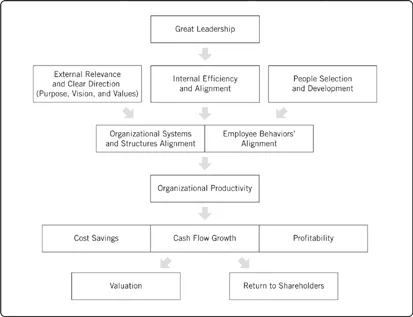
Of course, great leadership plays all the way down to the bottom line, as illustrated in Figure 1. When great leadership is exercised in its three main dimensions—external relevance, internal efficiency, and people selection and development—employee behaviors and their alignment with the organization’s direction inevitably raise the level of the organization’s productivity. When the organization’s productivity is raised, costs are contained, cash flow grows, and profits build—boosting the valuation of the organization and the shareholder returns it generates.
All told, not a bad return for investing your organization with great leadership.
HOW LEADERS HANDICAP THEMSELVES
For all the importance of great leadership, it doesn’t happen by itself. Without a framework, leaders often handicap themselves in a number of significant ways:
To overcome these obstacles, leaders need some guidelines; they need a framework for understanding and exercising great leadership.
Table of contents
- Cover Page
- Title Page
- Copyright Page
- Dedication
- Contents
- List of Figures
- List of Tables
- Preface
- Acknowledgments
- Part I The Foundations for Great Leadership Clarity from Confusion
- Part II Character in Leadership Soul, Heart, and Mind
- Part III Competence in Leadership Knowledge, Skill, and Talent
- Conclusion Your Leadership Development Curriculum
- About the Author
- Index
Trusted by 375,005 students
Access to over 1.5 million titles for a fair monthly price.
Study more efficiently using our study tools.
Frequently asked questions
Yes, you can cancel anytime from the Subscription tab in your account settings on the Perlego website. Your subscription will stay active until the end of your current billing period. Learn how to cancel your subscription
No, books cannot be downloaded as external files, such as PDFs, for use outside of Perlego. However, you can download books within the Perlego app for offline reading on mobile or tablet. Learn how to download books offline
Perlego offers two plans: Essential and Complete
- Essential is ideal for learners and professionals who enjoy exploring a wide range of subjects. Access the Essential Library with 800,000+ trusted titles and best-sellers across business, personal growth, and the humanities. Includes unlimited reading time and Standard Read Aloud voice.
- Complete: Perfect for advanced learners and researchers needing full, unrestricted access. Unlock 1.5M+ books across hundreds of subjects, including academic and specialized titles. The Complete Plan also includes advanced features like Premium Read Aloud and Research Assistant.
We are an online textbook subscription service, where you can get access to an entire online library for less than the price of a single book per month. With over 1.5 million books across 990+ topics, we’ve got you covered! Learn about our mission
Look out for the read-aloud symbol on your next book to see if you can listen to it. The read-aloud tool reads text aloud for you, highlighting the text as it is being read. You can pause it, speed it up and slow it down. Learn more about Read Aloud
Yes! You can use the Perlego app on both iOS and Android devices to read anytime, anywhere — even offline. Perfect for commutes or when you’re on the go.
Please note we cannot support devices running on iOS 13 and Android 7 or earlier. Learn more about using the app
Please note we cannot support devices running on iOS 13 and Android 7 or earlier. Learn more about using the app
Yes, you can access Great Leadership by Antony Bell in PDF and/or ePUB format, as well as other popular books in Business & Management. We have over 1.5 million books available in our catalogue for you to explore.