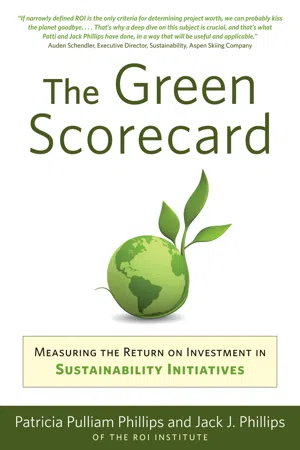
Too many organizations are currently caught in a "green slump, " struggling to engage in sustainability projects and making far less progress than they should be. Some businesses are striving to lead the way by equipping their facilities with new, energy-saving technologies or creating projects that contain post-consumer materials, whereas others may be just now implementing company-wide recycling programs. No matter which green initiative you choose, in order to succeed companies must adopt a results-based, return on investment (ROI) focus that helps them to identify, develop and implement green projects that add value—from an economic, environmental and societal perspective. In The Green scorecard, business leaders—from CEOs and CFOs to project managers and engineers—receive a reliable measurement and evaluation system that delivers credible data for decision makers. The valuable book, based on the ROI Institute's internationally renowned methodology, gives you clear steps for determining the overall worth of green projects—for both the environment and the bottom line.
eBook - ePub
Green Scorecard
Measuring the Return on Investment in Sustainability Initiatives
- 256 pages
- English
- ePUB (mobile friendly)
- Available on iOS & Android
eBook - ePub
Green Scorecard
Measuring the Return on Investment in Sustainability Initiatives
About this book
Information
Going Green
From Kyoto to Copenhagen
Chapter 1
Green Is Everywhere
The Proliferation of Green Projects
As we discovered on our trip to Rome, which we’ve described in the Introduction, green is everywhere. This chapter focuses on the variety of green initiatives that permeate the landscape where we live, work, and play; highlights the forces that are driving green initiatives throughout organizations and communities; and addresses issues about managing this change.
The Green Revolution
A green revolution is occurring throughout the world. This effort toward fundamental change is particularly pervasive in the United States. Perhaps Thomas Friedman (2008) captures this revolution best in his bestselling book Hot, Flat, and Crowded, in which he makes the case for a green revolution that should sweep through organizations, cities, communities, and governments to create what he describes as the Energy Climate Era. Here are a few examples of green initiatives.
GREEN METROPOLIS
Discussions about environmental issues often dwell on cities, focusing on their congestion, inefficiencies, and unmanageable challenges. Tall buildings, consuming enormous amounts of energy, and heavy traffic, inundating the environment with carbon emissions, are obvious environmental hazards. The cities themselves have taken the brunt of many of the social ills that stem from poverty, illness, crime, pollution, open sewers, and exhaust fumes. Despite these burdens, however, cities, with their great density, offer perhaps the best opportunities for environmentally friendly places to live and work. For example, the population in Manhattan is 67,000 people per square mile, more than 800 times the nation as a whole and roughly 30 times the city of Los Angeles (Owen, 2009). In every city, residents often swap the convenience of an automobile for proximity to their communities. Working near home allows people to live without the ecological disasters of cars, in contrast to workers who live in rural areas and have to use an automobile for every trip. In a city, people engage in environmentally friendly habits such as bicycling, mass transit, and walking while supporting each other as a community. Some cities are working hard to increase their residential appeal, which reduces the environmental burden caused by the mass exodus of the work force at the end of the day. Some cities, airports, and ports are striving to be the greenest in the world, with much progress. Here are three of the main ways that cities encourage residents to act as major contributors to sustainability efforts.
Driving Less
Perhaps the greatest impact on the environment comes from helping citizens drive less through the use of mass transit. Cities are investing large sums of money, including a large portion from The American Recovery and Reinvestment Act of 2009 stimulus package, in mass transit systems. Not only does this help the environment, but it reduces citizens’ travel time and costs. Cities also promote carpooling and vanpooling through a variety of services and regulations of auto use, including high-occupancy vehicle (HOV) lanes. Some large cities, particularly outside the USA, are already restricting the use of automobiles in the center city for certain hours or days. For example, Bogotá, Columbia, is proposing a Car-Free Bogotá, which encourages the use of mass transit and reduces the number of vehicles in the city. Road-space rationing based upon the last digits of the license plate on pre-established days is used in cities like México City, Mexico; Santiago, Chile; and São Paulo, Brazil. Most cities promote walking, jogging, and bicycling as well, providing trails, special biking lanes, and pedestrian plazas. Collectively, these activities have an important impact on the environment.
Living Closer
One of the problems with cities in the past was that more people moved to the suburbs, depending on mass transit to transfer them to the city center. Large, multifamily dwellings, situated close to centers of employment, are now becoming common fixtures in major cities. During the past two decades, many cities have initiated downtown redevelopment projects, particularly in building loft apartments, in an attempt to bring the population back to the inner city. These buildings place people in compact areas conveniently located where mass transit may not be needed. Some city planners cluster businesses in the suburbs near neighborhood communities, which also makes the commute distances shorter.
Living Smarter
Cities are doing a great job of making people aware of how to live smarter, healthier, and more environmentally friendly lives. Recycling programs are often initiated and supported. Cities sometimes require or encourage sustainable products and services. Cities offer all types of networking opportunities to bring people together to discuss, promote, and implement green initiatives. Building codes often require construction to be environmentally friendly. Cities promote and sometimes require energy-efficient utilities. All types of educational opportunities are offered to bring the green movement to citizens.
Because more people now live in urban areas than non-urban areas, these projects hold much promise. For example, the opportunity to influence more than half of the people in the United States—city dwellers—is impressive. However, the success of these projects is often uncertain. With millions of dollars spent on renovating old retail buildings or warehouses to create chic, livable flats, one must wonder, “Does it really work?” Are these cities, which offer so much promise, seeing a return on their investment? Are the benefits of spending taxpayer dollars on these projects paying off for the taxpayers? Considering the return on investment, often from the outset, helps ensure money is spent on the projects that have the greatest potential for success for all stakeholders.
GREEN ORGANIZATIONS
In 1994, Interface founder and chairman Ray Anderson set a daring goal for his commercial carpet company: to take nothing from the earth that cannot be replaced by the earth. At the time, carpet manufacturing was a toxic, petroleum-based process that released immense amounts of air and water pollution and created tons of waste. Fifteen years later, Anderson’s call for change at Interface has:
• Cut green house gas emissions by 82 percent
• Cut fossil fuel consumption by 60 percent
• Cut waste by 66 percent
• Cut water use by 75 percent
• Invented and patented new machines, materials, and manufacturing processes
• Increased sales by 66 percent, doubled earnings, and raised profit margins (Anderson and White, 2009)
Ray Anderson and Interface have been featured in three documentary films, including The Corporation and So Right, So Smart. In 1997, Anderson was named co-chair of the President’s Council on Sustainable Development and in 2006 he served on the National Advisory Committee that helped guide the Presidential Climate Action Project, a two-year, $2 million project administered by the Wirth Chair School of Public Affairs at the University of Colorado. He and Interface have been featured in The New York Times, Fortune, Fast Company, and other publications. Unfortunately, there are not enough Ray Andersons and organizations like Interface. Still, here are a few ways green organizations like Interface are making a difference.
Organizing for Green
The starting point for most organizations is to organize properly for green initiatives. This process begins with a mission statement, a vision statement, and a value statement that all incorporate green issues and sustainability efforts. This also involves the assignment of specific responsibilities to individuals involved in green projects. Role definition for all organizational stakeholders is a must if involvement, support, encouragement, and accomplishment of green objectives is the goal.
Promoting Green
Employees must understand the necessity for green projects and be aware of important environmental issues. Formal and informal meetings and communications using the plethora of social media tools can help. Training and learning programs make employees aware of the issues and the necessity to make improvements and adjustments. Brochures, guides, fact sheets, program descriptions, and progress reports help to promote and encourage green project participation.
Practicing Green
Organizational leaders must “practice what they preach” through visible and substantial green projects. These projects should be communicated to the organization, and their successes should be clearly documented. An example of a highly visible project is one that has been undertaken by Hewlett-Packard. A problem exists with the mountains of consumer electronics being disposed of in landfills. To set the example in this important area, HP has collected more than a billion pounds of e-waste, the weight of 1,200 jumbo jets, since 1987. HP is on track to recover, refurbish, and recycle two billion pounds of e-waste by the end of 2010 (www.hp.com/go/reuse-recycle).
Enabling Green
Organizations and communities are enabling stakeholders to be involved in green projects in their communities and in their personal lives. Organizations assist employees with recycling programs and support employees in a variety of ways to understand, promote, and be involved in green initiatives. For example, eight communities in the Silicon Valley area joined to create Climate Prosperity Project, Inc., a nonprofit organization to pursue climate change and an economic development opportunity. The communities, Silicon Valley/San Jose, CA; Portland, OR; St. Louis, MO/IL; Denver, CO; Seattle, WA; Southwest FL; Montgomery County, MD; and the State of Delaware are convinced that not only does climate change represent an environmental imperative, but it represents an extraordinary economic opportunity.
Rewarding Green
Progressive companies are rewarding stakeholders, for being involved in green efforts. For example, in 2008, Southern Company launched EarthCents programs, which include new and existing programs and educational efforts to help reduce residential and commercial energy consumption. According to Susan Story, CEO of Gulf Power, a subsidiary of Southern Company, the benefits of EarthCents include not only wise use of energy, but also reduction of costs that hit the pocket of their customers. In addition, shareholders are rewarded because corporate costs are reduced and capital expenditures are avoided (Alliance to Save Energy, 2009). Through EarthCents education programs, employees have an opportunity to engage in stewardship that is highly valued and recognized by the organization. Some organizations provide quarterly or annual awards for green efforts by employees or groups of employees. Others provide bonuses for green ideas. SunRidge Farms, a grower of organic and natural foods, offers their employees a $5 per day incentive for riding their bikes back and forth to work as part of the SunRidge bike-to-work program. Rewards are effective in motivating individuals to do more.
Measuring Green
It is important for green project success to be monitored and adjustments to be made along the way. Results must be communicated to stakeholders even if they show processes are not working so well. The lobby of the International Fund for Agriculture Development (IFAD) boasts a large chart showing the progress of green projects. Measurement is a critical part of accountability, and making adjustments as measures are taken is a great way to keep projects on track.
Buying Green
Green organizations purchase green materials and supplies through the procurement function by specifying and requiring green products. This is important with cleaning materials, for example, which are toxic and hazardous to the environment. Purchasing green paper products is a highly visible way to contribute to the green movement, because it touches so many employees and stakeholders.
Selling Green
Progressive green organizations ensure that their products and services are sensitive to environmental issues and help support sustainability efforts. This may mean that new products are developed to support the green movement. For example, Office Depot researched how to transform their market based on creating a green office. These offerings include a green book catalog as well as a green office website (www.officedepot.com/yourgreeneroffice). This site provides customers with definitions of terms and certifications, such as post-consumer recycle content. Through its effort, Office Depot reinforces to businesses that there are real cost-saving opportunities with green products.
Collectively, these efforts are appearing and getting repeated in thousands of organizations. If implemented properly, they can make significant progress with sustainability efforts. The important point is to make sure the value and success of these projects are known to stakeholders responsible for design, implementation, and funding of projects. Measurement systems must be put in place not only to measure progress, but also to ensure that each green project is successful. In addition, the right measurement system will provide data that can show how a project can be even more successful in balancing economic, environmental, and societal needs.
GREEN BUILDINGS
Green organizations are housed in green buildings—or at least they should be. Green buildings represent another important opportunity and challenge. The opportunity exists because there are more than thirty million buildings in the United States, most of which are anything but green. These buildings consume about one quarter of the global wood harvest, one-sixth of its fresh water, and two-fifths of the material and energy flows. They account for about 65 percent of electricity consumption and 30 percent of primary energy use. A typical house in the United States produces 26,000 pounds of green house gases each year, enough to fill up a Goodyear blimp (Schendler, 2009). The challenge is that becoming a green building is not easy.
Building Projects
The good news is that major building projects across the country are now largely adhering to new benchmarks with environmentally sustainable construction standards, focusing not only on recycled building materials but on energy efficiency as well. At the center of this movement is a certification program offered by U.S. Green Building Council (USGBC). This program, known as LEED certification (Leadership in Energy and Environmental Design), is a third-party verification system to show that a building was designed and built using true environmental standards, including energy savings, water efficiency, and CO2 emissions reduction. Almost all of the large-scale commercial proje...
Table of contents
- Cover Page
- Title Page
- Copyright Page
- Contents
- Introduction: Is Sustainability Sustainable?
- Part I Going Green: From Kyoto to Copenhagen
- Part II The Value of Measuring ROI: The Antidote to “Green-Sky” Thinking
- Part III The Green Scorecard at Work
- References
- Index
Trusted by 375,005 students
Access to over 1.5 million titles for a fair monthly price.
Study more efficiently using our study tools.
Frequently asked questions
Yes, you can cancel anytime from the Subscription tab in your account settings on the Perlego website. Your subscription will stay active until the end of your current billing period. Learn how to cancel your subscription
No, books cannot be downloaded as external files, such as PDFs, for use outside of Perlego. However, you can download books within the Perlego app for offline reading on mobile or tablet. Learn how to download books offline
Perlego offers two plans: Essential and Complete
- Essential is ideal for learners and professionals who enjoy exploring a wide range of subjects. Access the Essential Library with 800,000+ trusted titles and best-sellers across business, personal growth, and the humanities. Includes unlimited reading time and Standard Read Aloud voice.
- Complete: Perfect for advanced learners and researchers needing full, unrestricted access. Unlock 1.5M+ books across hundreds of subjects, including academic and specialized titles. The Complete Plan also includes advanced features like Premium Read Aloud and Research Assistant.
We are an online textbook subscription service, where you can get access to an entire online library for less than the price of a single book per month. With over 1.5 million books across 990+ topics, we’ve got you covered! Learn about our mission
Look out for the read-aloud symbol on your next book to see if you can listen to it. The read-aloud tool reads text aloud for you, highlighting the text as it is being read. You can pause it, speed it up and slow it down. Learn more about Read Aloud
Yes! You can use the Perlego app on both iOS and Android devices to read anytime, anywhere — even offline. Perfect for commutes or when you’re on the go.
Please note we cannot support devices running on iOS 13 and Android 7 or earlier. Learn more about using the app
Please note we cannot support devices running on iOS 13 and Android 7 or earlier. Learn more about using the app
Yes, you can access Green Scorecard by Patricia Pulliam Phillips in PDF and/or ePUB format, as well as other popular books in Business & Business Development. We have over 1.5 million books available in our catalogue for you to explore.