A certain amount of worry and stress can be energising. They may act as a natural warning system when something is wrong, and can help people meet deadlines and complete tasks. High levels of both are however counter-productive, and all too common. Generalised Anxiety Disorder (GAD) is believed to affect some two million people in the UK, while the World Health Organisation estimates that half of all cases go undiagnosed. These figures put anxiety only second to depression as a mental health problem. Topics covered in this book include: * What is 'normal' worry and when is it useful - e.g., sitting an exam, completing a work assignment * signs and symptoms of excessive worry and stress * tackling worry and stress - analysing the problem, accepting uncertainty * developing problem-solving skills, including prioritising and time management * the value of exercise (helps release serotonin) * diet, e.g. eliminating sugar, caffeine and alcohol * relaxation and breathing * when worry gets out of hand - what to do if you need help * treatment - cognitive behavioural therapy, medication * support groups.
- 128 pages
- English
- ePUB (mobile friendly)
- Available on iOS & Android
eBook - ePub
How to Beat Worry and Stress
About this book
Information
Topic
Personal DevelopmentSubtopic
Mental Health & Wellbeing1
It’s not ‘all in the mind’
So you’ve suffering from stress or anxiety or worry – and doubtless you’ve had lots of unpleasant symptoms. You’ve probably been to the doctor about them. Maybe you’ve had tests, and no one has really been able to find anything physically wrong with you.
You aren’t imagining it
So, are your symptoms ‘all in the mind’? I don’t think so.
Let me tell you a story. Suzie Jenkins had felt ‘stressed out’ for many months. She had a demanding job, and she was trying to bring up her two children on her own. Her husband had left her the previous Christmas, and quite often there were delays in the arrival of the monthly cheque that he was supposed to send her.
Then she began to experience troubling physical symptoms. In particular, she had bouts when her heart started to beat very fast and very hard. She told her best friend: ‘It goes at about 100 a minute, and it feels as though it’s going to burst out through my ribs.’
She went to her doctor. The GP examined her, and listened to her heart and lungs with his stethoscope – but he could find nothing amiss. But the attacks persisted. So the doctor decided to arrange an electrocardiogram (ECG), which is the well-known electrical test on the heart. The results came back as ‘completely normal’.
But Suzie was still troubled by the thumping. In an effort to find out what was wrong, the doctor ordered blood tests, including one for thyroid gland problems. However, all of these investigations were reported as normal too.
The palpitations continued. In some desperation, the doctor sent Suzie for a chest x-ray. It too turned out to be perfectly OK.
So what on earth was going on? Were Suzie’s attacks of fast heartbeats all in her mind?
No, they weren’t. Indeed, if anyone had taken her pulse during an attack, they’d have found that her heart genuinely was batting along at 100-plus beats per minute – although soon afterwards the rate went back to normal.
What was really happening was that because of the stress, anxiety and worry that she had been subjected to, Suzie’s body was producing far too much adrenaline, plus a related hormone called ‘noradrenaline’.
Adrenaline
Now what’s adrenaline? You often hear people talking about it these days, particularly in the media. For instance, an athlete may be quoted in the newspapers as saying: ‘I came into the home straight, and then the adrenaline really kicked in.’ Or a film star may tell a journalist: ‘When I went up to collect my Oscar, I had such a massive adrenaline rush.’ Also, fans of dangerous sports may refer to themselves as being ‘real adrenaline junkies’. By this they mean that they like getting extremely excited, particularly in perilous situations.
Now in reality it’s unlikely that many of these people really know what adrenaline is, but they’re correct in thinking that they produce a lot of it when they’re in exciting or dangerous situations.
So what is it? Well, adrenaline is a hormone that genuinely does have quite dramatic effects on the body. These are its main actions:
• It speeds up the pulse rate and heart rate.
• It makes the heart beat more strongly.
• It raises the blood pressure.
• It opens up the pupils of the eyes (giving people a wide-eyed, staring look).
• It diverts blood to the muscles, and away from places where it’s not immediately needed.
• It narrows the blood vessels (i.e. tubes) in the skin, often making people look very pale (hence the phrase ‘the blood drained from her face’).
• It increases sweating.
Note particularly those first two points: adrenaline accelerates your heart rate, and also makes your ticker beat more strongly.
Could those two actions have any relevance to Suzie Jenkins’s case? Most definitely! But we’ll come back to her in a minute.
First of all, let’s be clear about what adrenaline actually is. (Incidentally, if you’re American you may perhaps know it by the US scientific name of ‘epinephrine’.) It is a hormone – that is to say, a chemical messenger. It’s produced by your two adrenal glands. They are located just above your kidneys, as you can see from Figure 1.
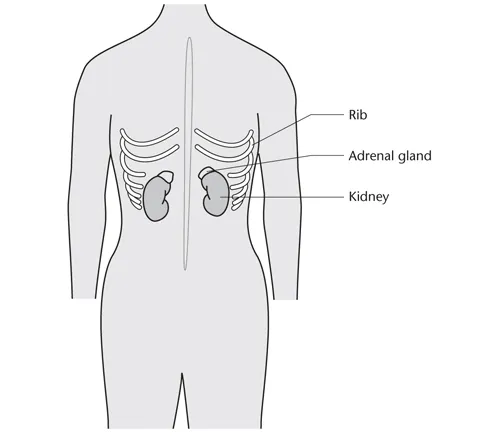
Figure 1 Location of the adrenal glands
The adrenal glands are tiny. Each of them is about the size of a Brazil nut, and weighs only about the same as a teaspoonful of sugar (5 grams). The important thing to grasp is that they are very much under the control of the ‘unconscious’ part of your brain.
So if you are under stress, or frightened, or simply excited, that part of your brain immediately sends messages to your adrenal glands, telling them to pour out more adrenaline.
Why? Simply because adrenaline prepares the body for urgent action. By getting the heart to beat faster and more strongly, and by opening up the tubes that carry blood to the muscles, adrenaline gets you ready for battle – or perhaps for running away. So, when one of your distant ancestors saw a dangerous animal, like a wild boar or a sabre-toothed tiger, galloping towards him, his adrenals instantly started pouring out adrenaline. Result? Within seconds, his body was ready to take on the savage creature – or else to run like blazes.
The ‘fright, fight, flight’ reaction
This natural outpouring of adrenaline is known as the ‘fright, fight, flight’ reaction, and that sums things up pretty well. Please note that this reaction is not under your conscious influence. So your mind doesn’t say: ‘Oh, let’s do a fright, fight, flight reaction here.’ No, the message to your adrenal glands is sent by quite primitive parts of your brain, over which you have no real control.
Now the adrenaline-induced ‘fright, fight, flight’ reaction is all very well on a battlefield, or if you’re about to run the 100 metres, or if you’re going out to play in a Cup Final. It will instantly get your body ready to deal with all of these situations. But in ordinary day-to-day life, what you do not need is frequent outpourings of adrenaline. After all, if you’re trying to get on with your job, or collect the children from school, or see the bank manager about your overdraft, you don’t require an ‘adrenaline rush’.
What you need is to keep cal...
Table of contents
- Cover
- About the author
- Overcoming common problems series
- Title page
- Copyright
- Table of contents
- Dedication
- Acknowledgements
- Introduction
- 1. It’s not ‘all in the mind’
- 2. Stress
- 3. The various types of stress
- 4. Anxiety
- 5. Worry
- 6. Bodily symptoms
- 7. Medication isn’t the answer
- 8. Lifestyle changes
- 9. Training your mind and body to cope
- 10. Professional help and psychological treatments
- 11. Cognitive Behavioural Therapy (CBT)
- Search items
Trusted by 375,005 students
Access to over 1.5 million titles for a fair monthly price.
Study more efficiently using our study tools.
Frequently asked questions
Yes, you can cancel anytime from the Subscription tab in your account settings on the Perlego website. Your subscription will stay active until the end of your current billing period. Learn how to cancel your subscription
No, books cannot be downloaded as external files, such as PDFs, for use outside of Perlego. However, you can download books within the Perlego app for offline reading on mobile or tablet. Learn how to download books offline
Perlego offers two plans: Essential and Complete
- Essential is ideal for learners and professionals who enjoy exploring a wide range of subjects. Access the Essential Library with 800,000+ trusted titles and best-sellers across business, personal growth, and the humanities. Includes unlimited reading time and Standard Read Aloud voice.
- Complete: Perfect for advanced learners and researchers needing full, unrestricted access. Unlock 1.5M+ books across hundreds of subjects, including academic and specialized titles. The Complete Plan also includes advanced features like Premium Read Aloud and Research Assistant.
We are an online textbook subscription service, where you can get access to an entire online library for less than the price of a single book per month. With over 1.5 million books across 990+ topics, we’ve got you covered! Learn about our mission
Look out for the read-aloud symbol on your next book to see if you can listen to it. The read-aloud tool reads text aloud for you, highlighting the text as it is being read. You can pause it, speed it up and slow it down. Learn more about Read Aloud
Yes! You can use the Perlego app on both iOS and Android devices to read anytime, anywhere — even offline. Perfect for commutes or when you’re on the go.
Please note we cannot support devices running on iOS 13 and Android 7 or earlier. Learn more about using the app
Please note we cannot support devices running on iOS 13 and Android 7 or earlier. Learn more about using the app
Yes, you can access How to Beat Worry and Stress by Dr. David Delvin in PDF and/or ePUB format, as well as other popular books in Personal Development & Mental Health & Wellbeing. We have over 1.5 million books available in our catalogue for you to explore.