Everyone feels anxious from time to time, and worry is a natural part of life. But it is all too common to allow concerns about our health, our security, our relationships or our place in the world to become a negative cycle and a burden. Anxiety gets called GAD when the worry is repetitive, becomes associated with a variety of emotional and physical symptoms, and begins to impact upon our ability to enjoy life. If these problems sound familiar to you, this book will provide you with practical help to deal with and overcome the problem.By picking this book up you've taken the first stride. Now, using the STEP system - a structured, CBT-based approach that delivers both support and proven techniques for beating anxiety - you can begin to transform your daily life. Written by an expert team with many years of clinical experience, this book will help you get a better understanding of your anxiety and what keeps it going, tackle negative thoughts and behaviour, and progress to a healthier, happier outlook - without fear of setbacks or relapse. ABOUT THE SERIES
Everyone feels overwhelmed sometimes. When that happens, you need clarity of thought and practical advice to progress beyond the problem. The How To Deal With series provides structured, CBT-based solutions from health professionals and top experts to help you deal with issues thoroughly, once and for all. Short, easy to read, and very reassuring, these books are your first step on a pathway to a happier future. They are perfect for self-directed use and are designed so that medical professionals can prescribe them to patients.
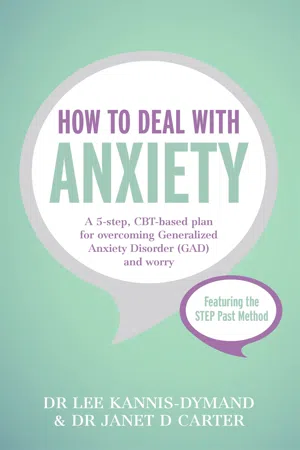
eBook - ePub
How to Deal with Anxiety
A 5-step, CBT-based plan for overcoming generalized anxiety disorder (GAD) and worry
- 256 pages
- English
- ePUB (mobile friendly)
- Available on iOS & Android
eBook - ePub
How to Deal with Anxiety
A 5-step, CBT-based plan for overcoming generalized anxiety disorder (GAD) and worry
About this book
Information
Topic
Personal DevelopmentSubtopic
Abnormal PsychologyPART 1
Support
Understand where you are now and where you want to be
CHAPTER 1
What is anxiety?

Overview
While people experience anxiety in individual ways, there are common features of anxiety. In this chapter we will:
• consider what anxiety is
• look at the way anxiety is typically experienced
• work out what specifically causes you to feel anxiety; once you understand this, you can target the anxiety effectively.
There are two worksheets in this chapter: one to help you to identify how anxiety affects you personally and where your anxiety problems may have come from; and one to help you consider the benefits of tackling your anxiety.
What is anxiety?
Anxiety may mean different things to different people in terms of how they feel it, show it and manage it. Anxiety can be distressing and disabling. Before tackling your anxiety, we need to help you to understand it as much as possible. This helps you to know what to do with your anxiety so you experience it less often. We would like to empower you to feel less threatened by your anxiety too.
As you read through this book and put into practice the strategies to reduce your anxiety, it is important to bear in mind that anxiety is experienced by all of us to some degree. Many people, at some point in their life, may battle overwhelming anxiety or even develop an anxiety disorder (see also Chapter 2). Briefly, an anxiety disorder occurs when anxiety becomes overpowering, persistent, causes the person ongoing distress and starts to affect their day-to-day life. There are various anxiety disorders and they are varied in their nature, but they have some common features and symptoms, such as:
• beliefs that something bad will happen in the future or in certain situations
• constant worrying or anxious thoughts that can be hard to control
• physical feelings of anxiety, like an increased heart rate, feeling shaky, feeling panicky, feeling hot, getting a churning stomach, or muscle tension
• feeling fearful, nervous, and anxious
• avoiding any things or situations that are believed to trigger anxiety or make it worse.
Anxiety problems and disorders are common. The current worldwide occurrence for anxiety disorders is 7.3 per cent of people, suggesting that one person in every 14 around the globe has an anxiety disorder at any one point in time. It is estimated that 11–22 per cent of the world’s population will suffer with an anxiety disorder in any one-year period (Bromet et al., 2011; Baxter et al., 2013); that’s up to 1 in 5 people. Given the high rates of anxiety experienced worldwide, it is not surprising that you or people you know are struggling with anxiety problems.
Having anxiety problems does not mean you are abnormal or weak, especially given how common anxiety is. Many people, including some well-known individuals, have suffered with problematic anxiety; examples include the singers Adele, Robbie Williams and Justin Timberlake, the actors Jennifer Lawrence, Johnny Depp and Scarlett Johansson, and sports people such as the footballer David Beckham, NFL player Ricky Williams, former Irish rugby player Alan Quinlan and former All Blacks player John Kirwan.
So having excessive anxiety does not mean you are abnormal or a failure; it just means that for you a number of factors in life have contributed to anxiety developing into a problem. It is the excessive anxiety that is the problem, not you!
Strange though it may seem, anxiety can be useful at times. To understand this we have to go back to the earliest periods in the history of the human species. When we were often exposed and vulnerable in the wild outdoors, a key to survival and protecting ourselves from harm was being able to respond quickly to threat. This is where anxiety comes in; basically, anxiety gets us moving quickly, fleeing from whatever is threatening us, or it prepares us to fight the threat. Sometimes, anxiety may lead to people feeling so overwhelmed that they freeze, much like a deer that has been stalked by a tiger will freeze to remain undetected. This is often referred to as the flight, fight or freeze response. It is unlikely that humans would have survived the dangers of the wild if we had not had this response. Remaining relaxed and not responding in ways that saved ourselves would have led to our species being wiped out.
Despite the millenia since, our bodies are still wired to react to threat. We still have the flight, fight or freeze response that goes hand in hand with anxiety. This can be valuable now too, for example if you are driving and another car pulls out in front of you, or if you have a child who is pulling something off a high shelf that may fall on top of them. In these situations, we react quickly because of the flight, fight or freeze response and because of anxiety. In these types of situations our anxiety is adaptive and protective. However, sometimes our anxiety occurs at other times and is out of context or it appears ‘out of the blue’ which is unhelpful and makes us feel distressed or apprehensive.
How is anxiety different from fear?
Often the words ‘fear’ and ‘anxiety’ are used interchangeably and this can create confusion. Researchers of emotions have reported that anxiety and fear are different but overlapping states (Sylvers et al., 2011). Two well-known researchers in the field of anxiety and the treatment of anxiety disorders, David A. Clark and Aaron Beck (2011), noted that fear is a basic and automatic judgment of threat or danger and is the central part of anxiety disorders. In contrast, they noted that anxiety is a more lasting condition of threat or apprehension that involves fear but also beliefs about things or events being uncontrollable or uncertain. They added that the person with anxiety believes they are vulnerable or helpless. Therefore, fear is the main emotion we feel but anxiety is the continuous state of being in ‘threat mode’ and can involve emotions such as fear but also physical reactions, like an increased heart rate, and responses or behaviours aimed at protecting ourselves or avoiding the thing we think is dangerous.
How do we experience anxiety?
Anxiety can be experienced in many ways. There are four components of anxiety reactions: our thinking, our emotions, our physical responses and our behaviour.
Our thinking
Our thoughts or thinking, often referred to in psychology as cognitive processes, are a key part of our anxiety response. Thoughts or beliefs related to feeling threatened in some way are the core feature in anxiety. Often if we have experienced anxiety a few times we may start to believe we are more vulnerable to harm. These beliefs about threat, and possibly our inability to manage anxiety, means that our thinking can become biased so that we might read danger into situations that may not be dangerous. Some examples of anxious thinking are: ‘I won’t cope’; ‘Something bad is going to happen to me’; or ‘No one will help me’. Also, our thinking can occur in the form of worry about danger or harm. Worry is a seemingly endless chain of ongoing and repetitive anxious thoughts that something awful or serious may happen. Worry is often experienced as ‘What if …?’ thoughts, such as ‘What if I can’t cope?’, ‘What if I fail?’, or ‘What if my child gets abducted?’. We might also experience our thoughts in the form of distressing pictures or images in our mind, as if an film projector in our head is showing our worst fears on the screen.
Our emotions
Anxiety itself can be an emotion. However, when we are anxious, we may feel other emotions or feelings too, such as fear, nervousness or apprehension. We may feel embarrassed about getting anxious. We can also feel frustrated, for example if we are fed up with feeling anxious or if our anxiety is preve...
Table of contents
- Cover
- Title
- Contents
- Acknowledgments
- Introduction
- Part 1 Support
- Part 2 Tackle
- Part 3 Escape
- Part 4 Practice
- Part 5 Progress
- Epilogue
- References
- Quiz answers
- Copyright
Trusted by 375,005 students
Access to over 1.5 million titles for a fair monthly price.
Study more efficiently using our study tools.
Frequently asked questions
Yes, you can cancel anytime from the Subscription tab in your account settings on the Perlego website. Your subscription will stay active until the end of your current billing period. Learn how to cancel your subscription
No, books cannot be downloaded as external files, such as PDFs, for use outside of Perlego. However, you can download books within the Perlego app for offline reading on mobile or tablet. Learn how to download books offline
Perlego offers two plans: Essential and Complete
- Essential is ideal for learners and professionals who enjoy exploring a wide range of subjects. Access the Essential Library with 800,000+ trusted titles and best-sellers across business, personal growth, and the humanities. Includes unlimited reading time and Standard Read Aloud voice.
- Complete: Perfect for advanced learners and researchers needing full, unrestricted access. Unlock 1.5M+ books across hundreds of subjects, including academic and specialized titles. The Complete Plan also includes advanced features like Premium Read Aloud and Research Assistant.
We are an online textbook subscription service, where you can get access to an entire online library for less than the price of a single book per month. With over 1.5 million books across 990+ topics, we’ve got you covered! Learn about our mission
Look out for the read-aloud symbol on your next book to see if you can listen to it. The read-aloud tool reads text aloud for you, highlighting the text as it is being read. You can pause it, speed it up and slow it down. Learn more about Read Aloud
Yes! You can use the Perlego app on both iOS and Android devices to read anytime, anywhere — even offline. Perfect for commutes or when you’re on the go.
Please note we cannot support devices running on iOS 13 and Android 7 or earlier. Learn more about using the app
Please note we cannot support devices running on iOS 13 and Android 7 or earlier. Learn more about using the app
Yes, you can access How to Deal with Anxiety by Lee Kannis-Dymand,Janet D Carter in PDF and/or ePUB format, as well as other popular books in Personal Development & Abnormal Psychology. We have over 1.5 million books available in our catalogue for you to explore.