OCD, or obsessive compulsive disorder, is a common and difficult condition characterised by intrusive thoughts which produce worry and the compulsive desire to carry out repetitive behaviours aimed at reducing anxiety. OCD symptoms can range from mild to severe, and can really impact upon our mental health and ability to enjoy life. Recovery from OCD is possible, however.By picking this book up you've taken the first stride. Now, using the STEP system - a structured, CBT-based approach that delivers both support and proven techniques for combating obsessive thoughts - you can begin to transform your daily life. Written by an expert author with many years of clinical experience, this book will help you get a better understanding of your OCD, take practical steps to progress to a healthier, happier outlook - without fear of setbacks or relapse. ABOUT THE SERIES
Everyone feels overwhelmed sometimes. When that happens, you need clarity of thought and practical advice to progress beyond the problem. The How To Deal With series provides structured, CBT-based solutions from health professionals and top experts to help you deal with issues thoroughly, once and for all. Short, easy to read, and very reassuring, these books are your first step on a pathway to a happier future. They are perfect for self-directed use and are designed so that medical professionals can prescribe them to patients.
eBook - ePub
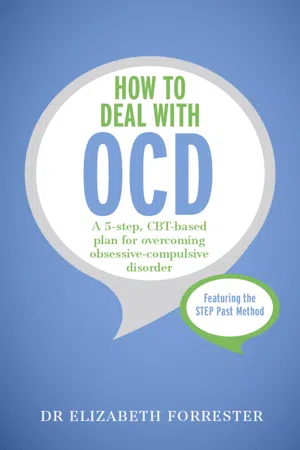
How to Deal with OCD
A 5-step, CBT-based plan for overcoming obsessive-compulsive disorder
- 256 pages
- English
- ePUB (mobile friendly)
- Available on iOS & Android
eBook - ePub
How to Deal with OCD
A 5-step, CBT-based plan for overcoming obsessive-compulsive disorder
About this book
Information
PART 1
Support
Understand where you are now and where you want to be
CHAPTER 1
What is OCD?

Overview
Obsessive–compulsive, obsessional, OCD. There’s a bit of confusion about what it really is. In this chapter we will:
• learn what OCD is
• recognize the difference between obsessions and compulsions
• understand why interference and distress is key to diagnosis.
In recent times, the term OCD has almost become an everyday expression. Someone who likes to keep their home clean and tidy may excuse themselves as being ‘a little bit OCD’. The ardent fan that has been to see Les Miserables more than 50 times may be described as ‘obsessed’.
It is even seen as a positive attribute, something to strive for – to be obsessed with work is valued by many as a sign of someone conscientious and successful. Even the media messages drummed into us every day insist that we can’t be too thin, too rich, or have too flashy a car. But in these examples, the person gets pleasure or satisfaction out of doing these particular things. To claim to be obsessed with something means we like or love something very much.
Yet anyone who suffers from OCD would hardly say they get pleasure from the ideas that come into their minds or the things they have to do. It’s far more likely that they feel worried and upset, constantly bothered by the things they have to do in an attempt to feel less worried.
It’s interesting to note how advertisers prey on our anxieties too: we can’t be too clean or too careful. Even if OCD isn’t a problem for us, they often succeed in making us worry … and so we buy their products to ensure our homes are clean, our hands are germ-free, or our families protected in the event of accidents or illness. We have managed to reduce that worry. An idea, a scary consequence, and a means of preventing it from happening. Even if we don’t wholeheartedly believe it. Fingers crossed, just in case …
What is OCD?
Already we’re beginning to see something of a pattern building up. It helps explain how we can all get the kinds of worries that we might find in obsessive–compulsive disorder. Nevertheless, it isn’t only that these kinds of thoughts or worries occur to us. Or that we foresee some kinds of disastrous consequences which make us feel anxious enough to try to prevent them happening. Or even that we take some kind of action in an attempt to prevent this scary outcome. The clincher is how much these things interfere in our lives – how distressing we find them and how much they interfere with our daily routines.
So to meet criteria for the diagnosis of OCD there are three key features:
• obsessions
• compulsions
• interference or distress.
Even if you already feel certain that OCD is the problem, let’s look at these in more detail. After all, knowledge is power and the better we can understand a problem the better equipped we are to deal with it.
What are obsessions?
One of the key features of obsessive–compulsive disorder is being bothered by obsessions: persistent thoughts or ideas that seem to just pop into our heads again and again, even though we’re not trying to have them. They’re sometimes called intrusive thoughts because they intrude. In other words, they interrupt us when we’re busy thinking or doing something else.
Obsessional thoughts can occur to us in different ways:
• as words, like a statement about something or speech in our head
• as a feeling of doubt
• as an image – a picture in our mind
• as an urge to do something.
To keep it simple, let’s just call them all ‘thoughts’ for the moment. Intrusive thoughts can feel quite different from other thoughts because they seem so difficult to ignore and get in the way of what we’re doing. They can also seem different to us since the content of the thoughts – what the thought is about – feels unacceptable to us in certain ways.
Obsessional thoughts often seem to go against the way we see ourselves. It may feel wrong to have them. Perhaps they seem quite shocking and disgusting because they aren’t the kinds of things we would usually choose to think about, or they represent things we would never dream of doing. Although they might be triggered by a particular situation we find ourselves in, they can equally just pop into our heads at any time for no particular reason. Here are some examples.
Thoughts
• I could give my family food poisoning.
• It’s not safe to leave the kettle plugged in.
• Magpies bring bad luck.
Doubts
• What if I’ve committed a crime and can’t remember?
• What if the binman cuts himself on that broken glass I put in the dustbin?
• Did I switch the iron off?
Images
• Attacking my partner with a knife.
• My baby in hospital because she’d eaten a raisin off the floor.
• Microscope view of germs covering the toilet.
Urges
• To touch a stranger inappropriately.
• To drive into oncoming traffic.
• To steal something.
These are only a few examples. It would be impossible to list every possible obsessional thought that someone might have. In the following chapters, there will be many more examples of different kinds of obsessional thoughts. You may have already found that some of the examples are similar to the kinds of thoughts you have had, although it’s likely that there are some differences too. The exact content of obsessional thoughts are as individual as you are, but they still fit into the same categories of thoughts, doubts, images and urges and can be understood in the same way.
What are compulsions?
Compulsions or compulsive behaviours are things that you feel you have to do and cannot resist doing. Quite often, compulsions are actions you feel you have to repeat doing, like washing your hands again and again, or having to check something several times to make sure you’ve done it right in order to relieve the anxiety experienced following an intrusive thought.
Compulsive behaviours are linked to obsessive thoughts in a meaningful way. If we regard obsessive thoughts as fears or worries, compulsions are actions we might take to prevent the fear or worry coming true. So if, for example, you experience a thought such as ‘I wonder if I closed the window?’ it is likely that you would feel compelled to check to see if you had closed it. These visible, observable behaviours are sometimes referred to as overt or physical compulsions.
While we often consider a behaviour to be something that we can see – like checking the window or washing hands – compulsive behaviours also refer to other things we feel we have to do in response to an intrusive thought that are not visible to others. The kinds of behaviours that other people can’t see because they are things we do in our head are sometimes referred to as covert or mental compulsions. It’s easy to overlook them since they seem such an ordinary part of our internal life. Here are some examples.
Overt compulsions:
• following a strict routine in the shower
• keeping knives and sharp objects out of sight
• touching, tapping or having to repeat an action.
Covert compulsions:
• trying not to have a particular thought
• trying to decide whether or not something is clean enough
• thinking a ‘good’ thought after a ‘bad’ one.
Compulsions or compulsive behaviours are sometimes referred to as neutralizing. ‘Neutralize’ means to cancel out or (especially in this setting) to make something safe.
As with the list of obsessions, these are only a few examples because we will discuss different types of compulsions in more detail later.
The role of interference and distress
Although the presence of obsessive thoughts or behaviours we feel compelled to carry out are important features of OCD, a further key consideration is that the thoughts and/or behaviours cause significant interference in everyday activities or cause a lot of distress. It’s likely that if you have OCD both of these things are true. In themselves, you might find the thoughts very upsetting but additionally the things you feel compelled to do might also be distressing, such as having to wash your hands so vigorously that they become really sore and chapped.
A ...
Table of contents
- Cover
- Title
- Contents
- Acknowledgements
- Foreword
- Introduction
- Part 1: Support
- Part 2: Tackle
- Part 3: Escape
- Part 4: Practice
- Part 5: Progress
- Resources
- References
- Copyright
Trusted by 375,005 students
Access to over 1.5 million titles for a fair monthly price.
Study more efficiently using our study tools.
Frequently asked questions
Yes, you can cancel anytime from the Subscription tab in your account settings on the Perlego website. Your subscription will stay active until the end of your current billing period. Learn how to cancel your subscription
No, books cannot be downloaded as external files, such as PDFs, for use outside of Perlego. However, you can download books within the Perlego app for offline reading on mobile or tablet. Learn how to download books offline
Perlego offers two plans: Essential and Complete
- Essential is ideal for learners and professionals who enjoy exploring a wide range of subjects. Access the Essential Library with 800,000+ trusted titles and best-sellers across business, personal growth, and the humanities. Includes unlimited reading time and Standard Read Aloud voice.
- Complete: Perfect for advanced learners and researchers needing full, unrestricted access. Unlock 1.5M+ books across hundreds of subjects, including academic and specialized titles. The Complete Plan also includes advanced features like Premium Read Aloud and Research Assistant.
We are an online textbook subscription service, where you can get access to an entire online library for less than the price of a single book per month. With over 1.5 million books across 990+ topics, we’ve got you covered! Learn about our mission
Look out for the read-aloud symbol on your next book to see if you can listen to it. The read-aloud tool reads text aloud for you, highlighting the text as it is being read. You can pause it, speed it up and slow it down. Learn more about Read Aloud
Yes! You can use the Perlego app on both iOS and Android devices to read anytime, anywhere — even offline. Perfect for commutes or when you’re on the go.
Please note we cannot support devices running on iOS 13 and Android 7 or earlier. Learn more about using the app
Please note we cannot support devices running on iOS 13 and Android 7 or earlier. Learn more about using the app
Yes, you can access How to Deal with OCD by Elizabeth Forrester in PDF and/or ePUB format, as well as other popular books in Personal Development & Cognitive Behavioral Therapy (CBT). We have over 1.5 million books available in our catalogue for you to explore.