The highly practical lessons in How to Get to Great Ideas are based on neuroscience, psychology and sociology. Written by former advertising creative director Dave Birss, this book offers a brilliant new system for conceiving original and valuable ideas. It looks at how to frame a problem, how to push your thinking, how to sell the idea, how to build support for it and how to inspire others to have great ideas. It proves that any organization - and any individual or department within an organization - can create a fertile environment for ideas. Combining a practical research-based system with fascinating insights and inspiring and humorous writing, the book also includes the problem-solving system RIGHT Thinking. This is a tool which enables a more effective way to generate more effective ideas, and is one that anyone can use to transform themselves or their business. Training on this system is also available in person from the author. And will be released soon as an online course.
I’d like to start with a confession: I’m embarrassed about the subject matter of this book. The main word that will be used to identify the topic that it covers is “creativity,” and—as you’ll see—I think the word causes more problems than it solves. For twenty years of my life I had the word “creative” in my job title, and now it causes my cheeks to flush and elicits an embarrassed cough. I’m mortified when I get introduced as “the creative guy.” I’m no more creative than anyone else. It’s just that, perhaps, I feel more comfortable expressing my ideas.
At one point I considered writing this book with the word
censored throughout. That’s how much I dislike it. Instead of focusing on creativity, I prefer to focus on ideas. They are the end result, after all. Creativity is the path to get to them. This book aims to clarify how to get to that end result more effectively.
But I guess I’m stuck with the “c” word. So instead of attempting to discard it, I’ll do my best to clarify it.
CREATIVITY IS A PROBLEM
Let me explain myself here. I don’t hate the creative act—quite the opposite. But I do feel uncomfortable with the word. It carries unhelpful baggage and leads to a myriad of misunderstandings.
Over the last few years, I’ve worked a lot with businesses to help them produce more effective ideas, and I’ve found that the word “creativity” is polarizing. Some people find it exciting; others will shake their heads and say: “Not me! I’m not creative!” When these naysayers opt out of any activity that’s labeled as “creative,” they are denying us access to their uniquely valuable ideas, perspectives, and skills.
So why is the word “creativity” nectar to some and poison to others?
SOME SIMPLE MISUNDERSTANDINGS
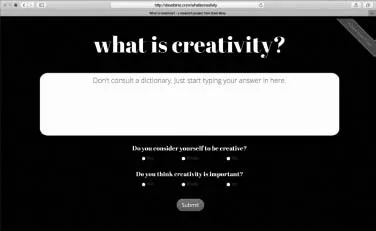
I came to the conclusion that most people don’t know what creativity actually means. My career has included time working in the advertising, broadcast, publishing, and music industries, and I came to suspect that my former colleagues misunderstood it as badly as anyone else, so I ran an online study to find out. I set up a simple webpage with the headline: “What is creativity?”, and below it a box inviting people to tell me their own personal definition without consulting a dictionary. I got 473 responses. The only consistent factor was the inconsistency of the answers.
The webpage I created to find out what people think “creativity” means
The responses split into a number of categories:
UNIMAGINATIVE CLICHÉS
Sadly, the most common answer was “Thinking outside the box.” The concept behind this reply isn’t wrong (I’ll actually be showing you that it’s thinking outside of a circle), but the act of using a cliché betrays both a lack of thinking and—worse—a lack of understanding. My heart sank every time I saw this stock response.
FLUFFY NONSENSE
Some of the most eye-rolling responses were “The soul manifesting itself into the world” and “Saying whatever one’s heart feels like it needs to say.” This kind of pseudo-spiritual approach adds mystique and fogginess where I believe we need clarity.
BRUTAL HONESTY
I laughed out loud when I received an entry that read “Creativity is the word artists use to justify their existence in a capitalist society.” But it highlights an issue that needs to be dealt with. Many people confuse art and creativity. Any belief that art is pretentious or highfalutin colors the holder’s opinion of any other form of creativity.
SPECIAL ABILITIES
Equally harmful is the belief that creativity is the exclusive domain of specially gifted people. Responses included “Creativity is a human character trait,” “A natural ability to conceive of and execute an original and inspiring idea,” and “It’s the ability to make shit up and come up with surprising solutions.” Some people may have a more natural aptitude than others to express ideas, but to limit creativity to certain blessed individuals devalues the thinking of others who don’t fit into a “creative” mold.
POETRY
Some responses were wonderfully imaginative. These included suggestions like “The unfettered freedom to explore idea space,” “The jump from the obvious to the wondrous,” and my personal favorite: “It’s unicorns farting out rainbows.” They’re lovely, witty, poetic, but not particularly useful.
My little study yielded more unhelpful answers than helpful ones. It confirmed my suspicion that the word creativity was broken, and it led me on a journey that resulted in the book you now hold in your hands.
Most people don’t know what creativity actually means
This book aims to offer a clearer understanding of creativity. It explains how ideas made us the species we are, why some people are better at coming up with ideas than others, and shows you a system that helps anyone have better ideas.
But before we set to work on these new thoughts, we need to get rid of some old ones.
LINGERING MISUNDERSTANDINGS
I don’t blame anyone for their misunderstandings about creativity. Many of these mistaken beliefs are historic hangovers dating back hundreds or even thousands of years. It seems that we’ve never had a good understanding of this topic. Here are my top ten offenders.
MYTH #1: IT’S A SPIRITUAL THING
The ancient Greeks and Romans believed the inspiration for creative acts could be attributed to one of nine goddesses.1 These mythical figures each had a separate specialism; at the time, this included poetry, history, music, song, dance, comedy, and astronomy (yes, that’s right, astronomy). The goddesses would whisper their genius into the lucky ears of humans because the dumb beasts were not capable of coming up with anything of value themselves.
It’s totally understandable how this kind of thinking came around. Ideas will sometimes strike us unexpectedly when we’re not actively focused on the task. And these ideas will often seem pretty well thought through. In a world dominated by benevolent and terrible gods, this concept of inspiration makes perfect sense. So the phenomenon was explained using the understandings of the age.
We’ve got fMRI scanners now. And the general consensus is that these goddesses don’t exist.
MYTH #2: YOU NEED TO BE A GENIUS
Many of the most famous creative minds through the ages are seen as being outstandingly intelligent. People like Albert Einstein, Archimedes, Isaac Newton, Da Vinci, and even Steve Jobs are seen as possessing unusually high intelligence. These individuals may all have had higher than average IQs but—without any disrespect to them—I don’t think that’s what led to their amazing ideas.
Intelligence only helps your creative thinking up to a point.2 And that point is just above the ability not to poke yourself in the eye with a fork when you’re eating. However, we can all develop traits that are far more powerful than a black belt in cleverness.
We can all develop traits that are far more powerful than a black belt in cleverness
MYTH #3: CREATIVITY EQUALS ART
People often confuse creativity and art. They think because they feel alienated by most of the work in an art gallery and have never had the desire to learn the saxophone or slap some paint on a canvas, that they can’t be creative. But art is only one subset of the far larger world of creativity.
It may be helpful to think of art as the non-practical side of creativity. That’s not intended to devalue it. Art plays an important role in society. It just doesn’t need to fix a problem.
Becoming a great artist often involves spending an obsessive amount of time developing a skill. You don’t need to be an artist to come up with valuable ideas. Creativity is open to everyone.
MYTH #4: EXPERTS COME UP WITH BETTER IDEAS
Education conditions us to believe we need to have all the knowledge before we can do something with it. But that’s just not the case. You do need a certain amount of knowledge to be able to come up with useful ideas, but too much knowledge can work against you.
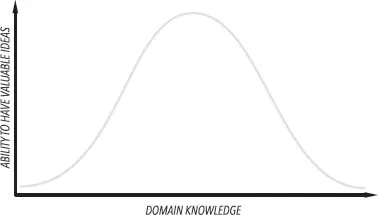
The longer you are part of an organization, an industry or a group of people, the more of this assumed knowledge you adopt. These are the very things that limit your thinking over time. There tends to be a sweet spot where you have enough knowledge to understand the problems but haven’t adopted too many of the limiting assumptions.
I think the ability to have valuable ideas works a bit like this:
Knowledge is useful up to a point and then it starts to hold you back
At the start of the journey, your energy goes into learning. Later on, it needs to go into unlearning. Expertise and experience are wonderful attributes to possess, but inexpertise can be just as valuable.
MYTH #5: YOU’RE AIMING FOR ORIGINALITY
I used to think that real creativity was all about coming up with an idea that no one else had ever come up with in the history of the planet Earth. But aiming for true originality is setting yourself an unattainable goal. If you actually do manage to achieve it, no one will have any reference for how to judge it. You’ll be misunderstood and your idea will be rejected.
Most ideas are fresh combinations of existing ideas. Combine a mobile phone with a computer and you get a smartphone. Combine a vacuum cleaner with the airflow system of a paint booth and you get a Dyson. Combine the film Jaws with Star Wars and you get the Alien franchise (it was allegedly sold into the studio using the simple description “Jaws in space”).3 You would still describe all of these things as creative or innovative but—as you can see—none of them can be described as truly original. And I’ve not yet come across an idea that legitimately can be.
MYTH #6: YOU NEED TO REMOVE ALL CONSTRAINTS
The general belief is that you need to remove any limitations and just let your thinking go wild. That sounds nice, but it doesn’t help people to come up with great ideas.
Great ideas very often come from dealing with restrictions. Constraints give you direction and focus. Some of the work I’m proudest of has come from overcoming unreasonable budgets, impossible timings, or other initially frustrating limitations. And I’m not alone in this.
When Gene Roddenberry was creating Star Trek in the 1960s, he faced a serious dilemma: it just wasn’t practically possible for the Starship Enterprise to land on a new planet every week.4 The scale of the spaceship would make it hugely difficult to film, and in any case the budget would never stretch to that kind of set build. Working within a very tight production budget, they had to find a practical way to land the crew anywhere on the planet. The solution he came up with was just to “beam them down.” The field of teleportation is now being researched at universities all over the world. In 2017, Chinese researchers succeeded in teleporting a photon 300 miles up to a satellite using quantum entanglement.5 What started as an imaginative science fiction solution is quickly becoming science fact.
MYTH #7: GREAT IDEAS SELL THEMSELVES
Howard H. Aiken, one of IBM’s most pioneering engineers, once stated that you shouldn’t worry about anyone stealing your ideas, because if it’s...
Table of contents
Cover
Title Page
Copyright
Dedication
Contents
Author’s note
Part 1: Reimagining Creativity
Part 2: Creative Structure
Part 3: Individual Creativity
Part 4: Corporate Creativity
Introduction
Endnotes
Trusted by 375,005 students
Access to over 1.5 million titles for a fair monthly price.
Study more efficiently using our study tools.
Frequently asked questions
Yes, you can cancel anytime from the Subscription tab in your account settings on the Perlego website. Your subscription will stay active until the end of your current billing period. Learn how to cancel your subscription
No, books cannot be downloaded as external files, such as PDFs, for use outside of Perlego. However, you can download books within the Perlego app for offline reading on mobile or tablet. Learn how to download books offline
Perlego offers two plans: Essential and Complete
Essential is ideal for learners and professionals who enjoy exploring a wide range of subjects. Access the Essential Library with 800,000+ trusted titles and best-sellers across business, personal growth, and the humanities. Includes unlimited reading time and Standard Read Aloud voice.
Complete: Perfect for advanced learners and researchers needing full, unrestricted access. Unlock 1.5M+ books across hundreds of subjects, including academic and specialized titles. The Complete Plan also includes advanced features like Premium Read Aloud and Research Assistant.
Both plans are available with monthly, semester, or annual billing cycles.
We are an online textbook subscription service, where you can get access to an entire online library for less than the price of a single book per month. With over 1.5 million books across 990+ topics, we’ve got you covered! Learn about our mission
Look out for the read-aloud symbol on your next book to see if you can listen to it. The read-aloud tool reads text aloud for you, highlighting the text as it is being read. You can pause it, speed it up and slow it down. Learn more about Read Aloud
Yes! You can use the Perlego app on both iOS and Android devices to read anytime, anywhere — even offline. Perfect for commutes or when you’re on the go. Please note we cannot support devices running on iOS 13 and Android 7 or earlier. Learn more about using the app
Yes, you can access How to Get to Great Ideas by Dave Birss in PDF and/or ePUB format, as well as other popular books in Business & Decision Making. We have over 1.5 million books available in our catalogue for you to explore.