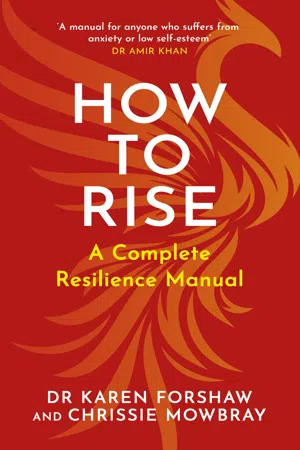
' A wonderful book for anyone with anxiety or low self-esteem ' Dr Amir Khan We all fall over. It's knowing how to rise that matters.Created by healthcare experts with over 45 years' clinical experience between them, How to Rise draws on both spiritual and psychological wisdom to create a Resilience Toolkit which tackles even the most difficult of circumstances. Outlining what a Resilient Mindset looks like, and drawing on years of experience working with some of the most stressed and anxious people in the healthcare industry, Karen Forshaw and Chrissie Mowbray have created a highly effective and potent blend of western therapies and eastern philosophy. Using their unique 'Resilience Gap Analysis Tool', you'll find out how to identify the weak spots in your armour before taking practical action to address areas of need and build your resilience with over 60 'tools' cross-referenced to your personalised Gap Analysis.With dozens of mindfulness, visualisation and other practical exercises all carefully curated to help you build a better mindset, How to Rise is a unique blend of holism and practical techniques with proven outcome. Tried and tested on hundreds of stressed NHS professionals, this is an essential read for anyone struggling with issues related to stress, self-esteem, anxiety or insecurity.
- 256 pages
- English
- ePUB (mobile friendly)
- Available on iOS & Android
eBook - ePub
About this book
Information
Topic
Personal DevelopmentSubtopic
Mental Health & WellbeingPart 1
THEORY
1
What is resilience?
Resilience can go an awful long way.
Eddie ‘the Eagle’ Edwards
Resilience
Resilience (noun): The capacity to recover quickly from difficulties; the ability of a substance or object to spring back into shape.
Resilience is the ability to bounce back when things do not go the way that you had hoped. Being resilient does not magically make our difficulties disappear, but it allows us to see beyond them and get the best outcome from the current situation.
Often, we do not have control over things that happen and we can end up in situations where our ability to cope is sorely tested. When the environment becomes stormy, if our levels of resilience do not respond then we can become swamped.
If we have, at our fingertips, an array of tools and techniques to improve our resilience skills then we survive and, better than that, we thrive.
Resilience is synonymous with buoyancy, staying afloat whatever the condition of the surrounding seas. There is a school of thought that encouraging resilience in people is asking them to put up with toxic environments. We believe, however, that resilient people will go on to create kinder environments.
Many people decide that they are not resilient, and that they are powerless to do anything about it. We need to wake up to the fact that resilience is entirely within our control. This book will help you to do just that. We will help you to become self-aware and expand your toolbox of resilience skills – and you will RISE!
Understanding resilience
Human beings have adapted to live in all parts of the globe in a relatively short space of time. This is a sign of our innate resilience. Our levels of success are a product of our interactions with the environment; adverse events and environmental stressors are weighed against our resilience skills. Building our repertoire of resilience skills tips this scale in our favour, and we flourish.
To develop these skills, we first need to understand the components of resilience. The more we know about these components, the better able we are to make positive changes. In addition, we will discuss the importance of establishing a baseline measurement of resilience – this allows us to monitor our progress as we walk the path of enlightenment.
Resilience has been researched scientifically for decades. Over time it has been classified in different ways. In evaluating that research, we have identified four distinct components: psychological resilience, emotional resilience, physical resilience and relationships.
Psychological resilience
In observational studies of thousands of children, Norman Garmezy1 identified that a child’s ability to thrive was determined by both internal and external factors. He determined that some children flourished despite extreme social deprivation and a significant lack of parental support. He concluded that these children had innate characteristics that helped them thrive. This is ‘resilience’.
Similarly, Emmy Werner2 followed the lives of 698 children on a Hawaiian island. She saw that, despite some of the most adverse early life events, a significant proportion of the children developed into successful adults. A stable positive adult presence was important, but there were children who flourished without this. Those children who thrived despite a lack of early support demonstrated a strong sense of self-awareness. Werner talked about this in terms of the children’s ‘locus of control’. This term, first coined by Julian B. Rotter, describes how much a person believes they are in control of their own life; in other words, their degree of belief in their own ability to change their life rather than being at the mercy of external circumstances.
Those with a strong internal locus of control recognize that they have the power to control their lives via their own responses. Those with a strong external locus of control have given away their power and do not accept responsibility for what happens to them. The locus of control is, in fact, a spectrum and we all sit at some point along it. Our position on this spectrum can vary depending on our circumstances. For example, a traumatic event may lead to it becoming more external. Werner’s study suggests that, the closer one sits to the internal end of the spectrum, the more resilient one is. The fact that this point can move means that it can be consciously changed.
The studies discussed above prove that those who have experienced adverse events in childhood can still be extremely resilient and experience success. A strong internal locus of control can thus make up for adverse events at any age.
To have an external locus of control is to tell yourself that you are powerless; you have no control over what happens in your life. Giving away responsibility for our thoughts and feelings disempowers us and leaves us vulnerable and less resilient.
In contrast, those with a strong internal locus of control recognize and own their own thoughts and feelings. They understand that others do not have the power to affect their emotions unless they choose to let them. If someone is rude, they are rude. We decide how to respond. We can choose whether it affects us or not. No one has the power to make us angry, upset or confrontational – unless we give it to them.
Being self-aware and developing a strong internal locus of control will clearly improve our resilience.
Emotional resilience
How we think or conceptualize things has a great impact on our resilience. Do we think in positive or negative ways? Is our cup half full or half empty?
We have little control over our childhood, our life experiences or our current environmental stressors. We do, however, have the ability to think about them in a different way. We can take control of how we perceive any life event. Any trauma can be seen as an opportunity. At the beginning of the twentieth century, Austrian psychologist Alfred Adler stated: ‘We are not determined by our experiences, but by the meaning we give to those experiences.’3
More recently, George Bonanno4 described that while we are all subject to the same evolutionary fight/flight mechanisms that served to protect our ancestors, our responses can be very different. We have the same rush of the stress hormones, adrenaline and cortisol, but some of us perceive events as trauma and others see them as opportunities for growth.
What they are both saying is that we can choose how an event affects us. We can give our power to it, calling it a trauma and feel all the negative emotions that go along with that. Alternatively, we can search for a positive aspect in the event. This might be an opportunity to right a wrong, a chance to learn a skill that will prevent a similar experience, or an opening to move towards a better future.
It is very important to stress that this is not about asking the sufferer of the trauma to take responsibility for what happened, nor is it condoning the action. This is about allowing the sufferer to take back their power in order to effect recovery.
Every event is an opportunity to learn about the Self and hone our resilience skills. We must learn to give meaning to adverse events in order to see them as opportunities. Choosing to see the positives in any given situation makes us more resilient and guides us safely through life.
Barbara Fredrickson’s work further supports this. In her book Positivity,5 the American psychologist describes how people with a positivity ratio of 3:1 (those who have three positive thoughts and feelings for each negative thought, over a period of time) ‘flourish’, while those who have a lower ratio ‘languish’. Her ‘broaden and build’ model explores how the effects of positive thoughts and feelings may not be felt as instantly as negative ones, but are every bit as powerful. If you drop a vase, there is an instant effect: the event shocks you and immediate negative thinking follows, for example ‘I’m so clumsy’ or ‘I’m so stupid’.
Positive actions, such as taking flowers to a sick relative, give a less intense feeling. The positive effects, however, accumulate over time. Fredrickson shows us that ‘broadening’ our self-awareness, encouraging new ideas and motivating us to try new things allow us to ‘build’ and develop skills, networks and supports, thereby improving our resilience.
Thinking in a positive way is something that we can learn to do.
Physical resilience
As healthcare professionals, we know that our overall resilience is affected by our health. In turn, our physical resilience is affected by the lifestyle choices we make. Adequate sleep, regular physical activity and a healthy diet have all been proven to contribute significantly to our wellbeing.
Poor sleep is a recognized symptom of anxiety and depression. Studies have also shown that poor sleep can contribute to the development of these conditions.
A lack of good-quality sleep has negative physical and psychological effects. Physically, our immune system is impaired, our blood pressure goes up, as does our risk of developing cardiovascular disease and diabetes. Psychologically, our memory, reaction time and performance are impaired and, as stated above, our risk of anxiety and depression are increased.6
The amygdala is the part of our brain that controls the fight/flight response caused by negative stimuli. When we are sleep deprived, our amygdala becomes overactive – initiating the fight/flight response following lower levels of stimulus, releasing stress hormones into our bodies. All of these factors impact on our ability to think positively and, therefore, affect our level of resilience.
Physical activity is known to disperse cortisol – a stress hormone. It also releases endorphins in our brain that make us feel happier and more positive. A 2015 study showed that regular exercise protected against the negative emotions common after an adverse event.7
Our diet can have profound effects on our physical and mental health. Direct effects include the irritability we feel from yo-yoing blood sugar levels (caused by eating high-sugar foods) and poor concentration caused by dehydration. Vitamins, minerals and proteins are essential for healthy cells. Caffeine is a stimulant, and too much can impair our functioning. Alcohol is an anxiolytic and is commonly used to wind down at the end of a hard day. Some may even think of it as one of their current resilience tools; however, it is a maladapted coping mechanism. Regular excessive alcohol consumption actually causes depression and impacts on the quality of our sleep.
The indirect effects of a poor diet include problems with body image, which commonly impact on feelings of self-worth and self-esteem. This moves us towards the external locus of control, which we know reduces our resilience.
Relationships and resilience
Hindu swamis, whose goal is spiritual transcendence, often live alone as hermits, cut off from the rest of the world. Ultimately, true resilience is being independent of anyone and unaffected by anything. For most of us, however, this is not real life. Human beings exist in multiple social groups, and we are supported by those networks. There is a difference between someone who chooses to be alone because they do not need connection, and someone who is lonely because they cannot make connections or they perceive that they need more connections than they currently have.
To be truly resilient, we should aim to detach from the need for connection but possess the skills required to connect should the need arise.
Our childhood, our life experiences and our social networks all contribute to our resilience. Our early life experiences are clearly important; a positive, loving adult role model gives a child the first building blocks of resilience. This was observed by Werner and her team in Hawaii. The adult did not need to be a parent – a sibling, a teacher, a coach or minister served in the same way.
Human cooperation first developed in our ancestors as a protective mechanism. In the harsh existence of primitive humans, anything that improved survival was worth cultivating. Social interaction was a big part of this. For modern humans the threats to survival are very different, but the need to make connections has remained and there are benefits to social networks. Research by Teo et al.8 has shown that poor-quality social relationships are a risk factor for developing depression. Human studies have shown that people with poor social support have higher levels of stress hormones and they release these hormones to smaller stimuli than those with good relationships.
We can work to build our networks and make connections, thinking of these as our safety net, there to protect and support us when things go wrong. Fredrickson’s broaden and build model, described above, shows how positivity helps develop these networks and how these networks support and help us to flourish.
Our social networks include all aspects of our life: our homes, places of education and our place of work. Talking to people who we know care about us is an important coping mechanism, and the ability to communicate with others is a resilience tool.
The number of relationships required to support one’s resilience will be entirely individual. The key is to have people we can trust who provide a warm, loving environment when we need it. The ability to build these relationships is a skill that can be learned.
To summarize, our resilience is made up of multiple factors. We have varying degrees of influence over these factors. We can work towards moving our locus of control to be internal, we can develop our self-awareness, reframing our thoughts in a positive way, and we can make healthy lifestyle choices. We can acknowledge our early life experiences without letting them define us, and we can build our social networks to support us.
Throughout this b...
Table of contents
- Cover
- Title
- Contents
- About the authors
- Foreword
- Introduction
- Part 1: Theory
- Part 2: Core Skills
- Part 3: The Resilience Toolbox
- Notes
- Copyright
Trusted by 375,005 students
Access to over 1.5 million titles for a fair monthly price.
Study more efficiently using our study tools.
Frequently asked questions
Yes, you can cancel anytime from the Subscription tab in your account settings on the Perlego website. Your subscription will stay active until the end of your current billing period. Learn how to cancel your subscription
No, books cannot be downloaded as external files, such as PDFs, for use outside of Perlego. However, you can download books within the Perlego app for offline reading on mobile or tablet. Learn how to download books offline
Perlego offers two plans: Essential and Complete
- Essential is ideal for learners and professionals who enjoy exploring a wide range of subjects. Access the Essential Library with 800,000+ trusted titles and best-sellers across business, personal growth, and the humanities. Includes unlimited reading time and Standard Read Aloud voice.
- Complete: Perfect for advanced learners and researchers needing full, unrestricted access. Unlock 1.5M+ books across hundreds of subjects, including academic and specialized titles. The Complete Plan also includes advanced features like Premium Read Aloud and Research Assistant.
We are an online textbook subscription service, where you can get access to an entire online library for less than the price of a single book per month. With over 1.5 million books across 990+ topics, we’ve got you covered! Learn about our mission
Look out for the read-aloud symbol on your next book to see if you can listen to it. The read-aloud tool reads text aloud for you, highlighting the text as it is being read. You can pause it, speed it up and slow it down. Learn more about Read Aloud
Yes! You can use the Perlego app on both iOS and Android devices to read anytime, anywhere — even offline. Perfect for commutes or when you’re on the go.
Please note we cannot support devices running on iOS 13 and Android 7 or earlier. Learn more about using the app
Please note we cannot support devices running on iOS 13 and Android 7 or earlier. Learn more about using the app
Yes, you can access How to Rise by Chrissie Mowbray,Karen Forshaw in PDF and/or ePUB format, as well as other popular books in Personal Development & Mental Health & Wellbeing. We have over 1.5 million books available in our catalogue for you to explore.