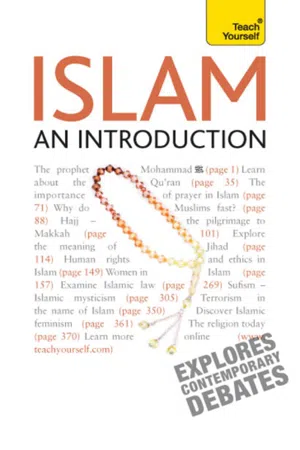
Do you want to learn more about this fascinating and complex world religion? Islam - an Introduction is a complete guide to the history, beliefs, and practicalities of this often misunderstood faith. Fully updated, it also addresses the key questions currently surrounding the religion, including women's rights, terrorism and fundamentalism, to give you a better understanding of Islam in the world today.NOT GOT MUCH TIME?One, five and ten-minute introductions to key principles to get you started. AUTHOR INSIGHTSLots of instant help with common problems and quick tips for success, based on the author's many years of experience. TEST YOURSELFTests in the book and online to keep track of your progress. EXTEND YOUR KNOWLEDGEExtra online articles at www.teachyourself.com to give you a richer understanding of psychology. FIVE THINGS TO REMEMBERQuick refreshers to help you remember the key facts. TRY THISInnovative exercises illustrate what you've learnt and how to use it.
descendants and the Umayyads, and its consequences.
The life of the blessed Prophet Muhammad
HIS BIRTH AND EARLY LIFE
The Prophet Muhammad
was a direct descendant of the Biblical patriarch Ibrahim/Abraham
, through his eldest son Isma’il
. He was born in Makkah, Saudi Arabia, in around 570 CE, a member of the Hashim clan of the Quraysh tribe. His father, Abdullah, a merchant, died before he was born, and his mother, Amina, died when he was only six years old, leaving him an orphan. He was reared first by his grandfather, Abd al-Muttalib, a man famous for his saintly life, and then by his merchant uncle, Abu Talib. The only person with him from his first breath to his last was his Abyssinian nurse Barakah (Umm Ayman), who he always called ‘Mother’.
Insight
Abdu’l Muttalib was the revered Guardian of the Ka’bah, a man famous for his visions, absolute faith in God, nobility and courage. He was a hanif, one of those untainted by paganism, who kept to the monotheism of Ibrahim
.
At this time, the people of Arabia were mainly superstitious pagans with a few notable monotheist exceptions, such as Abd al-Muttalib. There were also considerable numbers of Jews and Christians in Arabia, especially on the border with Syria, the north-east, and Yemen. Many Arabs lived nomadic lives on traditionally claimed territories, and there were only a few key cities such as Makkah, Yathrib and Taif. Makkah was a wealthy trading post that also happened to be the most important shrine for the Arab idols.
The cube-shaped Ka’bah temple claimed a very ancient history; the site was said to have been consecrated in the first place by Adam
, the first prophet, and then rebuilt by Ibrahim
and his son Isma’il
(Heb. Abraham, Ishmael). Originally dedicated to the One True God, over the centuries it had been utilized by polytheists and by the time of the Prophet
it was said to have contained 360 statuettes and cult objects to minor deities, including not only the moon-god and other astral ‘deities’, but also icons of the Virgin Mary and Jesus
, and the Prophet Ibrahim
.
Muhammad
grew up a particularly devout and honourable man, a believer in One God, like his grandfather. He worked first as a shepherd, and then as a merchant, working for his uncle, Abu Talib. He became well known and well liked, and earned the nickname ‘al-Amin’ (‘the Trustworthy One’) for his piety, honesty, fair dealing, and practical common sense. He was a founding member of an Order of Chivalry (the Hilf al-Fudul) dedicated to bringing justice and protecting the rights of the poor and weak.
Later, he was employed by a wealthy tradeswoman, Khadijah, who, after a short while, offered herself in marriage to him, although she was in her forties and he was about 25 years old. She had been married twice before and had at least five existing children. Despite the age difference, they were very happily married and had at least six children of their own. Their two sons (Qasim and Abdullah) died as infants, leaving Muhammad
with four daughters – Zaynab, Ruqaiyyah, Umm Kulthum and Fatimah. Only Fatimah survived him, and only by a few months.
He fostered two boys, his cousin Ali from the age of four, and a slave Zayd ibn Harithah from the age of 14. In due course Ali married Fatimah. Even though polygamy was normal among Arabs at this time, Muhammad
never considered any other marriage while Khadijah lived.
HIS CALL TO BE A PROPHET
His new wealth and security gave him much more time to devote to prayer and meditation. It had been his grandfather’s practice to withdraw to the solitude of the mountains around Makkah, often staying away for several days, and remaining in this seclusion during the entire month of Ramadan, and now Muhammad
was able to do the same. He particularly used to favour the Cave of Hira on Jabal Nur (the ‘Mount of Light’) overlooking Makkah, a two-hour climb up for those fetching his provisions. During the Ramadan month of the year 610 CE, when he was around 40 years old, something happened that changed his life completely.
A presence he identified as the angel Jibril (Gabriel) was suddenly there with him, and he was shown words and ordered to recite them. He protested that he was not a learned man and could not read them, but the angel insisted, and suddenly Muhammad
was given to understand what the words said. He was ordered to learn them, and repeat them to others. Thus came the first revelation of the verses now collected in book form, known as the Qur’an (the Recitation).
Insight
Jibril (Bib. Gabriel) represents the ‘presence of God’, and functions as the chief intermediary between the non-material Divine Being and the material world. Often referred to in the Qur’an as the ‘Holy Spirit’ or ‘Spirit of God’, ‘he’ is God’s means of communication with us, but not a part of a ‘holy trinity’.
The night this happened was towards the end of the month of Ramadan, which later became the Islamic month of fasting. The night is known as Laylat ul-Qadr. It is usually celebrated on the 27th night of Ramadan, although the exact date is not known.
From this moment of calling, Muhammad’s
life was no longer his own, but in the hands of Him who had called him to be a prophet, and to spend the rest of his days in His service. Modestly, he commenced his mission by repeating the messages to a small circle of his family and friends, but reports of what had happened spread like wildfire.
The first convert was a woman, his wife Khadijah; the first male convert was Ali (then aged ten), and the first adult males were his best friend, the merchant Abu Bakr, and his foster son Zayd.
The way of life he taught became known as ‘Islam’, which means ‘submission to the will of God’, and his followers were known as Muslims, ‘those who submit’. Allah, the Muslim name for God, simply means ‘the Almighty’.
Insight
People are often confused by the terms ‘Islam’, ‘Muslims’, ‘Muhammedans’, and the old-fashioned ‘Mahometans’. Islam is the actual faith, mean...
Table of contents
Cover
Title
Copyright
Contents
Acknowledgements
Only got a minute?
Meet the author
1 Muhammad
2 The Qur’an and its teachings
3 Islamic worship
4 Places of worship
5 Social Islam
6 Rites of passage
7 Legal Islam
8 Mystical Islam
9 Political Islam
10 Tomorrow’s Islam
Glossary
Taking it further
Index
Trusted by 375,005 students
Access to over 1.5 million titles for a fair monthly price.
Study more efficiently using our study tools.
Frequently asked questions
Yes, you can cancel anytime from the Subscription tab in your account settings on the Perlego website. Your subscription will stay active until the end of your current billing period. Learn how to cancel your subscription
No, books cannot be downloaded as external files, such as PDFs, for use outside of Perlego. However, you can download books within the Perlego app for offline reading on mobile or tablet. Learn how to download books offline
Perlego offers two plans: Essential and Complete
Essential is ideal for learners and professionals who enjoy exploring a wide range of subjects. Access the Essential Library with 800,000+ trusted titles and best-sellers across business, personal growth, and the humanities. Includes unlimited reading time and Standard Read Aloud voice.
Complete: Perfect for advanced learners and researchers needing full, unrestricted access. Unlock 1.5M+ books across hundreds of subjects, including academic and specialized titles. The Complete Plan also includes advanced features like Premium Read Aloud and Research Assistant.
Both plans are available with monthly, semester, or annual billing cycles.
We are an online textbook subscription service, where you can get access to an entire online library for less than the price of a single book per month. With over 1.5 million books across 990+ topics, we’ve got you covered! Learn about our mission
Look out for the read-aloud symbol on your next book to see if you can listen to it. The read-aloud tool reads text aloud for you, highlighting the text as it is being read. You can pause it, speed it up and slow it down. Learn more about Read Aloud
Yes! You can use the Perlego app on both iOS and Android devices to read anytime, anywhere — even offline. Perfect for commutes or when you’re on the go. Please note we cannot support devices running on iOS 13 and Android 7 or earlier. Learn more about using the app
Yes, you can access Islam - An Introduction: Teach Yourself by Ruqaiyyah Waris Maqsood in PDF and/or ePUB format, as well as other popular books in Theology & Religion & Islamic Theology. We have over 1.5 million books available in our catalogue for you to explore.