Why is it that many women believe that working with other women is harder than working with men? A clue: it's not because women actually are harder to work with.After decades of working to help women to succeed at work, Andie Kramer and Al Harris noticed the same thing over and over again: Women's relationships with other women are causing conflict in the workplace and this is hindering careers across the board.Their research demonstrates that at the root of these clashes lie stereotypes, toxic assumptions and societal expectations about how women should behave. Through extensive research and hundreds of interviews, Andie and Al have identified the most fraught scenarios of women working for, working with, supervising, and collaborating with other women. It's Not You, It's the Workplace provides practical, immediately usable techniques that will allow women to develop strong networks that will foster their career success and organizations to structure their policies and practices - unlocking the potential of women in team situations. The companies that succeed in the future will be those where bias no longer blocks women's career satisfaction or advancement to leadership.
eBook - ePub
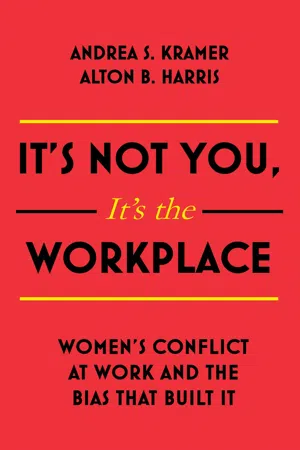
It's Not You, It's the Workplace
Women's Conflict at Work and the Bias that Built it
- 256 pages
- English
- ePUB (mobile friendly)
- Available on iOS & Android
eBook - ePub
It's Not You, It's the Workplace
Women's Conflict at Work and the Bias that Built it
About this book
Information
PART I
Women’s Workplace Relationships with Other Women
Chapter 1
Women Are Mean to Each
Other—Or So We’re Told
THERE IS AN ACTIVE COTTAGE industry devoted to characterizing women’s workplace relationships with other women as fundamentally antagonistic. Women are said to bully other women, spread malicious rumors about them, behave in two-faced ways toward them, seek to undermine their self-confidence, and secretly plot to destroy their professional standing. Typical of such characterizations (almost always made without comprehensive empirical evidence) are the following:
•“Women are the focus of gossip and suffer humiliation, betrayal, or social exclusion at the hands of other women with surprising frequency.”1
•“Female aggression tends to be mental and emotional like gossip and backstabbing [that is] designed to create shame, cause emotional distress and wreak havoc in a rival’s life.”2
•“Conflict among women in the workplace is out of control and has become an area of intensified research and concern.”3
The authors of the works from which these statements are drawn all view women’s same-gender workplace relationships as plagued by jealousy, envy, and competition. They think that because of evolution, socialization, or misogyny, women see other women as rivals, competitors, and enemies. Behaviors such as manipulation, undermining, betrayal, backstabbing, trash talking, and one-upsmanship are said to be the modus operandi. These authors assert that these conflicts are intensely personal and specifically intended to hurt other women’s positions, reputations, and status. Because they see these conflicts as driven by internally generated motivations, women are assumed to be in control of their conflicts and should be able to end them by simply understanding and ending their hurtful behaviors.
We have serious doubts that women’s same-gender conflicts are the result of internally motivated envy, jealousy, or competitiveness. We also seriously doubt that these characteristics are part of women’s nature. In fact, we believe this entire approach to women’s relationships with other women is profoundly misguided. By assuming that there are unique, identifiable psychological differences between the sexes, these authors deflect attention from the substantial evidence that women and men are more alike than they are different. While there are differences in abilities and brain functions, the differences are very small—usually of the magnitude of a few percentage points across the entire population.4
Women and men do not have fixed feminine or masculine traits. Moreover, the workplace situations in which women and men find themselves are far more determinative of their behavior than inherent qualities or characteristics. When we view women and men as having unique, distinctive, and permanent psychological predispositions, personality traits, and task aptitudes, we ignore the importance of context. Context is not just people’s immediate situations, but also the totality of their lives, including the environments within which they work, love, play, and struggle. If we are ever to get to the root of women’s same-gender workplace conflicts, we need to focus on the situations in which these conflicts are created, not on women’s internal characteristics.
There are most certainly differences in women’s and men’s predispositions, attitudes, bearings, communication techniques, language patterns, and so on. But we do not believe these are permanent, immutable differences. These differences are largely due to imbalances in the perceived power, status, and value that women and men grow up with. It is external context, not internal characteristics, that reveals the causes of women’s same-gender workplace conflicts.
As we argue in the next chapter and throughout the remainder of this book, women often experience unique difficulties working positively with other women, not because of the way women are but because of the biased workplace situations women encounter. To paraphrase the title of this book, women’s conflicts with other women arise not because of their personal characteristics but because of the characteristics of their workplaces.
Representative Books
The titles of some of the books published over the past decade in the “women are antagonistic to other women” genre paint a very ugly picture of women’s same-gender relationships: Tripping the Prom Queen;5 Mean Girls Grown Up;6 Mean Girls, Meaner Women;7 Catfight;8 Mean Girls at Work;9 Working with Bitches;10 Woman’s Inhumanity to Woman;11 The Bitch in the House;12 and The Stiletto in Your Back.13 Let’s take a brief look at common claims made by books in this genre before we provide our critique as to why we disagree with the fundamental claims made by these books.
Common Claims
Virtually all of these books make two common claims. First, they claim that while most women are fully aware of women’s purported mutual antagonism, they are reluctant to acknowledge or discuss it. For example, in Woman’s Inhumanity to Woman, Phyllis Chesler writes,
When I began this work, most people, including feminist academics, were not talking about the ways in which women, like men, internalize sexist values or about the human female propensity to evil. . . . [As one woman said to me,] “I think you should be writing about how men oppress women not about what oppressed people do in order to survive.”14
In Tripping the Prom Queen, Susan Shapiro Barash echoes Chesler’s experience:
No matter what other topics I was asking about, I found hints of a dark secret, a problem that everyone seemed to sense but no one was willing to talk about: women’s rivalry. . . . I emerged from my research feeling as though [female rivalry] must be a theme in every woman’s life. We’re just not allowed to talk about it. We’ll do anything rather than face up to female envy and jealousy. . . . [W]e sweep all evidence of a bleak picture [of women’s relationships with other women] under the rug.15
In the introduction to The Twisted Sisterhood, Kelly Valen tells us,
It seems we’ve conditioned ourselves to deny, discount, and just plain swallow our intra-female hurts as something we shouldn’t indulge or whine about. . . . Few of us are eager to acknowledge we’ve been burned by our “sisters.” Fewer yet wish to admit that they feel unsafe with certain women or that the primary threat to their emotional security radiates not from the usual suspects like men, but from fellow females.16
And Michelle Villalobos confidently states in The Stiletto in Your Back,
Female rivalry is something people generally avoid discussing. Personally, I dislike the notion that I am competitive with other women, and I’d be willing to bet that most of us avoid admitting—even to ourselves—when we feel insecure or when we compare ourselves to our girlfriends, colleagues or sisters and find ourselves lacking. Not to mention, perhaps we feel like we are betraying our sex by highlighting or acknowledging that sometimes women play dirty.17
The claim that women are reluctant to talk about same-gender rivalry, competitiveness, and antagonism is puzzling. If there really is such a reluctance, why are there so many books on the topic? Why does the popular press so regularly write about women’s difficulties in working with other women?18 And why are there so many websites and blogs devoted to the subject?19 Beyond the disconnect between the claim that women are reluctant to talk about women’s rivalry and the great flood of such talk, concern about the hurtful nature of women’s same-gender competitiveness has been a central theme of the modern women’s movement since its very beginning. For example, the first issue of Ms. magazine in 1972 carried an article by Letty Cottin Pogrebin entitled “Competing with Women.” In the article, Pogrebin urged women to stop seeking to raise themselves up “by standing on the crushed remains of [their] sisters.”20
The second common claim these books make is that women’s same-gender antagonism is caused by some aspect of women’s own internal makeup—some fundamental characteristic of their nature, or some basic female need, desire, or deficiency. As a consequence, the authors each conclude that all it will take to improve women’s relationships with other women is for women to look inside themselves, recognize why they are antagonistic to other women, and just stop being that way. For example, in Mean Girls Grown Up, Cheryl Dellasega writes,
It is clear that RA [relational aggression] is internally motivated [and is] a behavioral dynamic that can be changed with effort.21
In Mean Girls, Meaner Women, Erika Holiday and Joan Rosenberg advise us,
The act of self-reflection leads to awareness and awareness can lead to change. . . . Regardless of age, if you desire changes in your relationships with women, you can “start wherever you are”. . . . If you are a woman who has treated other women in ways that betray, exclude, demean, or devalue them, please pause and reflect before you behave in hurtful ways in the future.22
Katherine Crowley and Kathy Elster, the authors of Mean Girls at Work, go so far as to claim that by having read their book, you will have
gained greater knowledge and practical tools for working with and supporting other women at work—no matter how different they are from you. If we can acknowledge that the workplace is naturally competitive, we can also strive to compete with one another in fair, productive, and professional ways. Our hope is that if you’ve practiced mean behavior at work in the past, you can contain your inner “mean girl” and learn to get ahead without resorting to covert or indirect aggression toward other women.23
And Valen confesses,
Ultimately . . . I’m happy to leave it to the experts to figure out what breeds our aggressions. . . . We can talk about the “reasons” ad nauseam, use them as crutches to excuse or explain away our interaction and complacency, and even feel sorry for ourselves. But at some point we really do have to look within ourselves, examine our role in it, and just “do” or stop doing certain things.24
While we certainly agree that we should all strive to be nicer people, we seriously doubt that women’s individual efforts at self-improvement will do much to end women’s distinctive same-gender workplace conflicts. We believe that the only way to end these conflicts is awareness of the biases that are found in gendered workplaces. Before developing this argument further, let’s look more closely at why so many people who write about the difficulty women have working with other women believe this difficulty is rooted in women’s fundamental natures.
Differences
While there is general agreement in the books we’ve discussed that women’s purported same-gender antagonism—what the authors identify as women’s meanness, hostility, bitchiness, competitiveness, treachery, untrustworthiness, bullying, and so forth—is due to motivations that are internally generated, there is no general agreement as to why women are supposedly programmed in this way. There are, however, three reasons that are most commonly given to explain this purported antagonism: evolution, socialization, and internalization of the dominant culture’s misogyny. Although we do not believe that women’s distinctive same-gender workplace conflicts are the result of the way women are, by examining each of these explanations we can begin to understand why so many people disagree with us.
Evolution
Proponents of the view that women are genetically predisposed to be antagonistic toward each other argue that natural selection operates to ensure that the genes of only the fittest individuals are passed on to the next generation. As a result, evolutionary processes have shaped women to be inherently competitive with other women in the hunt for superior mates. And, because competing for a desirable mate is directly connected to competing for the scarce resources needed to sustain their offspring, women are constantly competing with each other for everything they need or want. In other words, proponents of the evolutionary explanation of the origins of women’s same-gender antagonism assert that women are inherently competitive with other women because evolution has made them that way.
Among the books that argue that women are mean to other women, the evolutionary perspective is most clearly articulated in The Stiletto in Your Back. Villalobos argues, “Female competition and the roots of why women ‘play dirty’ can be traced all the way back to our cave-dwelling, primate, pre-human and early human ancestors.”25 Women compete for the most desirable mates, primarily based on youth and bea...
Table of contents
- Cover
- Praise for: It’s Not You, It’s the Workplace
- Title Page
- Copyright
- Dedication
- Contents
- INTRODUCTION
- PART I: WOMEN’S WORKPLACE RELATIONSHIPS WITH OTHER WOMEN
- PART II: GENDER IN THE WORKPLACE
- PART III: SOCIAL IDENTITY IN THE WORKPLACE
- PART IV: GOING FORWARD
- GLOSSARY
- NOTES
- ACKNOWLEDGMENTS
- REFERENCES
- INDEX
Trusted by 375,005 students
Access to over 1.5 million titles for a fair monthly price.
Study more efficiently using our study tools.
Frequently asked questions
Yes, you can cancel anytime from the Subscription tab in your account settings on the Perlego website. Your subscription will stay active until the end of your current billing period. Learn how to cancel your subscription
No, books cannot be downloaded as external files, such as PDFs, for use outside of Perlego. However, you can download books within the Perlego app for offline reading on mobile or tablet. Learn how to download books offline
Perlego offers two plans: Essential and Complete
- Essential is ideal for learners and professionals who enjoy exploring a wide range of subjects. Access the Essential Library with 800,000+ trusted titles and best-sellers across business, personal growth, and the humanities. Includes unlimited reading time and Standard Read Aloud voice.
- Complete: Perfect for advanced learners and researchers needing full, unrestricted access. Unlock 1.5M+ books across hundreds of subjects, including academic and specialized titles. The Complete Plan also includes advanced features like Premium Read Aloud and Research Assistant.
We are an online textbook subscription service, where you can get access to an entire online library for less than the price of a single book per month. With over 1.5 million books across 990+ topics, we’ve got you covered! Learn about our mission
Look out for the read-aloud symbol on your next book to see if you can listen to it. The read-aloud tool reads text aloud for you, highlighting the text as it is being read. You can pause it, speed it up and slow it down. Learn more about Read Aloud
Yes! You can use the Perlego app on both iOS and Android devices to read anytime, anywhere — even offline. Perfect for commutes or when you’re on the go.
Please note we cannot support devices running on iOS 13 and Android 7 or earlier. Learn more about using the app
Please note we cannot support devices running on iOS 13 and Android 7 or earlier. Learn more about using the app
Yes, you can access It's Not You, It's the Workplace by Alton B. Harris,Andrea S. Kramer in PDF and/or ePUB format, as well as other popular books in Business & Women in Business. We have over 1.5 million books available in our catalogue for you to explore.