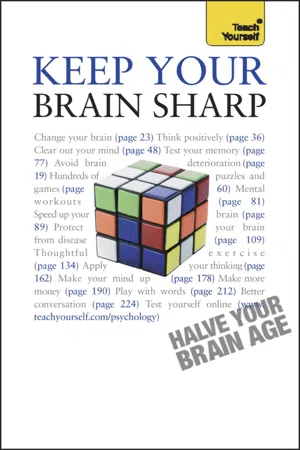
Do you forget things easily? Are you worried that you're losing your mental edge? Don't be! Keep Your Brain Sharp will prove that, in fact, your mature brain is bigger and better than ever, and it will give you hundreds of diverting puzzles, games, tests and exercises to keep it that way. It explodes the myths about old age and mental decline, explains why you get better when you get older and gives you a set of great mental workouts in a brain-boosting bible ideal for you if you think your best intellectual achievements may well lie ahead.NOT GOT MUCH TIME?One, five and ten-minute introductions to key principles to get you started.
AUTHOR INSIGHTSLots of instant help with common problems and quick tips for success, based on
the authors' many years of experience.
TEST YOURSELFTests in the book and online to keep track of your progress.
EXTEND YOUR KNOWLEDGEExtra online articles at www.teachyourself.com
to give you a richer understanding of how to keep your brain sharp.
FIVE THINGS TO REMEMBERQuick refreshers to help you remember the key facts.
TRY THISInnovative exercises illustrate what you've learnt and how to use it.
- 384 pages
- English
- ePUB (mobile friendly)
- Available on iOS & Android
eBook - ePub
Keep Your Brain Sharp: Teach Yourself
About this book
Information
Topic
Personal DevelopmentSubtopic
Personal Success1
The pursuit of happiness
In this chapter you will learn:
- that chemical reactions in your brain determine whether you feel high or low, optimistic or pessimistic, and that they affect how well you think
- that you can control chemical reactions in your brain by what you do and what you think, and by what you eat and what you drink
- that the pursuit of happiness is largely fruitless and that you can more easily achieve a state of BLISS, through Body-based pleasures, Laughter, Involvement, Satisfaction and Sex.
There is nothing either good or bad, ’tis thinking makes it so.
After William Shakespeare
Introduction
In this chapter, you will discover that chemical conditions in your brain change when you experience emotion, and when you think about the emotions which others may be feeling. Thinking thoughts and feeling feelings are chemical processes. Each affects the other.
The need for you to consider what you are feeling, as well as what you are thinking, arises in a number of thinking tasks, for example:
- An important part of thinking critically is the evaluation of an action’s potential consequences for others. At 50+ you are much better at predicting likely consequences than a younger person. We call this empathetic thinking.
- When you need to think creatively, your emotions are an important source of the mental energy needed to generate a long list of novel possibilities. At 50+ you have many more possibilities at your disposal than a younger person. Your emotional response to emerging ideas feeds both your intuition and your capacity and courage to make novel associations and creative connections between the many memories and images in your 50+ head.
- When recalling what was felt, as well as what was seen and said and done, you need to think reflectively. At 50+, you have so much more experience from which to learn.
- In general, optimistic expectations correlate with the strength of your immune system – the probability that you will recover from serious diseases, like cancer, correlates to the likelihood that you will achieve successful outcomes on thinking tasks, like problem solving and strategy formulation.
Emotional intelligence
The capacity to link emotions to thinking was described by Goleman as ‘emotional intelligence’ in 1996, and as ‘social intelligence’ in 2006. Research by both Goleman and Damasio shows that you need to involve your emotions, particularly when thinking about problems and plans.
Emotional information is processed in a part of the brain called the amygdala. The amygdala is constantly sending messages to the prefrontal lobes of the brain. This means that there is a constant flow of emotional information to the parts of the brain involved in calculation and argument. McGaugh points out that the effect is not always helpful. For example, when fear or anxiety rises beyond a certain level, your ability to think and remember is impaired. On the other hand, when you feel positive or amused, the messages sent by the amygdala appear to improve your ability to think. Feeling positive or amused seems to increase the likelihood that you will come up with original solutions.
Insight
Emotions and the brain
Emotions and the brain
Brain scans show that when people form intentions, on which they eventually act, certain parts of their brains need to be involved, while the problem, choice, discussion or plan is being thought about. One essential area of the brain that needs to be included is the part which processes emotions. What you feel about the situation is an important component of your thinking about the situation.
To discover for yourself how closely connected are your thoughts and feelings, try the following activity.
A thinking and feeling experiment
Try the following experiment, either with a partner, or a pen and paper. Look around and write ‘I am noticing…’ (write down what you are looking at or listening to) and ‘I am thinking…’ (write down what you are thinking at that moment) and ‘I am feeling…’ (write down a single word describing that emotion). Keep this up for about 15 minutes. Review the results. Notice how many times you can change what you are feeling, even in 15 minutes. Notice what kinds of observations and thoughts are followed by what kinds of feelings.
Repeat, trying to increase the number of positive feelings you can experience in 15 minutes. Note that you can choose what you notice – what you look at, what you listen to. This increases the chance that you can find something positive to think about and this in turn means that you can feel better.
Try to complete the following sentences in succession. When you have completed number three, go back to number one. Keep going round the loop for as much time as you can spare. When you can do it easily, do it as often as you can. Keep it up to maintain mental fitness:
- Right now I am noticing… (a person, a colour, a sound, a smell, a taste, a texture).
- And right now I am thinking… (e.g. an opinion or a judgement).
- And right now I am feeling… (e.g. an emotion – a simple word).
For increased mental suppleness, just keep going round the loop. For increased concentration span, increase the number of repetitions you do at one time. For increased mental agility and thinking speed, try to go round as quickly as you can without hesitation. You may notice that how you feel is changed by what you think, and what you think is related to what you notice. Because you can control what you notice by where you choose to focus, you can exert increasing control over your thoughts and your emotions.
Emotional and verbal thinking
The use of verbal thinking (Chapter 6) to identify and label the feelings you are experiencing, is more productive than just expressing the feelings impulsively. This is because, when you shout or otherwise give vent to your anger, for example, you leave a neural pathway between the amygdala and the brain’s frontal lobes. This increases the ease with which subsequent stray feelings can disable your ability to think, especially under pressure.
Make me thoughtful not moody,
Let me see good things in unexpected places,
Let me see unexpected talents in unexpected people,
And, oh, let me have the grace to tell them so.
From a seventeenth-century nun’s prayer
Insight
Internal dialogue
Internal dialogue
Conversations with yourself in your head (internal dialogues) need to explore what you are feeling about whatever you are thinking about – this means that you have to have as precise vocabulary as possible for labelling your feelings.
THE LIMITATIONS OF THE YOUNG ADULT BRAIN
In young adults, a hormone-driven dendrite explosion reaches the back of the brain, which deals with stimulation and emotion, well before it reaches the front of the brain, which deals with verbal reasoning. This leaves young adults vulnerable to confusing feelings, which they are not able to label, let alone challenge. Because their amygdalae are connected to the prefrontal lobes of their brains, the emotions of young adults take up short-term memory space which they need to make judgements, comparisons, calculations, decisions and logical arguments. Gottman realized that the thinking space of many young people, young men in particular, is quickly overwhelmed and disabled by their emotions. This is especially true following criticism. For example, for a typical male–female relationship between two young adults to survive, she has to make at least five positive comments about him for every one negative comment she makes about him.
Are you feeling anxious or are you feeling just worried?
At 50+, people can experience increased anxiety – often unattached to anything in particular and for no obvious reason. Anxiety can obsess your mind to the point where you no longer have enough free working space in your brain.
When people at 50+ are worried, it is right to take note. The 50+ have experience of the kind of things that can go wrong. Often a 50+ worry is a sensible preparation and rehearsal for things that may indeed go wrong. Worrying enables the 50+ to prepare contingency plans and these are often reassuring to others, as well as themselves. Contingency plans can be a good defence against chronic anxiety, which lowers performance on thinking tasks. One hundred and twenty-six studies of more than 36,000 students have shown that anxiety, and difficult...
Table of contents
- Cover
- Title
- Copyright
- Acknowledgements
- Contents
- Meet the authors
- Only got a minute?
- Only got five minutes?
- Only got ten minutes?
- Preface
- Introduction
- First thoughts
- Part one: Making love and making money at 50+
- 4 Oxytoxic food and mental fitness
- 5 Making more money
- 6 Lust, love, sex and intimacy at 50+
- Part two: Brain workout
- Final thoughts
- Appendices
- Answers
Trusted by 375,005 students
Access to over 1.5 million titles for a fair monthly price.
Study more efficiently using our study tools.
Frequently asked questions
Yes, you can cancel anytime from the Subscription tab in your account settings on the Perlego website. Your subscription will stay active until the end of your current billing period. Learn how to cancel your subscription
No, books cannot be downloaded as external files, such as PDFs, for use outside of Perlego. However, you can download books within the Perlego app for offline reading on mobile or tablet. Learn how to download books offline
Perlego offers two plans: Essential and Complete
- Essential is ideal for learners and professionals who enjoy exploring a wide range of subjects. Access the Essential Library with 800,000+ trusted titles and best-sellers across business, personal growth, and the humanities. Includes unlimited reading time and Standard Read Aloud voice.
- Complete: Perfect for advanced learners and researchers needing full, unrestricted access. Unlock 1.5M+ books across hundreds of subjects, including academic and specialized titles. The Complete Plan also includes advanced features like Premium Read Aloud and Research Assistant.
We are an online textbook subscription service, where you can get access to an entire online library for less than the price of a single book per month. With over 1.5 million books across 990+ topics, we’ve got you covered! Learn about our mission
Look out for the read-aloud symbol on your next book to see if you can listen to it. The read-aloud tool reads text aloud for you, highlighting the text as it is being read. You can pause it, speed it up and slow it down. Learn more about Read Aloud
Yes! You can use the Perlego app on both iOS and Android devices to read anytime, anywhere — even offline. Perfect for commutes or when you’re on the go.
Please note we cannot support devices running on iOS 13 and Android 7 or earlier. Learn more about using the app
Please note we cannot support devices running on iOS 13 and Android 7 or earlier. Learn more about using the app
Yes, you can access Keep Your Brain Sharp: Teach Yourself by Simon Wootton,Terry Horne in PDF and/or ePUB format, as well as other popular books in Personal Development & Personal Success. We have over 1.5 million books available in our catalogue for you to explore.