CUT 50% OF YOUR MEETINGS AND IMPROVE THE ONES THAT REMAIN Meetings are essential to collaboration and decision making, but they are often irrelevant, time consuming and badly run. People spend an average of 2 days per week in meetings and 50% of it is wasted. This book will help you win back that wasted day a week by cutting out the half of face to face and virtual meetings that do not need to happen and radically improving the ones that remain.The two authors, one an experienced CEO and consultant to major multinationals, the other a millennial line manager working within one of the world's largest companies, find common ground, and occasional disagreements on creating new ways of meeting both face to face and through technology that are far more engaging and effective for everyone.The book focuses on three main areas:
· Dealing with the business and corporate cultural challenges in changing the way we meet
· Cutting out the unnecessary topics and participants that make up 50% of todays meetings
· Designing and running faster and more focused face to face and online meetings with more relevant content; clearer decisions and actions, and much higher levels of participationFull of examples and practical tools that will improve everything from your regular team meetings to management meetings, online conferences, global meetings and big events. This book will lead you through practical actions and targets to kill the meetings that do not need to happen and radically improve the ones that remain.
eBook - ePub
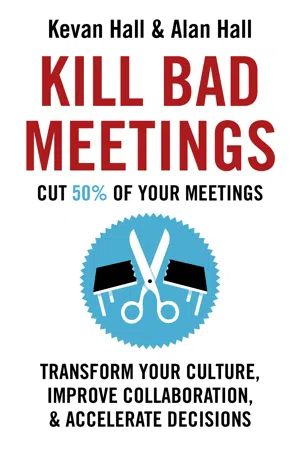
Kill Bad Meetings
Cut 50% of your meetings to transform your culture, improve collaboration, and accelerate decisions
- 224 pages
- English
- ePUB (mobile friendly)
- Available on iOS & Android
eBook - ePub
Kill Bad Meetings
Cut 50% of your meetings to transform your culture, improve collaboration, and accelerate decisions
About this book
Information
Part 1
The opportunities and barriers to fewer, better meetings
In the Preface we outlined at a high level the cost of meetings to organizations in general.
In Part 1 we will show you how to identify the real cost of meetings in your specific organization and how to use this to build the business case for change and for investment in improving your meetings.
Although the principles that follow are relatively simple, it can be surprisingly hard to change your meetings culture. This is because having too many meetings is often a symptom of some deeper underlying corporate cultural beliefs and practices.
We will help you to understand and find ways of dealing with these underlying problems to sustain your move to fewer, better meetings.
• Chapter 1 – The best business case you never made
• Chapter 2 – The rest of the iceberg
Chapter 1
The best business case you never made
 | Actions – put together a business case for improving meetings in your organization |
 | Target – raise your own and your organization’s awareness of the cost of meetings and the opportunity to improve |
As we have already seen in the Preface, the total cost of meetings to organizations in general is huge.
However, in building a business case and being credible in proposing change, we need to be specific about the impact on our own organization. While many people think they attend too many meetings, the total cost of these meetings is often hidden in individual budgets and the salaries and expense budgets of those who attend.
It is tempting to jump right in and try to improve your meetings but we have found it to be essential to put together a proper business case for four key reasons:
| 1. | The numbers are usually startling and this can help build the energy and the desire to change |
| 2. | It requires quite significant effort to change our culture around meetings. We are not going to achieve this just by running a few meetings training sessions, so we need to build a proper business foundation for the investment and effort involved |
| 3. | If we are going to get priority for this initiative, we need to be able to see a significant payback. Think of this project as similar in scale and return to opening a new office, launching a significant new product or service, or massively improving the performance of a factory. Imagine yourself pitching for investment at this level |
| 4. | Any quality improvement exercise should start with a measure. Start by calculating the cost and quality of your meetings and raising awareness with your colleagues. This will also give you a “before” measure against which to evaluate the success of your changes |
Luckily this information about meetings is not hard to find.
The costs of meetings fall into two categories: direct costs and consequent costs.
For the purposes of this book we will define “meetings” as including more than two people either face to face or through technology – conference call, video, or web meeting. We exclude one-to-one meetings as many of the principles later in the book will not apply to these conversations.
In this chapter, we will use examples at an organizational level; you can also take these principles to put together a business case just for your own meeting or at a departmental level.
Direct costs
Direct costs include:
| • | The salary costs of attendees |
| • | The salary costs of preparation and travel |
| • | The expenses involved in running the meeting |
These are relatively easy to find.
1. Salary costs of attendees
First, find the number of people in your organization who are regularly attending meetings. Most people attend some meetings, but the real problems and opportunities for improvement are likely to be among your managerial and professional populations. This will often be the top 10–15 percent of people in your organization (depending on your industry and business).
Almost everyone attends some meetings but you will get most benefit by keeping it simple and focused on this more senior group. They are also the people who drive the meetings attended by most of the rest. If you can change the way they work the approach will trickle down as they realize the benefits and change their behaviors around meetings. This way you will influence everyone else too.
Second, calculate the average cost of these people. Your payroll or HR people will have this information.
We know from our own research that the average cost of employment (salary, social charges, and other direct costs of employment) of a manager or professional person in Europe or the USA is about $100,000 (at 2017 rates). It is worth finding out the actual figure for your business – for several of our clients’ their corporate average for these populations has been above $200,000.
Third, ask your people two simple questions:
Think about the meetings you attend where there are more than two people present – whether that is face to face or virtua...
Table of contents
- Cover
- Also by Kevan Hall
- Title Page
- Imprint Page
- Dedication
- Acknowledgements
- Contents
- Preface
- Part 1 - The opportunities and barriers to fewer, better meetings
- Chapter 1 - The best business case you never made
- Chapter 2 - The rest of the iceberg
- Part 2 - Save a day a week by killing unnecessary meetings and topics and removing unnecessary participants
- Chapter 3 - Saying no to more meetings
- Chapter 4 - Killing unnecessary topics
- Chapter 5 - Removing unnecessary participants
- Part 3 - Designing much better meetings
- Chapter 6 - What is your purpose?
- Chapter 7 - Drive outcomes and process, not agendas
- Chapter 8 - Improving the participant experience
- Chapter 9 - Faster, better decisions
- Chapter 10 - Taking information-giving out of your meeting
- Chapter 11 - Taking your meetings global
- Chapter 12 - Running big events and conferences
- Part 4 - Making your meetings flow
- Chapter 13 - Facilitation tips
- Chapter 14 - Continuous improvement and follow-up
- Part 5 - Embedding the Change
- Chapter 15 - Embedding the change and overcoming resistance
- Chapter 16 - Conclusions
- About Global Integration
Trusted by 375,005 students
Access to over 1.5 million titles for a fair monthly price.
Study more efficiently using our study tools.
Frequently asked questions
Yes, you can cancel anytime from the Subscription tab in your account settings on the Perlego website. Your subscription will stay active until the end of your current billing period. Learn how to cancel your subscription
No, books cannot be downloaded as external files, such as PDFs, for use outside of Perlego. However, you can download books within the Perlego app for offline reading on mobile or tablet. Learn how to download books offline
Perlego offers two plans: Essential and Complete
- Essential is ideal for learners and professionals who enjoy exploring a wide range of subjects. Access the Essential Library with 800,000+ trusted titles and best-sellers across business, personal growth, and the humanities. Includes unlimited reading time and Standard Read Aloud voice.
- Complete: Perfect for advanced learners and researchers needing full, unrestricted access. Unlock 1.5M+ books across hundreds of subjects, including academic and specialized titles. The Complete Plan also includes advanced features like Premium Read Aloud and Research Assistant.
We are an online textbook subscription service, where you can get access to an entire online library for less than the price of a single book per month. With over 1.5 million books across 990+ topics, we’ve got you covered! Learn about our mission
Look out for the read-aloud symbol on your next book to see if you can listen to it. The read-aloud tool reads text aloud for you, highlighting the text as it is being read. You can pause it, speed it up and slow it down. Learn more about Read Aloud
Yes! You can use the Perlego app on both iOS and Android devices to read anytime, anywhere — even offline. Perfect for commutes or when you’re on the go.
Please note we cannot support devices running on iOS 13 and Android 7 or earlier. Learn more about using the app
Please note we cannot support devices running on iOS 13 and Android 7 or earlier. Learn more about using the app
Yes, you can access Kill Bad Meetings by Kevan Hall,Alan Hall in PDF and/or ePUB format, as well as other popular books in Business & Meetings & Presentations. We have over 1.5 million books available in our catalogue for you to explore.