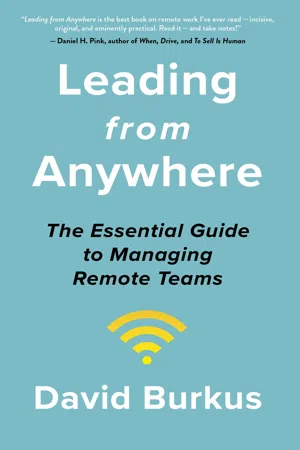
' Leading From Anywhere is the best book on remote work I've ever read - incisive, original, and eminently practical. Read it - and takes notes.' - Daniel H. Pink, author of When, Drive, and To Sell Is Human It's undeniable that we're entering a new era of remote work. So, how can managers ensure that their businesses run as usual when the way that we work looks so... unusual?Top business thought leader David Burkus has mined the very best research on virtual teams and case studies of companies that have not just survived but thrived through remote work to provide managers with the field guide to leading remotely, packed with everyday examples and illuminating insights. Structured around the lifecycle of working on a team, Burkus tackles the key inflection points and challenges that managers face in this new landscape from taking the team remote and adding new members, to communicating effectively and quickly, managing performance, keeping the team engaged, and celebrating individual departures or adjourning the team as a whole.If you want your remote team to have a harmonious work-life balance while increasing productivity, this is your indispensable guide.
- 256 pages
- English
- ePUB (mobile friendly)
- Available on iOS & Android
eBook - ePub
About this book
Information
1
GOING REMOTE
Whether you’re leading a new team in a remote company or you’re charged with taking your in-person team remote, your team’s success or failure depends on a few key elements. Even before you’ve settled on what software to use, get your team to a place of shared understanding, shared identity, and shared purpose.
THE MINUTE WE shut our door, we stopped producing any revenue.”
Curtis Christopherson never planned to lead remote teams or work with clients remotely. But all that changed when the COVID-19 crisis forced his business to shutter. Suddenly Christopherson, the founder and CEO of Innovative Fitness, was watching his in-person training model get thrown out the window. Innovative Fitness was celebrating its twenty-fifth anniversary just as it was making plans to close the doors to every one of its twelve locations. At the start of 2020, the company employed more than 250 personal trainers and support personnel. Each of those trainers worked out of a physical location that had a reputation for drawing in clients. “If you’re staying at the Ritz-Carlton in Toronto and want a personal training session, the concierge sends you to us. That’s how similar the quality of our customer experience is.”
Innovative Fitness’s entire revenue depended on in-person interactions in a world where in-person interactions were suddenly scarce. As the novel coronavirus pandemic grew uncontainable, Christopherson knew his company would need to change fast.
When he was informed that a few people and a couple of clients had come back from a trip to Europe and tested positive for the coronavirus, Christopherson didn’t hesitate. That very night, Sunday, March 15, he scheduled an all-hands videoconference and told everyone they wouldn’t be opening the next day. He didn’t know what they would do, but he did know they weren’t going to unknowingly contribute to the virus’s spread. Christopherson told his employees that they would be paid in full through the end of that week and that the company would have a full plan ready to go by then as well. “We told them, ‘We’ll figure it out and we’ll get back to you by Friday.’ And then we put our heads together and tried to find that plan.” They looked at best-case scenarios of being closed for a few weeks and worst-case scenarios of being closed for six months. And they looked at pivoting the entire business.
They chose to pivot.
They chose to go remote.
The company was already working with a software provider to develop a proprietary system for appointment scheduling and billing. They reached out and asked a wild question: “Can you add video calling to the platform?” When their provider said yes, they had their plan. They would create — in two weeks — an entire system for their personal trainers to meet virtually with their existing clients and keep the relationships (and revenue) going. They also created a curriculum not only to teach their trainers how to use the software but also to effectively train remote clients — software they were still in the process of building. And they created template workout plans that could be used with no equipment in a variety of home environments.
On that Friday, one week into their two-week transformation, Christopherson again met online with his entire staff. He told them, “We’re going to offer the same quality of service and the same training schedule to all of our clients. Nothing is going to change except how we meet to train them.” Christopherson also leaned heavily on the company’s existing mission and vision and stressed how understanding they were of each employee’s situation because of the crisis. But at the end of the meeting he asked a simple question: “Are you in?”
“Out of approximately 225 trainers, 205 said yes right away,” Christopherson recalled.
On March 30, Innovative Fitness launched its virtual personal training service with a team of fully trained virtual fitness instructors.
While a majority of their in-person clients have now returned to the studio, the virtual offering is still Innovative Fitness’s fastest-growing revenue source — and it’s not going away.
Christopherson reflected on how large — and overdue — this shift felt. “What’s craziest to me is that we had totally ignored basically all technology. We had a website, but it was barely optimized,” he explained. “In the twenty-five years we’d been in existence, we’d never converted a single website visitor to a client without them coming into a location and talking to one of us.” Once they launched their virtual offering, they started seeing customers all over the world sign up, with very little interaction needed. Having a remote division of the company has allowed Innovative Fitness to find clients anywhere at any time, but it’s also allowed them to hire and retain talent from all over the world. In the past, if a trainer moved outside of their geographic footprint, that was the end of the relationship. Now Innovative Fitness can keep them on as part of the team.
Instead of a brick-and-mortar company with a virtual training offering, Christopherson now considers Innovative Fitness a remote company that happens to own a few gyms. “We’re striving to become the Uber of personal training. Anywhere you are in the world, we can connect you with a fitness instructor to guide you through a custom-tailored workout based on your goals, needs, abilities, and equipment.”
Christopherson may not have planned on one day leading a remote company. But now he’s got no plans to go back.
Many of the challenges Christopherson and Innovative Fitness faced are shared by every leader tasked with managing a remote team. They had to figure out how to train clients in a virtual environment, but, more important, they had to figure out how to train more than two hundred employees to work together and with their clients entirely remotely. That’s your primary challenge as a remote leader as well, and one that’s critical to the success of a remote business: helping the team learn to work together without face-to-face interaction.
Whether a new crisis has mandated that your team go remote, or you’ve just become the leader on an already remote team, “going remote” creates a lot of obstacles beyond simple logistics.
How do you make people feel like a team when they’re not physically together?
How do you help them collaborate when they can’t just walk to each other’s cubicles?
How do you keep them aligned and motivated to the task at hand, even when they’re working in different time zones or juggling responsibilities at home?
Fortunately, while remote work might be new for a lot of organizations, remote teams have existed in some form for long enough that we can learn an incredible amount from their successes and setbacks. Martine Haas and Mark Mortensen have been studying remote teams for years — including global ones made up of members from a cross section of an organization (a truly “boundaryless” type of team if ever there was one). They have seen how going remote can create a host of challenges and opportunities for teams and their leaders. But two elements in particular stood out as unique challenges that leaders need to address whether their existing team is going remote or they’re just forming a new team in a remote environment: shared understanding of one another’s work habits and environment and shared identity among the team.
In this chapter we’ll look at how to accomplish each in turn and offer a third element that’s important and urgent for managers of all types of teams: uniting your team around a shared purpose.
Shared Understanding
In the traditional models of how teams develop, there’s a controlled chaos in the early moments of the team’s life. One prominent model even calls the first stage after a team forms “storming,” because team members are voicing their opinions and feeling one another out, so conflict is a given until the team gradually settles into norms of behavior and everyone learns about the others’ working habits. Most of these models were developed for in-person teams, where teams can move through this stage rapidly. In a remote team, it falls to the leader to bring about these norms while minimizing the conflict. That’s where shared understanding comes in.
Shared understanding refers to the extent to which members of the team have a commonly held perspective on the team’s expertise, assigned tasks, context, and preferences. Different members of the team have different skills, abilities, and knowledge. On a remote team, it’s likely that they’ll also come from different cultural contexts and different contextual constraints. While this may also be true of in-person teams, the chances of being misunderstood or misinterpreted are higher in a remote team, which lacks the influence of a shared environment. Team members need to know who knows what, who’s taking on what responsibility, and also how to approach each person with requests for help — or offers of help, for that matter. Providing team members with space to develop this shared understanding is crucial.
One simple way to get started is to build in purposefully unstructured time during team meetings or elsewhere in the week to discuss a wide range of topics. Giving the team space to talk about daily life events, family moments, or even industry news unrelated to the task at hand provides each team member with an opportunity to learn more about the others. Haas and Mortensen even recommend letting team members give “virtual tours” of their workspaces by panning the camera around the room during a video call and showing their remote-team members the environment they work in (including what distractions they are dealing with and how they stay productive).
Another simple approach to shared understanding is coordinating calendars. The location-free nature of teams gives everyone freedom to design a calendar that works for them. But it’s best if those calendars have a little bit of overlap in them. Having to work together on projects with a full day’s delay can get tiresome. And unless you’re a truly global team, it’s a burden you don’t have to bear. So, while you’re setting shared expectations with the team, guide them to a place where everyone’s calendar has at least a few hours of overlap to make it possible to jump on a quick call or exchange a few notes throughout the day.
Along with shared understanding comes equal access to infrastructure and developing an understanding of each other’s technological capabilities. Remote teams rely on technology, and it’s the team leader’s role to make sure that team members have equal access to the technologies they’ll need to collaborate. Consider how much Innovative Fitness needed to consider on behalf of its employees (and clients) before it could launch its virtual offering and know it would succeed. Likewise, you need to figure out who needs what, and also who needs the training to use those tools. And don’t neglect yourself when it comes to that training — it’s hard to run an effective virtual meeting when you keep forgetting how to unmute yourself.
This includes not just the technology, but access to information. Make sure your people have access to everything they need. Many companies adopt a “need to know” policy toward information and access to software. With the exception of human resources information, most companies have much less truly sensitive information than they might think. But in an effort to lock down the little bit that is sensitive, companies often unknowingly lock employees out of the information needed to do their job well. In an office environment, this is a mere inconvenience — employees have to track down the person responsible for granting access and wait while they enable it. In a remote environment, it can be downright production-blocking — finding the right person might be easy, but waiting on them to grant access can take days (or longer), because everyone is working asynchronously.
And if you can’t default to trusting your employees, then you’ve got bigger problems to solve than whether or not to give them a username and password.
Developing shared understanding makes coordinating roles easier and collaboration faster. It’s a crucial first step in bringing a remote team together or taking an existing team remote. But it’s not the only step.
Shared Identity
Developing shared identity is important for any team — but especially for remote ones. Shared identity refers to the extent to which team members feel the same sense of who they are as a designated group. It indicates whether or not individual members truly feel like this is the team they’re a part of and most loyal to. Decades of social science research have shown that individuals make sense of their world by applying categories and labels to their environment — including themselves and the people around them. “Team” is one such label, and it carries great importance, because when we identify with a particular group, that group shapes our own identity and behavior.
A strong shared identity in a team reduces conflict, standardizes norms of behavior, increases cohesion and collaboration, and ultimately enhances team performance. But in a remote environment where one or two members of the team are located together and others are scattered, an individual’s sense of team can be distorted. Humans have a tendency toward “us versus them” thinking, and the “us” can easily be misinterpreted as in-person team members or even employees in a different function in the organization who happen to work in the same location.
One potent example comes to mind from early in my career, when I worked in sales on a remote “team.” The organizational chart defined my team as the nine people who all reported to the same district sales manager. However, the company had two other representatives working in the same territory as me and calling on the same customers (though, thankfully, selling different products). In that blurry context, it was impossible to distinguish which team I was really a part of. Was it the people who all shared the same boss? Or the ones I’d call for help because they lived in the same city, shared the same problem clients, and responded to requests much faster?
I still don’t know the answer to that question twenty years later, but I do know who still gets a Christmas card every year — and it’s not my old boss.
Deliberately developing shared identity eliminates that confusion. One powerful way to develop not just a team identity but a bond between team members is to point to (and continue pointing to) the team’s superordinate goal. Superordinate goals are the objectives that affect everyone in a group (or across groups) and that require participation from everyone affected in order to be achieved. They can be a goal, but they can also be a challenge — a challenge that threatens everyone in the team unless that team comes together to take it on. For Innovative Fitness, that primary goal was just ensuring that the organization would survive, but even now they lean heavily on the company’s mission and values of using personalized fitness to help people live their best lives.
Studies of superordinate goals show that when multiple groups are brought together and tasked with something that requires them to choose between collaboration and failure — they choose collaboration more often. In doing so, they choose to redefine their team not as the original group but as the newly formed team of teams. And that new identity lingers as long as the superordinate goal is out there.
Superordinate goals may be the key to smashing silos and ending turf wars throughout an organization. And for a remote team, superordinate goals are the secret to shared identity. When you’re discussing roles and responsibilities, or even just checking progress, make sure you connect individual efforts back to the superordinate goal. Whenever you’re talking about individual productivity, take the time to point back to the larger “why?” your team is working for. Remind individuals that their individual efforts are progress toward a larger mission, and be prepared to share stories of how even the smallest wins for your team were milestones toward that mission.
It’s tricky to know if your team’s performance objectives alone are large enough to become the superordinate goal that creates shared identity. That’s why in recent years I’ve taken an unorthodox approach with the companies and leaders I work with to ensure goals are seen as superordinate. It all has to do with how we talk about the larger purpose.
Shared Purpose
We know that people want a sense of purpose, and they want it for more than just their personal lives. They want it at work as well. But we also have to admit that a lot ...
Table of contents
- Cover
- Also by David Burkus
- Title Page
- Dedication
- Contents
- Introduction
- 1. Going Remote
- 2. Building Culture Remotely
- 3. Hiring Remote Teammates
- 4. Building Bonds from Afar
- 5. Communicating Virtually
- 6. Running Virtual Meetings
- 7. Thinking Creatively
- 8. Managing Performance
- 9. Keeping Engaged
- 10. Saying Goodbye
- Conclusion
- Appendix A: Technology for Remote Leaders
- Appendix B: Additional Questions from Remote Leaders
- Acknowledgments
- Notes
- About the Author
- Copyright
Trusted by 375,005 students
Access to over 1.5 million titles for a fair monthly price.
Study more efficiently using our study tools.
Frequently asked questions
Yes, you can cancel anytime from the Subscription tab in your account settings on the Perlego website. Your subscription will stay active until the end of your current billing period. Learn how to cancel your subscription
No, books cannot be downloaded as external files, such as PDFs, for use outside of Perlego. However, you can download books within the Perlego app for offline reading on mobile or tablet. Learn how to download books offline
Perlego offers two plans: Essential and Complete
- Essential is ideal for learners and professionals who enjoy exploring a wide range of subjects. Access the Essential Library with 800,000+ trusted titles and best-sellers across business, personal growth, and the humanities. Includes unlimited reading time and Standard Read Aloud voice.
- Complete: Perfect for advanced learners and researchers needing full, unrestricted access. Unlock 1.5M+ books across hundreds of subjects, including academic and specialized titles. The Complete Plan also includes advanced features like Premium Read Aloud and Research Assistant.
We are an online textbook subscription service, where you can get access to an entire online library for less than the price of a single book per month. With over 1.5 million books across 990+ topics, we’ve got you covered! Learn about our mission
Look out for the read-aloud symbol on your next book to see if you can listen to it. The read-aloud tool reads text aloud for you, highlighting the text as it is being read. You can pause it, speed it up and slow it down. Learn more about Read Aloud
Yes! You can use the Perlego app on both iOS and Android devices to read anytime, anywhere — even offline. Perfect for commutes or when you’re on the go.
Please note we cannot support devices running on iOS 13 and Android 7 or earlier. Learn more about using the app
Please note we cannot support devices running on iOS 13 and Android 7 or earlier. Learn more about using the app
Yes, you can access Leading From Anywhere by David Burkus in PDF and/or ePUB format, as well as other popular books in Business & Management. We have over 1.5 million books available in our catalogue for you to explore.