What does it mean to lead with vision? In the first book devoted entirely to vision as a key leadership principle, the authors delve deeply into the notion that a compelling vision that motivates and inspires is a true differentiator for organizations that want to hire and retain talent, be more competitive, and thrive in uncertain times. But a compelling vision on its own is not enough, which is why the authors, sought-after leadership development experts globally, provide readers with detailed analysis of the essential things leaders must do to effectively engage the workforce around that vision: embody courage, forge clarity, build connectedness, and shape culture. Leading with Vision draws on quantitative data from the authors' research of over 400 companies supplemented with real-world examples from thoughtful leaders who exemplify the core principles of leading with vision in established companies, including: Olukai, Bumble Bee, Coresystems, Jimbo's, Bunge, and more. The book also includes an actionable blueprint developed by the authors that leaders and their organizations can implement on day one of their journey.
eBook - ePub
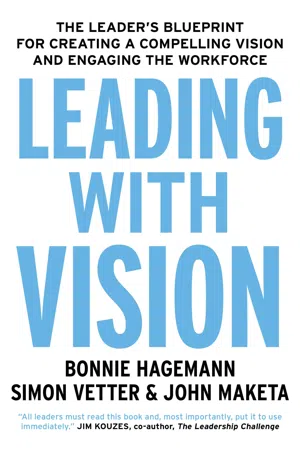
Leading with Vision
The Leader's Blueprint for Creating a Compelling Vision and Engaging the Workforce
- 320 pages
- English
- ePUB (mobile friendly)
- Available on iOS & Android
eBook - ePub
Leading with Vision
The Leader's Blueprint for Creating a Compelling Vision and Engaging the Workforce
About this book
Information
CHAPTER 1
The Disconnect
LET’S RETURN TO THAT CONFERENCE ROOM in San Diego where Simon, John, and I started to think about how we could find ways to help leaders create a compelling vision and engage others around it, particularly the Gen Y members who almost demand to be motivated and inspired before they will opt in. In addition to what we’d seen in our field work, we were very focused on the research, which clearly indicated that the trends in executive development were shifting and that leading with vision and employee engagement were now the key indicators for success. The first thing we wanted to do was compare notes about what we’d seen in the workplace, so we shared some anecdotes and insights.
GENERATION Y
Generation Y was born in the 1980s and 1990s. Most are children of the Boomers; they are typically perceived as being increasingly familiar with digital and electronic technology, and they are credited with actively shaping today’s corporate culture and employee expectations.
Simon began by telling us a story about Bruce, the Gen Y son of his friend Mike. Bruce is a twenty-five-year-old graduate with a degree in accounting and finance. Right out of university, he went to work for a renowned Fortune500 company. Initially, he was extremely excited. It was a huge company with a great brand and a great reputation, but after only a few months Bruce went to his father and said, “Dad, I’m out. This place sucks.”
Taken aback, Mike asked what had happened. Bruce said, “I work in a cubicle. Every morning my manager walks by my cubicle. He walks by again every day at lunch. He walks by in the afternoon. And then, he walks by at the end of each day. He never even looks at me when he passes my cubicle.”
Mike saw the picture but hoped Bruce wasn’t jumping too soon. He said, “Maybe you should give it a few more weeks. The manager might change, or you might get a new manager.”
“No, I’m done. I’m out,” Bruce said.
Bruce quit and started looking for another job. A few months later, he got a position with a start-up, a small email security company. His role moved slightly from straight finance to a more sales-support finance role. His clients were on the East Coast, and he was on the West coast, meaning the clients started their workday at 5:00 a.m. Pacific time. Using his flex time, Bruce shifted his hours to accommodate his clients. Now, he gets to work at 5:00 a.m. every morning. He’s the first person in the office. At 6:00 a.m. the CEO arrives. He always walks by Bruce’s office, peeks in, and checks with him. Even when Bruce is on the phone, the CEO gives him a thumbs-up through the open door, just recognizing that he’s there, which clearly lets him know he’s important. Bruce loves his new job, and, to top it off, he gets paid more and has stock options.
This anecdote sums it all up: Truly engaging your people is paramount. It makes all the difference to your success as an organization. Every employee, no matter what generation they are, wants to feel engaged with their work and understand what they are helping to achieve. However, the Boomers and Gen Xers may be content to clock-in and clock-out, wishing away the hours and/or doing the bare minimum, but Generation Y is built differently. They want to be engaged, stimulated, motivated, and involved. If they aren’t, then they leave.
As Bruce’s reaction illustrates, big companies with great names can no longer rely on their reputation to attract and retain their talent pool. Instead, they need a compelling vision and a way to create personal connectedness. Otherwise, employees won’t commit to the organization.
The research we will share in chapter 4 shows that creating this personal connectedness will achieve increased organizational commitment, lower staff turnover, and produce higher returns to the bottom line. In Bruce’s case, if he had been personally connected to the company’s vision, he may have decided to stay there rather than move to another company, despite its lackluster manager. Connectedness would also have helped the company keep a talented person who was willing to go above and beyond and who was prepared to come into work at 5:00 a.m. every day to help clients across the continent. Losing Bruce was a serious loss for that company.
A WIDENING GAP
John had a disengaging experience from his own work past to share. For one of his past employers, he attended a strategy session with his manager and ten colleagues to review plans for the next year. They met in a drab hotel conference room with only one window, and the blinds were half drawn. Here’s how John described the day. “It was foggy outside, and when my manager shared her Excel spreadsheet with the team, my brain became even foggier. We went through it line by excruciating line—all day, trying to determine which products were making the most profit, what the margins were, where expenses could be lowered, which markets we should focus on, and the price of eggs in China. . .
Here’s the truth: It’s not all about the money. People may leave for money, but they’ll stay in spite of the money if they’re personally connected to the organization—that is, if they feel confident, excited, and even inspired.
“We hovered over and around that damn spreadsheet for hours. By the end of the day, we were all beyond exhausted. The only thing we were looking forward to was drinks. Afterward, we made our way to the bar, where we ordered pitchers of margaritas, asked the bartender to turn on Survivor, and then worked really hard to forget about the business for a while. My only connection to the company that day was my fellow drinking buddies and the happy hour mental escape.
“The very next day, I was eating lunch at my desk when a recruiter called. He said, ‘I have a great opportunity to talk to you about.’ I looked through my office window, remembered the previous day’s meeting, turned my chair around, and said, ‘I’m so glad you called. Whaddya got?’ I couldn’t wait to get out of there.” Motivation is everything.
LEADING BY THE NUMBERS
The scene that John wanted to escape is all too common. In our experience across industries and continents, we’ve found that leaders are more likely to lead with numbers than vision. Leaders of public companies are often the most likely to use the spreadsheet approach, perhaps because they are rewarded almost solely on data-driven shareholder value. How do leaders determine shareholder value? Through a series of financial spreadsheets. But, is that enough?
The shareholders aren’t asking, “Are your employees connected to the organization?” or, “Do they feel important at work?” No; shareholders are asking, “Where’s my return on investment?” Public-company leaders—and leaders in many other organizations—are conditioned to focus on numbers instead of people, but here’s the issue: people drive the numbers. Numbers may be inspiring for the sales team or for the senior leaders whose bonuses are impacted, but the majority of employees are not compelled to go to work every day to help the company hit a number. A number is not a vision.
In fact, sometimes even a cool environment, high salaries, and great benefits aren’t enough to effectively support and retain employees, and companies need to take the time to figure out if there’s another problem or if another key piece is missing. For instance, I did some work in an organization with a surprising situation. It is a huge, multibillion-dollar corporation, a top competitor in its field. It was one of the coolest and hippest environments imaginable. The facilities were incredible, the benefits were over the top, and the employees were paid generous salaries. The organization had gyms, restaurants, and even an employee garden. It gave out sports team tickets to employees. The workforce was fairly young and energetic. Everyone wanted to work there.
Until they did.
Once they were employed, the trade-off became clear. It was an extreme work environment, with long hours and weekend work expected at every level. Many employees who worked there began to suffer myriad health issues—often related to stress and anxiety. They were burned out, depressed, and so anxious that they started missing work to attend doctors’ appointments to get antidepressants and antianxiety medications. Over time, the loss of hours on the job started to impact the bottom line, and the company’s leaders knew something had to be done.
You may think that the leaders tried to get to the bottom of their employees’ discontent or that they researched what it could possibly be in such a stunning environment with high salaries that depressed their employees. You may think that they were going to make changes to the working conditions that were making people sick. But, no. That’s not what happened. Instead, they just streamlined the process of getting their employees’ prescriptions refilled: they hired an on-site physician.
Problem solved? You guessed it: not by a long shot.
In 1954, Abraham Maslow presented his theory that once our basic needs of food, health, and housing have been met, we all then strive for love and belonging (McLeod 2013). We want to be part of a community. We seek inclusion. After that, we want respect, because self-esteem is important to our mental well-being. As long as people have enough money to cover their bills, they are more likely to stay with a company that offers them a sense of connectedness and shows them respect than they are to chase more dollars with an organization that doesn’t address these higher-level but still fundamental needs.
DILBERT CLONES
Organizations of all sizes grapple with employee disengagement. Consider one of John’s past clients, a large conglomerate with over 36,000 employees. In his work, he found that there was an entire department where the employees from the front line to the vice president had no idea what they were supposed to be doing. The organization had been through a massive reorganization to operate as a matrix, and in the process chaos took over. A matrix organizational structure is one where there are shared services across departments. For example, marketing may be a shared service. So there is one marketing department and it serves all of the business units. The same is often true for accounting, engineering, sales, project management, etc. Then there are business unit leaders who are responsible for overseeing products and services. This type of structure often requires dual reporting lines, as an engineer may technically work for the VP over engineering (hard line) but will have a dual reporting relationship (dotted line) to the business unit leader where the work is being conducted.
The employees in this particular department wanted to do a good job, but they would start working on a project only to see it scrapped or the direction changed. They were frustrated and bored. They weren’t challenged or stimulated, and they openly shared that morale was extremely low in the department. The reorganization lasted a long time—too long—and in the process, the best talent in this department left. They were unwilling to wait until the organization was reset in order to add value. They lost their connection and many felt they didn’t have a reason to stay.
Without a sense of connectedness, people can begin to do strange things, including giving up big salaries or leaving without confirmed employment elsewhere. While many employees do their best to be productive, regardless of whether or not they feel connected to the organization or its vision, others begin to take on the characteristics of the cartoon character Dilbert, spending as much time trying to avoid meaningful work as they do trying to produce it. The work, for them, becomes a daily grind where they force themselves up the stairs on the way to work—and then take those exact same stairs two at a time on the way out in the evening. The goal of creating a compelling vision is to reverse this scenario so that employees start the working day excited, taking the stairs two steps at a time and giving 100 percent effort while at work. They are energized and excited by the opportunity to be an important and valued part of the story.
THE RESEARCH
As mentioned in the introduction, our Trends in Executive Development (Hagemann et al., 2016) research revealed that the ability to create a compelling vision and engage others around it has become the number one challenge in leadership competency development and is essential for executives to develop if they are to inspire others, command loyalty, and keep talent engaged. It is also the most lacking leadership competency in next-generation leaders. As we noted in our Trends report, “As we look at the future we see an ever-more, hyper-competitive business environment, where the most successful organizations will be the ones with leaders who can create a compelling vision—and who can convey that vision to customers and employees.”
The Trends in Executive Development survey has been conducted by Executive Development Associates, Inc.1 approximately every two years since the early 1980s, and 2016 was the first time that creating a compelling vision and engaging others around it had been the number one trend. Once this competency rose to the top, John, Simon, and I went to work to understand it further. What we learned is that creating a vision is difficult for most leaders, and creating a compelling vision is profoundly difficult for almost all of them.
If we are to get technical about it, a vision has to be visual; that is to say, it needs to be something people can see in their mind’s eye. However, to be compelling, there has to be more to it than that. Employees can be very clear about the vision and have the picture firmly in their mind without having it in their heart. They could show up for work every day and still not be connected to the organization or to the vision. For it to be compelling, employees have to believe in it. They have to desire it. They have to feel connected to the vision in a very personal way.
But what are the key ingredients that make a vision really compelling? What is needed for employees to feel it and to get excited? Therein lies the crux of the problem.
FOG CAN BE VERY DANGEROUS
Let’s look at why creating a vision that is clear can be a difficult challenge. Many organizations have visions that do not mean anything. A few years ago, Simon met with Stan, the vice president of sales in a large software company. Simon asked, “What is the vision for your company?”
Stan gave Simon a blank look, reached into his drawer, and then pulled out a three-by-five-inch index card. He started reciting the words printed on the card. His voice was dry and monotone, as if he were reading a legal document, and his face revealed no enthusiasm whatsoever. Who could blame him? The words he read were downright boring. Stan wasn’t engaged around the vision. He was reading it, but he wasn’t compelled, and he wasn’t seeing it. He was in the fog that so many leaders and employees are in when it comes to vision. Here’s a visualization to make the point.
A few years ago Simon and four friends went skiing in Davos, Switzerland. One afternoon, they took a six-mile downhill run from the top of the mountain down into the village. Clouds moved in quickly, turning into thick fog with a heavy snowstorm and winds. Since there were no trees around, it was really hard to see the slope path. They couldn’t see farther than twenty yards; they lost orientation, and almost lost themselves in the fog. Consequently they moved slowly and cautiously to navigate downhill. It was really dangerous and scary because there was no vision.
The next day, Simon and his friends got up early and were back at the same mountaintop with different conditions. The sun was shining bright over the mountain peaks. There was blue sky and two feet of fresh powder. When they stood on the top of the mountain, the panorama was breathtaking and the excitement high. As they took turns in the deep powder and let the fresh snow splash into their faces, they yelled out of joy and gave each other ...
Table of contents
- Cover
- Title Page
- Copyright Page
- Contents
- Introduction:
- CHAPTER 1
- CHAPTER 2
- CHAPTER 3
- CHAPTER 4
- CHAPTER 5
- CHAPTER 6
- CHAPTER 7
- CHAPTER 8
- CHAPTER 9
- CHAPTER 10
- CHAPTER 11
- CHAPTER 12
- CHAPTER 13
- References
- Index
Trusted by 375,005 students
Access to over 1.5 million titles for a fair monthly price.
Study more efficiently using our study tools.
Frequently asked questions
Yes, you can cancel anytime from the Subscription tab in your account settings on the Perlego website. Your subscription will stay active until the end of your current billing period. Learn how to cancel your subscription
No, books cannot be downloaded as external files, such as PDFs, for use outside of Perlego. However, you can download books within the Perlego app for offline reading on mobile or tablet. Learn how to download books offline
Perlego offers two plans: Essential and Complete
- Essential is ideal for learners and professionals who enjoy exploring a wide range of subjects. Access the Essential Library with 800,000+ trusted titles and best-sellers across business, personal growth, and the humanities. Includes unlimited reading time and Standard Read Aloud voice.
- Complete: Perfect for advanced learners and researchers needing full, unrestricted access. Unlock 1.5M+ books across hundreds of subjects, including academic and specialized titles. The Complete Plan also includes advanced features like Premium Read Aloud and Research Assistant.
We are an online textbook subscription service, where you can get access to an entire online library for less than the price of a single book per month. With over 1.5 million books across 990+ topics, we’ve got you covered! Learn about our mission
Look out for the read-aloud symbol on your next book to see if you can listen to it. The read-aloud tool reads text aloud for you, highlighting the text as it is being read. You can pause it, speed it up and slow it down. Learn more about Read Aloud
Yes! You can use the Perlego app on both iOS and Android devices to read anytime, anywhere — even offline. Perfect for commutes or when you’re on the go.
Please note we cannot support devices running on iOS 13 and Android 7 or earlier. Learn more about using the app
Please note we cannot support devices running on iOS 13 and Android 7 or earlier. Learn more about using the app
Yes, you can access Leading with Vision by Bonnie Hagemann, John Maketa, Simon Vetter,John Maketa,Simon Vetter in PDF and/or ePUB format, as well as other popular books in Business & Leadership. We have over 1.5 million books available in our catalogue for you to explore.