Leaving on Top: Graceful Exits for Leaders explores what it means to move on from a career with a class and a view for what's next. While most graceful exiters pursue a variety of interests throughout their professional lifetime, others are content to reach the top and then cling to it. Through this research, David Heenan has found that most leaders can be categorized into four exiting types: Timeless wonders: With their skills very much intact, these white-haired prodigies have no need to call it quits. Aging Despots: Reluctant to leave the spotlight, they are past their prime and should turn the reigns over to a new generation. Comeback Kids: Whether to return their enterprises to their former glory, or simply save themselves from boredom, these once-departed leaders have returned with a vengeance. Graceful Exiters: Quitting while ahead, they leave a sterling reputation as they move on. Heenan understands how to exit gracefully from his profession - he's done it several times. In Leaving On Top, he pairs wisdom derived from his experience with dozens of high-profile exits, both graceful and untimely. Heenan's examination includes ten exiting lessons from leaders of industry, such as: Know Thy Situation: Situations change, and the intuitive know when a great career has fizzled.
Take Risks: Accept change as a natural part of your transition, push your comfort zone to confront new challenges.
Keep Good Company: Build alliances to help plan your exit strategy, then stay connected.
Keep Learning: Graceful exiters remain curious. They are intellectually interested, alert, and adaptable.
Know When to Walk Away: Blind determination often backfires. Don't let professional success cloud your personal life.
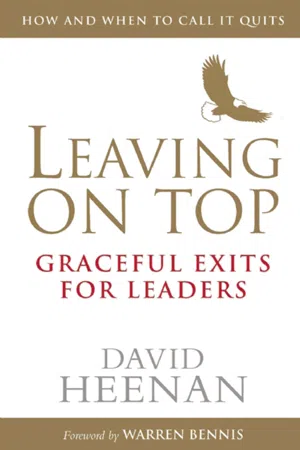
- 256 pages
- English
- ePUB (mobile friendly)
- Available on iOS & Android
eBook - ePub
About this book
Information
CHAPTER 1
TIME’S UP
“When the horse dies, dismount.”
—ENGLISH PROVERB
PEOPLE FROM THE SOUTHERN parts of the United States talk about having to make “hurtin’” decisions: choices that tear at the soul. None is more painful than deciding when to leave on top—when to leave a beloved calling, whether it’s business, entertaining, athletics, healing, or winning hearts and minds. The naked truth is that there comes a time when the door will slam on everyone. No one really wants to pack it in. And yet, everyone does.
“You’ve got to know when to hold ’em, know when to fold ’em, know when to walk away and know when to run,” goes Kenny Rogers’s timeworn song. Leaving on Top explores the psychological drama of quitting when you’re ahead versus clinging to a role in which you are no longer effective and tarnishing a distinguished career. For the past several years, I have been scrutinizing dozens of traumatic, life-altering sayonaras—and how men and women of every stripe confront them. Some handle this basic human fear with dignity and candor; others don’t. Through their gripping stories, you will better understand how to come to terms with one of life’s most formidable challenges: the graceful exit.
In what Lance Armstrong called his “dream scenario,” the embattled Texan would finish the 2010 Tour de France on the Champs-Élysées in Paris wearing the famous yellow jersey, or maillot jaune, thereby reinvigorating his bully pulpit to promote the worldwide fight against cancer. That dream gained credence the year before when the seven-time Tour winner re-emerged from a three-and-a-half-year retirement to capture an astonishing third-place finish in cycling’s ultimate contest. However, at 38, he knew that his comeback was a gamble. Up to that point, the oldest rider to win the three-week, 2,000-plus-mile suffer-a-thon was Firmin Lambót, who had won it nearly a century ago in 1922 at the age of 36. Anything less than victory, teammates warned, could tarnish Armstrong’s legacy.
Yet the aging icon portrayed his return to biking’s most popular race as more than preserving the Lance brand or mollifying the ego of an aging athlete who missed the spotlight. After all, many other champions—Michael Jordan, George Foreman, Dara Torres, and Martina Navratilova—had come back successfully from retirement. Steadfastly denying taking performance enhancers and breaking his sport’s rules, Armstrong was betting that his competitive fire and athletic experience could fend off the attack of younger legs. But it was not to be.
On a sweltering July day, Armstrong’s dream was dashed after he crashed three times on the race’s first foray into the sun-baked French Alps. Bloodied and bandaged, he plummeted to 39th place overall.
“My Tour is finished,” the controversial superstar and cancer survivor lamented. “I’ve had lots of years where it’s been very different, so I’m not going to complain.” Armstrong’s disastrous day in the mountains marked the end of an era: his days of the grueling two-wheeled challenge were over.
For centuries, youth and creativity have been inextricably linked. Youth brings vigor and vision. “The time of enterprise and hope,” Samuel Johnson called it. That piercing truth is reinforced in today’s culture, which facetiously calls the last trimester of life the “golden years.” Sooner or later, all of us must face—like the oven bird of Robert Frost’s poem—the problem of “what to make of a diminished thing.” We all have a shelf life where we begin to lose our spark—and we wonder how to exit with grace.
Reflecting on the winter of his own distinguished career, John Updike noted that the “memories, impressions and emotions from your first twenty years on earth are most writers’ main material; little that comes afterward is quite so rich. By the age of forty, you have probably mined the purest veins of this precious lode; after that, creativity is a matter of sifting the leavings.”
Many great writers, musicians, physicists, mathematicians, and inventors tend to start strong and peak early. Certainly, wünderkinds often flame out prematurely in Updike’s publishing world, where youth is almost always served. J. D. Salinger wrote The Catcher in the Rye when he was 32, and then went into seclusion. Harper Lee, at 34, stopped publishing after her Pulitzer Prize–winning masterpiece, To Kill a Mockingbird, one of the most beloved books in all of America’s literary canon. Leo Tolstoy, too, wrote no big novels after Anna Karenina (completed 33 years before his death). In each instance, their creative stuff had been snuffed.
Yet, examples abound of other writers who were late to the spotlight, finding fame in their senior years. The novelist Thomas Hardy became a full-time poet in his late 50s and wrote what many feel is his greatest poem at the age of 61. Alex Haley’s Pulitzer Prize–winning Roots was published when he was 55, and he had retired from the U.S. Coast Guard. After 30 years of teaching high school English, Frank McCourt was shocked to learn that, at 66, he had written a bestseller, Angela’s Ashes, about his early childhood in poverty-stricken Ireland. It took even more decades before 96-year-old Harry Bernstein achieved literary success with a memoir, The Invisible Wall, profiling his own miserable childhood in an English mill town.
Creative output, therefore, does not crest and ebb at any predetermined time, and a decline in productivity is far from inevitable. Besides writers, many other individuals have fired their creative spark in their advanced years. Grandma [Anna Mary] Moses first picked up a paintbrush at 76 and was still painting when she was 100. Martha Graham was a working choreographer well into her 90s. Frank Lloyd Wright completed the Guggenheim Museum in New York at 91. Perennially cool jazz legend Dave Brubeck, now in his 90s, still plays before full houses. As actress Bette Davis famously put it, “Old age ain’t for sissies!”
Furthermore, a growing body of research suggests that the fall of the creative curve can be postponed. Studies of brain plastic-ity—the lifelong ability of our gray matter to adapt to changing demands—are proving that our creative horizons need not narrow with age. “We never lose our potential to learn new things as we grow older,” says Gay Hanna, head of the National Center for Creative Aging. “In fact, we can master new skills and be creative all our lives.” What’s more, the brains of people in their 50s and 60s apparently work better in many ways than those of younger adults. The brain actually feeds on novelty, and studies show that cognitive ills can be delayed—even prevented—by taking on new mental challenges, such as learning a new language, reading a difficult book, or tackling a new pursuit.
Painters, writers, composers, and sculptors—the gamut of creative types—work until they die. They often find life’s best rewards late in the game. Works created by Paul Cezanne in his 60s, for example, command fifteen times the price of paintings he did as a young man. Even the award-winning Updike, who died in 2009 at 76, conceded that “an aging writer has the not insignificant satisfaction of a shelf of books behind him, … and the pleasure of bookmaking remains creation’s giddy bliss.” Still, the stereotype of aging and diminished productivity persists.
Confronting the final act to a productive career is also compounded by a culture in which one’s profession is a real-life passport to identity, to selfhood, to self-esteem. “You are what you do,” says management guru Warren Bennis. “If one leaves, one is nowhere, like a character in a Beckett play, without role, without the props of office, without ambience or setting.” For many leaders their whole persona is wrapped up in their job. Their partners, staff, and others are their community. As a result, many equate saying goodbye with euthanasia and castration—and hang on too long. But how long is too long? “When you no longer have some snap in your garters,” geriatric U.S. Sen. Russell B. Long once quipped.
On his 90th birthday, Justice Oliver Wendell Holmes gave a radio address in which he quoted a line of ancient Latin poetry: “Death plucks my ear and says, ‘Live—I am coming.’” In grappling with their mortality, some would-be Methuselahs refuse to grow old without a fight—seeking out age-defying aids, from hair plugs and Harleys to Botox and little blue pills.
Others demonstrate that growing old and maintaining competence aren’t mutually exclusive. Crusty codgers like Warren Buffett, Clint Eastwood, Betty White, and Sandra Day O’Connor are able to resist the gravitational pull of time, maintaining their enthusiasm and sharpness. They seem to get better with age and stay as professionally and socially engaged as possible. They refuse to ride into the sunset—and why should they? But they are true outliers.
For most of us, time does not move with merciful slowness. “No matter how you sugarcoat it,” Bennis adds, “aging forces us to confront the essential tragedy of our species.” While medical technology and genetic enhancements are moving individuals to a longer life (longevity has doubled since the mid-19th century), it’s hard to reverse the clock. Like it or not, the 70s represents the end, not the beginning. Average life expectancy remains 78. It’s rising, but not as fast, perhaps, as our expectations.
As we shall see, balancing the push and pull between timetables and dreams is an inexact science. It can be a mistake to call it quits too early, and it can be easy—as well as self-defeating—to stay too long. The trick to the graceful exit, says columnist and septuagenarian Ellen Goodman, who retired after 46 years of deadlines about social change, “begins with the vision to recognize when a job, a life stage, a relationship is over—and to let it go…. It involves a sense of the future, a belief that every exit line is an entry, that we are moving on rather than moving out.”
“Don’t retire, retread!” advises Robert Otterbourg, author of Retire & Thrive. He tells folks to shun the forbidding signposts: should have, would have, and could have. Moving on, as Goodman suggests, is not life’s final chapter, but simply the end of one phase of adulthood and the beginning of another.
It’s certainly too soon to order a coffin for Ed Koch, the former congressman and mayor of New York. Since leaving Gracie Mansion in 1989, the peripatetic octogenarian has had several lives: lawyer, talk-show host, columnist, movie reviewer, university lecturer, author (I’m Not Done Yet!) and TV judge on The People’s Court. “It suits an old workaholic like me just fine,” Koch writes of his many roles. Polymaths like the no-nonsense Koch forge new highways of their own choosing. His “last hurrah” is his current crusade to reform New York state government, a task many have tried—and failed—to accomplish.
“God writes straight with crooked lines” goes a Portuguese proverb, meaning the oddest happenings often make sense only in the long run. Leaders contemplating leaving on top recognize that the topology of life is ever changing. For them, the whole-life experience is an exploration, a journey of self-discovery. They would agree with the novelist, poet, and composer Paul Bowles, who said, “The point of life is to have fun, if there is any point at all. Enjoyment is what life should provide.”
The central decision to bid adios to a certain position, therefore, should always begin with this question: Will I enjoy more—and contribute more—today and tomorrow than yesterday? If not, the timing is right to enter the next stage of life.
Career transitions are never easy. After being stripped of his cycling titles for doping and banned from competition, Lance Armstrong, at 40, faces the prospect of a tarnished legacy. Drug cheat or persecuted hero? Although his time is up as a professional athlete, his primary focus remains his high-profile attack on cancer, as attested by more than 70 million Livestrong wristbands. He has become an established celebrity outside sports. “Here’s a guy who hangs out with Matthew McConaughey, Bono and Ben Stiller,” said Neal Rogers, managing editor of VeloNews magazine. “A lot of people don’t equate Lance Armstrong with athleticism anymore.”
Nonetheless, jettisoning a longstanding career and heading into unchartered waters takes tremendous drive and confidence. Graceful exiters are highly motivated. Their spunk and spirit of self-renewal pays off. People who are able to reinvent themselves “have a way of reducing stress and of assuming that they’re not so bound up in the power games of life that they’re highly vulnerable to disappointments and setbacks,” says Abraham Zaleznik, distinguished psychoanalyst and professor emeritus at Harvard Business School. “They have something more going for them.”
These intrepid adventurers want to stretch their limits. Rather than being shackled to the past, they are on a never-ending search for higher mountains to climb and a bigger canvas to impact people. J. B. Fuqua, founder and former chairman of the multibillion-dollar Fuqua Industries, long advised business bigwigs to explore second careers to escape creeping corporate boredom. Having served four terms in the Georgia Legislature, the self-made entrepreneur combined business with philanthropy, becoming one of Duke University’s biggest benefactors. “Becoming a CEO is not the end of the learning curve,” he told his corporate colleagues. “It’s more like a new beginning.”
Fuqua brought a panoply of assets, including self-awareness and independence, that served both him and his multiple roles well. That kind of self-possession and personal equilibrium guarantees happiness, regardless of the métier an individual may once have pursued.
Similarly, Winston Churchill, arguably the greatest figure of the last century, long advocated the merits of exploring virgin territory. “The creation of new forms of interest are a policy of first importance to a public man,” he wrote. A Nobel Prize–winning author, a mesmerizing orator, and an accomplished artist, Churchill was the quintessential Renaissance man. He made it his life’s mission to reinvent himself. Beyond balancing the affairs of state, “the Last Lion,” as William Manchester called him, insisted that personal experimentation was the true test of happiness.
Of course, the nature of work also influences when to call it a day. “The more spiritual the work,” suggests author and talk-show host Michael Medved, “the better the chance for rewards that last a lif...
Table of contents
- Cover Page
- Title Page
- Copyright Page
- Dedication Page
- Contents
- Acknowledgments
- Foreword
- 1 Time’s Up
- 2 Letting Go (Anne Mulcahy/John Calley)
- 3 Founding Fathers (Howard Schultz/Richard Kelley)
- 4 Still in the Game (John Gagliardi/Joe Gibbs)
- 5 Fighting Back (George Foreman/Mike Tyson)
- 6 After the Gold (Eric Heiden/Dara Torres)
- 7 Broadcast News (Vin Scully/Bob Uecker)
- 8 Senior Statesmen (Tom Coburn/Daniel Akaka)
- 9 Creative Genius (Michael DeBakey/Harry Gruber)
- 10 The Entertainer: A Survivor’s Guide (Betty White/Jimmy Dean)
- 11 Exit Laughing (Johnny Carson/Ed McMahon)
- 12 Leaving on Top
- Notes
- Index
Trusted by 375,005 students
Access to over 1.5 million titles for a fair monthly price.
Study more efficiently using our study tools.
Frequently asked questions
Yes, you can cancel anytime from the Subscription tab in your account settings on the Perlego website. Your subscription will stay active until the end of your current billing period. Learn how to cancel your subscription
No, books cannot be downloaded as external files, such as PDFs, for use outside of Perlego. However, you can download books within the Perlego app for offline reading on mobile or tablet. Learn how to download books offline
Perlego offers two plans: Essential and Complete
- Essential is ideal for learners and professionals who enjoy exploring a wide range of subjects. Access the Essential Library with 800,000+ trusted titles and best-sellers across business, personal growth, and the humanities. Includes unlimited reading time and Standard Read Aloud voice.
- Complete: Perfect for advanced learners and researchers needing full, unrestricted access. Unlock 1.5M+ books across hundreds of subjects, including academic and specialized titles. The Complete Plan also includes advanced features like Premium Read Aloud and Research Assistant.
We are an online textbook subscription service, where you can get access to an entire online library for less than the price of a single book per month. With over 1.5 million books across 990+ topics, we’ve got you covered! Learn about our mission
Look out for the read-aloud symbol on your next book to see if you can listen to it. The read-aloud tool reads text aloud for you, highlighting the text as it is being read. You can pause it, speed it up and slow it down. Learn more about Read Aloud
Yes! You can use the Perlego app on both iOS and Android devices to read anytime, anywhere — even offline. Perfect for commutes or when you’re on the go.
Please note we cannot support devices running on iOS 13 and Android 7 or earlier. Learn more about using the app
Please note we cannot support devices running on iOS 13 and Android 7 or earlier. Learn more about using the app
Yes, you can access Leaving on Top by David Heenan in PDF and/or ePUB format, as well as other popular books in Business & Management. We have over 1.5 million books available in our catalogue for you to explore.