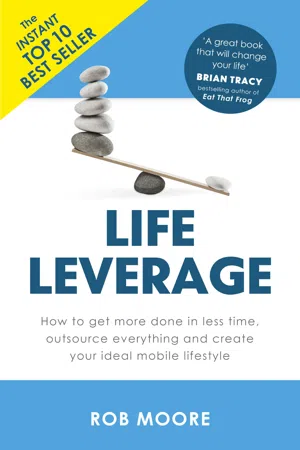
You are just one small step away from the life you know you deserve. It's time to leverage your life. Life Leverage means taking control of your life, easily balancing your work and free time, making the most money with the minimum time input & wastage, and living a happier and more successful life.Using Rob Moore's remarkable Life Leverage model, you'll quickly banish & outsource all your confusion, frustration and stress & live your ideal, globally mobile life, doing more of what you love on your own terms.Learn how to:
- Live a life of clarity & purpose, merging your passion & profession
- Make money & make a difference, banishing work unhappiness
- Use the fast-start wealth strategies of the new tech-rich
- Maximise the time you have; don't waste a moment by outsourcing everything
- Leverage all the things in your life that don't make you feel alive'This book shows you how to get more done, faster and easier than you ever thought possible. A great book that will change your life'. Brian Tracy, bestselling author of Eat That Frog
eBook - ePub
Life Leverage
How to Get More Done in Less Time, Outsource Everything & Create Your Ideal Mobile Lifestyle
- 288 pages
- English
- ePUB (mobile friendly)
- Available on iOS & Android
eBook - ePub
Life Leverage
How to Get More Done in Less Time, Outsource Everything & Create Your Ideal Mobile Lifestyle
About this book
Information
Section 1: Concept
This section, which is about the concept of Life Leverage, covers philosophy, architecture, attitude and a way of thinking about life. This is the anti-system mindset and methodology of Life Leverage. Like the great architects who have a single concept for a building, or the best-selling books that have one single, recurrent theme, or the niche businesses that serve one sole purpose and don’t try to be everything to everybody, and the band that creates a great riff or chorus that they repeat throughout the song to make it catchy, your entire life by design is built on the Life Leverage concept.
Life Leverage: how to get more done in less time, outsource everything and create your ideal mobile lifestyle.
#1 There’s no such thing as ‘time management’
‘Time management’ as a concept is utterly ridiculous. It must surely be one of the most misunderstood concepts in work and life. The more you think about ‘managing’ time, the more of a slave to it you become. It’s like trying not to think about something you are thinking about only making you think about it more.
You cannot manage time. It does not stand still for anyone. It does not wait. You cannot control it in anyway. Time will keep going, it doesn’t care about you, and it will take you with it in the end.
So how come there are so many time-management books and gurus? Perhaps it’s because everyone is looking for the shortcut or time hack to beat, and save, time. It was Brian Tracy, perhaps one of the world leaders in the tactical field of time management, whom I hold in very high regard, who first taught me what ‘time management’ is:
TIME MANAGEMENT IS LIFE MANAGEMENT
You don’t ‘manage’ time, you ‘manage’ yourself. You manage your life. You manage your decisions, behaviours and emotions. This book isn’t called ‘Time Leverage’, it is called Life Leverage. It’s about leveraging elements of yourself and your life, to make it appear as if you have more time.
We all get graced with enough time on this planet to do amazing things that can leave a legacy for generations to come. If one person can reach the Moon, make a billion, get a PC into every home, rid the world of polio, become the world’s best bodybuilder then highest-paid actor then state governor, in their lifetime, then so can you. Bill Gates and Arnie have the same number of minutes in an hour, hours in a day, days in a week, weeks in a year, years in a decade as you.
So it’s never about how much time you or anyone else has or hasn’t, and all about how you choose, use and invest that time, that makes all the difference – the difference between being somebody and being anybody.
If you miss a deadline, it wasn’t that you didn’t have enough time; you didn’t manage your workload or workflow well enough. You weren’t disciplined enough to do what needed to be done in the time that you had, which was enough when you started.
If you don’t do something that’s important to you, or you can’t balance all the things in your life, then you aren’t managing your priorities effectively. If you feel you are running around doing things for the benefit of other people and not for yourself, making other people rich and not making yourself happy at home, or you are confused, frustrated and overwhelmed, then you this is down to you. You allowed time to do that and blocked time to do the things that make the biggest difference to your life (your vision).
If you get to the end of the day and think to yourself, ‘Did I actually get anything meaningful done?’ and the answer is ‘No’, then you wasted the greatest gift and the most scarce and valuable resource known to humankind: time.
Time is our most valuable and precious commodity, slowly running out, slowly catching up on us. Time is being invested or wasted. There is no ‘in between’. Time is your currency, asset and mechanism of value and exchange. You can only ‘manage’ time by managing your life and how you invest the time that you have, which is equal to the time everyone has. Time is currency and how you can cash in on that currency has its own chapter, coming soon.
Life management is discipline in action. Discipline isn’t about pain, self-negation or sacrifice as much as it is about having a vision: a longer-term view of who and where you want to be, and making the right, highly prioritized decisions moment to moment, even when you don’t feel like it in that moment.
Life management, previously known as time management, is about leveraging other time-related assets such as people, capital, ideas, information, software, systems (all explained in detail in Life Leverage strategies in Section 2) to maximize your results and benefit to you, ‘burning’ away as little of your own time as possible, so you can invest the maximum amount of your own personal time as possible, according to your highest values and towards your vision and legacy.
CHEATING TIME
You ‘cheat’ time, or get more done in less (of your personal) time, through outsourcing and leverage. Not through working harder and longer. You ‘cheat’ time through understanding time as asset and currency, not as tasks, to-do lists and what you have to get done.
You ‘cheat’ time by being clinical about highest ‘priorities’ and lowest ‘posteriorities’ (low or anti-priorities); single-mindedly focusing on highest-value or highest Income-Generating Tasks (IGTs), and delegating, delaying and/or deleting everything else.
Summary
You can’t manage time, you can only manage your life. In the rest of this book, the ‘how to’ tactics of preserving and leveraging time for maximum productivity will be revealed. So will the intuitive, spontaneous understanding of your highest values, your life’s vision and the legacy you want to leave behind that guides your efficient investment of time, never wasting a second or getting pulled into other people’s urgencies.
#2 Time currency
Time is the real, universal currency. Before money was exchanged in a ‘fiat’ system, and even before the introduction of coins and precious metals, before governments controlled the monetary system, people would exchange their time to create a product (a cobbler or smith, for example) or provide a service that someone else perceived to have value. If they didn’t, they likely died, unless they could hunt, because they’d have no mechanism to buy food.
Individuals would exchange their own product or service that they had exchanged their own time and passion to create, and these would be exchanged in turn for other products or services. When there was no universal monetary system to regulate fair exchange, you had the manifestation of your time invested as your one and only currency.
The value of that currency was directly related to the value of the time invested. And the value to the recipient of that time invested was their perception of that value, not yours. So time, as a currency, is in fact how recipients of your manifested time investment perceive the value of it to them and/or their life. They will then exchange something they value in return for it. This is known as ‘fair exchange’. Fair exchange is the natural and agreed right balance between buyer and seller, giver and recipient, during a sale and purchase where a transaction happens.
Currency literally means ‘flow’. Currency is an always-moving value exchange of time investment. Money is the end result, but currency is the continual flow of time between interconnected people. Just as money flows from one person to another to another very quickly, so can, and does, your time. You make more money by creating more currency, also known as economy, enterprise or GDP (gross domestic product), all of which are the flow of time in monetary form.
If fair exchange doesn’t take place, or the balance is at either extreme of the spectrum in favour of the buyer or seller, one party feels that they’re not valued highly enough, or that they are being cheated. In this instance, time as currency loses its value and circulation, where the buyer who feels cheated looks for compensation and tells others of their experience, or the seller who feels undervalued can’t sustain funding their free time or can’t make profit with high enough prices to pay their overheads.
THE IRONY OF TIME
The irony of time is that most people can’t or don’t measure time, and therefore place a real value to it. You can’t master what you don’t measure. Instead, they place value on material items or financial mechanisms, spending or wasting all their time to get a very physical remuneration.
Society raises and forces you down a route convincing you the right way to live is to work hard your whole working life, exchanging all your time for a small amount of money to just get by and just pay your bills, taking overtime and sacrificing free time, so that you can save up or buy free time later in life, to do what you always wanted to do. But when you get to your later years, you start running out of time, and the money you thought you’d saved for retirement is less and doesn’t last. So you have to work longer and harder, never getting those years back. Then, when you finally can retire to do the things you love to do, you die.
Society in the industrial age set up three stages of ‘life’ related to work: learning, earning and yearning years. Learning years are 0–18, earning years are 18–65-plus (it used to be 50) and yearning years are 65 to the end of life. You’re sausage-machined into going to school and learning to get a job or career, and encouraged to work most of your life to set up some free time right at the end, if you get there.
There’s an illness or phenomenon known as ‘Broken Heart Syndrome’. Its more official name is Takotsubo cardiomyopathy. This is a syndrome or illness where the heart temporarily enlarges and doesn’t pump well, causing shortness of breath, angina and sometimes death. It is a physical reaction to a surge in stress hormones that can be caused by an emotionally stressful event. This ‘Broken Heart Syndrome’ is one of the main killers of people when they ‘retire’. They literally die from sudden loss of purpose, belief and hope, caused by no vision and their lack of financial provision.
This must not be you. This would be such a sad and empty way to die. You should die having lived a long and exuberant life that made a huge difference to others, and go out in a blaze of glory.
WARNING: the learning, earning and yearning societal system is an outdated model. This is the antithesis of Life Leverage. This is the way most people in the world understand and are forced down, but it is not the only way.
THE ALTERNATIVE – THE LIFE LEVERAGE WAY
The Life Leverage way means that you can earn in the learning years. You can teach your children about business and money from four years old. You can put audios on in the car, get them watching educational YouTube videos on the tablet at a young age, and they can start setting up online businesses and earning money at 13 years old.
The Life Leverage way means you can keep learning in the earning stage of life. Don’t stop learning just because you’ve finished school. Continually investing in your education and knowledge will ensure that you continually get a return on your time and increase your financial reward.
The Life Leverage way means that you don’t have to wait to your yearning years to ‘retire’. You can do what you love and love what you do, make your passion your profession and your vocation your vacation.
Work doesn’t have to be work, and you can take ‘mini-retirements’ every week or every month, you can ‘front-load’ rather than ‘rear-load’, or delay, your retirement. You don’t have to have all work at the front of your life (front-loaded) and all retirement at the end of your life (rear-loaded). I ‘retired’ twice, in 2007 and 2009; never again, it was so boring! It was like eating Italian with no carbs. I lasted no more than a month before I needed a purpose. I didn’t want to start my slow decay. I know now that I just had the wrong definition of ‘retirement’. I had defined retirement the way society defines it, and not how it really should be for someone who controls his or her own life and time.
You can now ‘work’ remotely and mobile, anywhere in the world, while on vacation. You can mix business with pleasure, and social with operational. You can merge passion and profession. You can redefine both. Work doesn’t have to be work any more.
Life Leverage means that you don’t have to wither and die in your yearning years. You don’t have to reminisce or wish you’d seen your children grow up or you’d done more with your life, or not worked as hard.
Here are the five biggest regrets of the dying:
1. I wish I hadn’t worked so hard.
2. I wish I’d had the courage to live a life true to myself, not the life others expected of me.
3. I wish I’d had the courage to expr...
Table of contents
- Cover
- Title Page
- Copyright
- Dedication
- About Rob Moore
- Contents
- Foreword: If it wasn’t for you…
- Introduction
- Section 1: Concept
- Section 2: Strategy
- Section 3: Tactics
- Section 4: Blueprint
- Afterword: What are you going to do now?
Trusted by 375,005 students
Access to over 1.5 million titles for a fair monthly price.
Study more efficiently using our study tools.
Frequently asked questions
Yes, you can cancel anytime from the Subscription tab in your account settings on the Perlego website. Your subscription will stay active until the end of your current billing period. Learn how to cancel your subscription
No, books cannot be downloaded as external files, such as PDFs, for use outside of Perlego. However, you can download books within the Perlego app for offline reading on mobile or tablet. Learn how to download books offline
Perlego offers two plans: Essential and Complete
- Essential is ideal for learners and professionals who enjoy exploring a wide range of subjects. Access the Essential Library with 800,000+ trusted titles and best-sellers across business, personal growth, and the humanities. Includes unlimited reading time and Standard Read Aloud voice.
- Complete: Perfect for advanced learners and researchers needing full, unrestricted access. Unlock 1.5M+ books across hundreds of subjects, including academic and specialized titles. The Complete Plan also includes advanced features like Premium Read Aloud and Research Assistant.
We are an online textbook subscription service, where you can get access to an entire online library for less than the price of a single book per month. With over 1.5 million books across 990+ topics, we’ve got you covered! Learn about our mission
Look out for the read-aloud symbol on your next book to see if you can listen to it. The read-aloud tool reads text aloud for you, highlighting the text as it is being read. You can pause it, speed it up and slow it down. Learn more about Read Aloud
Yes! You can use the Perlego app on both iOS and Android devices to read anytime, anywhere — even offline. Perfect for commutes or when you’re on the go.
Please note we cannot support devices running on iOS 13 and Android 7 or earlier. Learn more about using the app
Please note we cannot support devices running on iOS 13 and Android 7 or earlier. Learn more about using the app
Yes, you can access Life Leverage by Rob Moore in PDF and/or ePUB format, as well as other popular books in Business & Management. We have over 1.5 million books available in our catalogue for you to explore.