Global customers, supply chains and more integrated business functions mean that work now cuts across the traditional vertical silos of country and function. But the 'solution' of the matrix structure also brings multiple bosses, competing goals and higher levels of complexity. Traditional management training prioritizes clarity, predictability and control. In a matrix we need to be able to balance this with the ability to tolerate ambiguity, manage uncertainty and decentralize control. Managers need an expanded toolkit to help them move from the hard to the soft, from the concrete to the ambiguous and back again depending on the situation. Making the Matrix Work introduces some new ideas and practical tools in 3 key areas. * Leading people beyond clarity to flexibility A matrix trades clarity for flexibility. We need to create enough clarity on goals and roles and to align with others; but we also need to cope with ambiguity, manage complex trade-offs and dilemmas and deal with higher levels of conflict. * Being connected and effective We set up a matrix to improve cooperation and communication across the silos but be careful what you wish for! It is easy to become over-connected to poor quality meetings, teams and communication. More teamwork, meetings and emails are not the answer. * Creating control by giving it away. The complexity and diversity of the matrix can undermine trust and lead to an increase in central control and bureaucracy. We need to prevent this by building trust, empowering and creating commitment. Accountability without control and influence without authority are the norm. Kevan Hall's new book will help you develop your matrix mindset and will show you how to establish and engage networks that do not depend on role, control or authority to get things done. This book gives individuals working in the matrix the tools to take control of their own goals, role and success and shows matrix managers how to lead others to make their matrix really work.
eBook - ePub
Making the Matrix Work
How Matrix Managers Engage People and Cut Through Complexity
- 240 pages
- English
- ePUB (mobile friendly)
- Available on iOS & Android
eBook - ePub
About this book
Information
1 Introduction
Welcome to the matrix, where multiple bosses, competing goals, influence without authority, and accountability without control are the norm. It is a world where skills, not structure, are the drivers of business and personal success.
At its simplest, a matrix reflects the reality that work no longer fits within the traditional “vertical” structures of function and geography. Today, work is much more “horizontal”: it cuts across silos and even extends outside the organization to include suppliers, customers, and other business partners.
Most large organizations now operate some kind of matrix organizational structure in order to serve global customers, coordinate international supply chains, and run integrated internal systems and business functions.
In a matrix, we routinely work with colleagues from different locations, business units, and cultures in cross-functional and virtual teams. Matrix working is now everywhere – and it requires different skills in leadership, cooperation, and personal effectiveness.
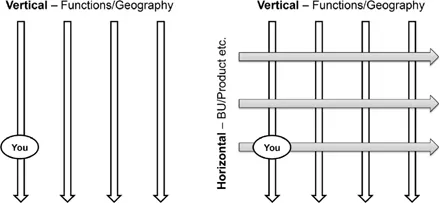
Figure 1.1 From vertical to matrix working
MATRIX ADVANTAGES AND DISADVANTAGES
Matrix management is not the latest management and consulting fad; it has been around since the 1970s. As soon as organizations have multiple locations, countries, or business units that require coordination, some form of matrix evolves, even if only at group level. As organizations become more integrated and share systems, resources, or talent, the matrix evolves so that it reaches deeper into the organization.
Structure should always follow strategy. The four key advantages that organizations seek when introducing a matrix structure are:

The business logic is compelling, but introducing a matrix does mean a step up in complexity in the way people work together and many organizations have struggled with implementation. Some even claim to have abandoned the matrix (although in reality they usually just move to a simpler form). The disadvantages they cite include:
Both the advantages and disadvantages of the matrix are fundamentally about people and the way they work together. Delivering the advantages and avoiding the disadvantages cannot be achieved through a structural change alone, only by building the skills and mindset necessary to cut through the complexity.
A DAMAGING PREOCCUPATION WITH STRUCTURE
Organizations that ignore skills and seek a structural solution on its own can remain stuck in an endless cycle of reorganizations, which not only fail to solve the problem, but make it worse by disrupting the networks and relationships that really get things done.
In my work with over 50,000 people in 300 major multinationals in more than 40 countries, I have learned that structural change solves nothing, and that an excessive focus on structure has been positively damaging to the development of matrix management. Much more important are the networks, communities, teams, and groups that form within a matrix to get things done. Structural change is a blunt, slow, and imprecise tool for forcing change:
Skilled people can make almost any structure succeed, but even the most elegant structure will fail if the people within it do not have the skills to make it work.
DELIVERING STRATEGY REQUIRES SKILLS
Effective organizational change flows from strategy to structure to systems to skills. All four waves of change need to be completed and aligned in a successful matrix implementation.
Once organizations are clear about their strategy, they can then focus on the formal structure and the high-level people moves necessary to make their goals happen.
At the same time, many organizations begin a necessary but expensive and time-consuming journey toward common systems. A full-scale SAP, Oracle, or Microsoft Business implementation can take several years and have a major, organization-wide impact on business processes such as product lifecycles, customer relationship management (CRM), supply chain and human capital management. In a large, global organization a full SAP implementation may take five years or more. Depending on the size of your business, and including employee costs, such an implementation could cost tens or even hundreds of millions of dollars.
Nevertheless, many organizations do little beyond announcing the structural changes, and fail to consider how to build the skills to cope with this higher level of complexity. Insufficient thought is given initially to changing criteria for selection and promotion, rewards, capabilities, and training and development to reflect the new environment.
A successful matrix implementation requires the embedding of strategy, structure, systems, and skills. A failure to manage change in any of these four areas can lead to a failure of the overall implementation.
In my experience, many organizations invest heavily in structure and systems and neglect the development of skills. When people find it difficult to operate the matrix, they may blame the structure and reorganize again, instead of realizing they lack the necessary skills.
A SHIFT IN POWER FROM STRUCTURE TO SKILLS
Because authority and power are shared between multiple bosses in a matrix, they become less effective as ways of getting things done. Individuals with multiple bosses have to manage tradeoffs and make decisions about where to invest their time and enthusiasm. Managers can feel as if they have lost the authority and control they had in the simpler, functional, single-manager structure of the past.
Two common complaints from managers new to matrix working illustrate this concern:
I will introduce some tools and concepts for dealing with these challenges later, but for now let’s think about the implications of these statements. Are these managers really saying that they cannot get things done without direct control and hierarchical authority?
We call the people who raise these objections “matrix victims.” Their resistance is often rooted in a lack of confidence in their skills and capability to get things done without traditional control and authority.
In a modern organization, with skilled people, an overreliance on control and power can in fact be counterproductive. It can create unwilling followership at best and is more likely to provoke disengagement, resentment, and avoidance. A hierarchical and control-based individual or corporate culture will really struggle to make a matrix work.
During the implementation of a matrix organization, companies such as IBM and Cisco reported losing around 20 percent of their managers through a combination of structural change and turnover of those who did not fit the new way of working. Most organizations see this turnover as an essential part of bringing about the necessary change in style and embedding matrix behaviors. If your leaders are overreliant on hierarchy and control, they may not be suitable for managing in the matrix.
This shift in power from the structure of the past to the shared authority and more complex skills of the matrix does not go unopposed. Despite the reality that work has become more horizontal, many organizations have struggled to break the power of vertical silos. Traditionally, authority, control, and power rested in vertical functional and geographic silos; and they still provide the route for career progression for most people. Consciously or unconsciously, powerful vertical managers may resist the loss of power to horizontal processes and reporting lines.
THE EMPLOYEE ENGAGEMENT UPSIDE
While the move from structure to skills can be uncomfortable for managers, it can provide a significant upside in employee engagement, critical in all organizations. High levels of engagement increase “discretionary effort,” meaning that people are prepared to go the extra mile to achieve their goals. Greater engagement correlates with high levels of performance, retention, and learning.
Matrix structures often get a bad press for increasing complexity and even conflict, but they do allow us to engage some powerful drivers of employee engagement.
This book will show that matrix success requires individuals to take more ownership of their goals and roles; creates broader and more meaningf...
Table of contents
- Cover Page
- Title Page
- Copyright Page
- Contents
- 1 Introduction
- Part I: Clarity
- Part II: Cooperation
- Part III: Control
- Part IV: The Matrix Mindset and Skillset
- Acknowledgments
- Index
Trusted by 375,005 students
Access to over 1.5 million titles for a fair monthly price.
Study more efficiently using our study tools.
Frequently asked questions
Yes, you can cancel anytime from the Subscription tab in your account settings on the Perlego website. Your subscription will stay active until the end of your current billing period. Learn how to cancel your subscription
No, books cannot be downloaded as external files, such as PDFs, for use outside of Perlego. However, you can download books within the Perlego app for offline reading on mobile or tablet. Learn how to download books offline
Perlego offers two plans: Essential and Complete
- Essential is ideal for learners and professionals who enjoy exploring a wide range of subjects. Access the Essential Library with 800,000+ trusted titles and best-sellers across business, personal growth, and the humanities. Includes unlimited reading time and Standard Read Aloud voice.
- Complete: Perfect for advanced learners and researchers needing full, unrestricted access. Unlock 1.5M+ books across hundreds of subjects, including academic and specialized titles. The Complete Plan also includes advanced features like Premium Read Aloud and Research Assistant.
We are an online textbook subscription service, where you can get access to an entire online library for less than the price of a single book per month. With over 1.5 million books across 990+ topics, we’ve got you covered! Learn about our mission
Look out for the read-aloud symbol on your next book to see if you can listen to it. The read-aloud tool reads text aloud for you, highlighting the text as it is being read. You can pause it, speed it up and slow it down. Learn more about Read Aloud
Yes! You can use the Perlego app on both iOS and Android devices to read anytime, anywhere — even offline. Perfect for commutes or when you’re on the go.
Please note we cannot support devices running on iOS 13 and Android 7 or earlier. Learn more about using the app
Please note we cannot support devices running on iOS 13 and Android 7 or earlier. Learn more about using the app
Yes, you can access Making the Matrix Work by Kevan Hall in PDF and/or ePUB format, as well as other popular books in Business & Organisational Behaviour. We have over 1.5 million books available in our catalogue for you to explore.