MBA In A Week is a simple and straightforward way to get the edge in business, giving you everything you really need to know in just seven short chapters. Every day it focuses on one area of MBA study, from global business, finance and accounting, to strategy, marketing and operations management.This book distils the most practical business insights of an MBA into easy-to-digest bite-sized chunks, giving you a basic knowledge and understanding of the key concepts, together with practical and thought-provoking exercises. Whether you choose to read it in a week or in a single sitting, MBA In A Week is your fastest route to success: - Sunday: Global business pressures and change
- Monday: Finance, economics and accounting
- Tuesday: Entrepreneurship, ethics and social responsibility
- Wednesday: Strategy and marketing
- Thursday: Operations management
- Friday: Organizational behaviour and human resources management
- Saturday: Research and change management ABOUT THE SERIES
In A Week books are for managers, leaders, and business executives who want to succeed at work. From negotiating and content marketing to finance and social media, the In A Week series covers the business topics that really matter and that will help you make a difference today. Written in straightforward English, each book is structured as a seven-day course so that with just a little work each day, you will quickly master the subject. In a fast-changing world, this series enables readers not just to get up to speed, but to get ahead.
eBook - ePub
MBA In A Week
All The Insights Of A Master Of Business Administration Degree In Seven Simple Steps
- 128 pages
- English
- ePUB (mobile friendly)
- Available on iOS & Android
eBook - ePub
MBA In A Week
All The Insights Of A Master Of Business Administration Degree In Seven Simple Steps
About this book
Information
The importance of organizational behaviour and HR departments and their impacts on communications and efficiencies in the management of businesses receive a lot of attention in MBA degrees and in business schools today.
People, processes and work link organizational behaviour (OB) and HR management (HRM), emphasizing intercultural and cross-cultural perspectives for organizational development, talent management, personal development and leadership. Emotional intelligence (EI) is emphasized increasingly in HR departments and executive boardrooms as a useful skill to increase people’s abilities to recognize behaviours, moods and impulses, and to manage them effectively in any situation.
The ability to understand people’s emotions and how they may be controlled encourages better management and more effective communications in workplaces.
From Theory X to Theory Y … and beyond
In 1911 the US mechanical engineer Frederick W. Taylor (1856–1915) published his groundbreaking study Principles of Scientific Management, in which he addressed the issue of how to motivate workers to produce more. Taylor argued that workers were primarily motivated by money and accordingly developed a differential piece-rate system for the workplace: those workers who did not meet the expected output received a lesser rate of pay, while those who achieved or exceeded the expected output earned the higher rate. This approach has subsequently become known as Theory X, and has been much criticized on account of its rather reductive approach to both motivation and human nature.
Strikingly absent from Taylor’s understanding of motivation was the role of group behaviour. This was addressed directly by a new generation of theorists (writing from the 1920s until as late as the 1960s), human relationists, who argued that, in addition to money, workers sought respect, fair treatment and attention; they wanted to be wanted.
The Hawthorne Experiments |
In the 1920s workplace efficiency researchers observed how lighting affected workers assembling electronic components at Western Electric’s Hawthorne plant near Chicago. Results indicated that lighting did not affect production consistently – increasing light increased production, but reducing light also increased production! Workers, it seemed, weren’t responding to the change in lighting but to the fact that they were being observed by the researchers – later dubbed the ‘Hawthorne Effect’. Management was taking an interest in them and that was enough to increase productivity! |
Their studies revealed that a worker’s motivation was shaped not only by his or her personality and needs but also by the group to which he or she belonged. While one clique of workers might have developed an ethic of hard work and a sense of responsibility, another might encourage ‘clock-watching’ and doing only so much work as was required and no more.
The next generation of theorists focused on the role of the manager in improving efficiency and output. Previously, management had been about control; now it was about facilitation by meeting workers’ needs. People work to make a living, of course, but they also work to fulfil certain needs, including:
• to contribute to organizational objectives
• to attain a feeling of accomplishment
• to use their creativity in the work environment.
To maximize motivation, managers need to keep the full variety of needs in mind when dealing with workers. This approach has since been termed Theory Y, as it so sharply contrasts with Taylor’s.
Maslow’s hierarchy of needs |
The classic tool for understanding employees’ varying needs is still Abraham Maslow’s ‘hierarchy of needs’, first outlined in 1943 but given its fullest expression in his book Motivation and Personality (1954). 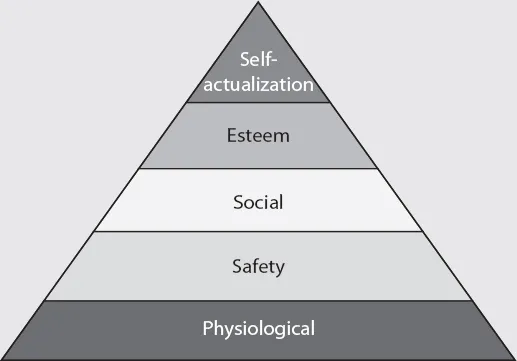 Self-actualization – personal growth and fulfilmen... |
Table of contents
- Cover
- About the Author
- Title
- Contents
- Introduction
- Sunday: Global business pressures and change
- Monday: Finance, economics and accounting
- Tuesday: Entrepreneurship, ethics and social responsibility
- Wednesday: Strategy and marketing
- Thursday: Operations management
- Friday: Organizational behaviour and human resources management
- Saturday: Research and change management
- 7 × 7
- Answers
- Copyright
Trusted by 375,005 students
Access to over 1.5 million titles for a fair monthly price.
Study more efficiently using our study tools.
Frequently asked questions
Yes, you can cancel anytime from the Subscription tab in your account settings on the Perlego website. Your subscription will stay active until the end of your current billing period. Learn how to cancel your subscription
No, books cannot be downloaded as external files, such as PDFs, for use outside of Perlego. However, you can download books within the Perlego app for offline reading on mobile or tablet. Learn how to download books offline
Perlego offers two plans: Essential and Complete
- Essential is ideal for learners and professionals who enjoy exploring a wide range of subjects. Access the Essential Library with 800,000+ trusted titles and best-sellers across business, personal growth, and the humanities. Includes unlimited reading time and Standard Read Aloud voice.
- Complete: Perfect for advanced learners and researchers needing full, unrestricted access. Unlock 1.5M+ books across hundreds of subjects, including academic and specialized titles. The Complete Plan also includes advanced features like Premium Read Aloud and Research Assistant.
We are an online textbook subscription service, where you can get access to an entire online library for less than the price of a single book per month. With over 1.5 million books across 990+ topics, we’ve got you covered! Learn about our mission
Look out for the read-aloud symbol on your next book to see if you can listen to it. The read-aloud tool reads text aloud for you, highlighting the text as it is being read. You can pause it, speed it up and slow it down. Learn more about Read Aloud
Yes! You can use the Perlego app on both iOS and Android devices to read anytime, anywhere — even offline. Perfect for commutes or when you’re on the go.
Please note we cannot support devices running on iOS 13 and Android 7 or earlier. Learn more about using the app
Please note we cannot support devices running on iOS 13 and Android 7 or earlier. Learn more about using the app
Yes, you can access MBA In A Week by Alan Finn in PDF and/or ePUB format, as well as other popular books in Business & Business generale. We have over 1.5 million books available in our catalogue for you to explore.