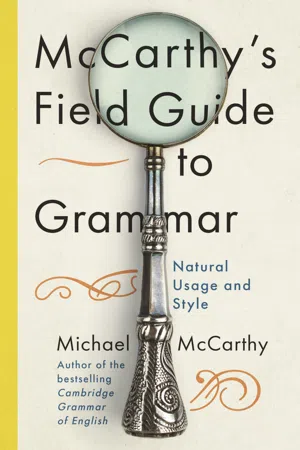
You ain't gonna like it: bad grammar's not so bad. - The Times Remember all those grammar rules from school? No? Most of us don't. Mike McCarthy, renowned corpus linguist and co-author of the 900-page Cambridge Grammar of English answers the awkward questions that regularly bother us about English grammar. In this helpful A-Z field guide, McCarthy tells us what the conventional rules are as well as shows us what people are writing or saying now and gives simple reasons why you might choose one or the other so that you can speak and write with confidence.Through witty and entertaining examples pulled from 50 years of teaching, 40 years of field notes picked from books, newspapers, letters, radio and TV, etc., and shamelessly eavesdropping on people's conversations in public spaces, and a British and American English computer database, McCarthy has created a book to browse and enjoy, as well as a useful reference to keep on your bookshelf.Why a Field Guide to grammar?
- A to Z format makes it easy to access and to find what you're looking for
- Presents solutions to a host of common, everyday grammatical problems
- References current events to bring relevance to the grammar ( fronted adverbials anyone?)
- Looks at historical usage to illustrate how the English language has evolved, and continues to evolve
- Gives guidance on appropriate usage where more than one way of saying something exists
- Distinguishes between spoken and written grammar where appropriate
- includes advice on vocabulary, spelling, pronunciation, punctuation and style
- Compares North American and British grammar, and includes Englishes from around the world
- Charming drawings to illustrate the playfulness in the English language
- Grammar guide backed by data and researchTrue to the Chambers name, this field guide is as much quirky as it is informative. It is the perfect gift for any language lover, student, teacher, struggling parent or carer supporting their child's schooling, the grammar purist or the grammar descriptivist.
- 192 pages
- English
- ePUB (mobile friendly)
- Available on iOS & Android
eBook - ePub
About this book
Information
Topic
ArtSubtopic
Art GeneralGRAMMAR AND USAGE A–Z
Aa
AAPA
English doesn’t have many words beginning with a double A, but this one came to the rescue. It is an Urdu word that has made it into the prestigious Oxford English Dictionary. It means an older sister and it’s also used as a form of address to other older women. It is a good example of how words from across the world become integrated into English, in this case from the Indian sub-continent.
See INDIAN ENGLISH, LOAN WORDS
ABBREVIATIONS
There is probably now a greater need than ever to shorten words when so much of our communication is through finger-and-thumb jabbing on phones and tablets. Most abbreviations are transparent, though some are from Latin, such as e.g. (exempli gratia – for example), i.e. (id est – that is), N.B. (nota bene – please note), cf. (confer – compare).
One choice you have to make is whether to punctuate abbreviations. Full stops / periods are generally used more in American English than in British English in abbreviations such as a.m., p.m., and in titles such as Dr., Ms. and Mr. Names of companies and other institutions, especially in their advertisements and logos, usually don’t use punctuation (BA – British Airways; CIA – Central Intelligence Agency).
Old newsreels from the 1950s often show British television cameras with B.B.C. proudly emblazoned on their side, but nowadays it is always just BBC (British Broadcasting Corporation).
Texting and social media posting has brought us into a whole new world of abbreviations: LOL (laugh out loud), IMHO (in my humble opinion), TBH (to be honest), BTW (by the way) are just a few of them.
Tip: TBH, IMHO, you should perhaps be careful not to use them in more formal situations.
See FULL STOP, PERIOD
ACCEPT and EXCEPT
It’s perhaps surprising, in this age of tyrannical automatic spell-checkers and grammar-checkers, to find so many web pages dedicated to explaining the difference between accept and except, and so many people posting questions online about the difference between them and how to use them. But grammar-checkers often get it wrong and spell-checkers are sometimes too clever for their own good, so, just for the avoidance of doubt: accept is a verb which means to receive, agree or say yes to something, except is a preposition or conjunction meaning ‘not including’. The problem is that they can sound the same in everyday informal speaking, so they get mixed up in people’s minds.
I am proud to accept this award on behalf of my teammates. (to receive)
Everyone except Maya looked happy. (Maya was the one person not happy)
Except with for is usually followed by nouns or noun-equivalents.
Except for a small minority, everyone voted for the changes to the rules.
In times past, when school grammar textbooks laid down the law, everyone had to accept the rules… except, of course, where there were exceptions.
ACCOMMODATION
Note the spelling: -cc- -mm-. Traditionally, British English treats this as a mass (uncountable) noun, so it is not used in the plural.
They have some wonderful accommodation for students on campus these days, not like when I was at university.
However, American English and some other world varieties of English have long been happy with plural accommodations in sentences like the above and you’ll occasionally see and hear it in British English too.
ACROSS
There is a journalistic use of this which has become common in British English in recent years, meaning ‘up to date with’, as in:
Stay tuned. Our Rome correspondent will be keeping us across that story in the coming hours.
ADJECTIVE
See BASIC TERMINOLOGY: A GUIDE
ADVERBIALS
What adverbials do in clauses
Primary school teachers will be familiar with the problems of teaching grammar to 8–11-year-olds and struggling with the prescriptions of the official curriculum. In the English National Curriculum, this includes teaching children about adverbials. During the pandemic home-schooling months of 2020, a number of parents told me they too were struggling with the concept of adverbials, something the 30–50 age group say they were never taught at school. BBC Radio 4’s Today devoted a discussion to adverbials on 29 January 2021; adverbials seemed to be the subject of a media moral panic.
Basically, English clauses consist of various components. There are subjects (the ‘doers’ of actions, the ‘agents’), verbs (the actions, states and processes the agents engage in), objects (the people and things acted upon, the ‘receivers’) and adverbials (the circumstances surrounding actions and events). Adverbials fill in the information about how, when, where, why things are done or happen, the degree to which they are done, and so on.
Here are some simple examples.
S = Subject V = Verb O = Object A = Adverbial
| S | V | O | A | COMMENT |
| I | sold | my car | last week. | tells us when |
| It | happened | so quickly. | tells us how | |
| They | built | a house | on the edge of the village. | tells us where |
| It | offended | her | greatly. | tells us to what degree |
Adverbials are often prepositional phrases, i.e. phrases that begin with prepositions, such as on Monday, in the corner, over the bridge, at six o’clock. But they can also be single adverbs playing the role of adverbials in the clause, such as carefully, suddenly, greatly, upstairs, yesterday. In some grammars, clauses starting with -ing or a preposition + -ing are called adverbial clauses and are treated as adverbials:
Taking great care not to be seen, she removed the money from the envelope.
Fronted adverbials
Adverbials can be quite mobile, occupying different positions in clauses. In the table of examples, they were all at the end, but often they are brought to the beginning for emphasis, contrast, or special focus. These are called fronted adverbials.
Suddenly, there was a loud bang.
On the ground floor there are three reception rooms and a large kitchen-diner. Upstairs there are three bedrooms and a family bathroom.
Carefully and with some trepidation, they stepped on to the rope bridge.
Fronted adverbials have been a great source of public debate and controversy in the UK, with some questioning the wisdom of teaching such terminology to very young children.

Table of contents
- Cover
- Title
- Contents
- Introduction
- How to use this book
- GRAMMAR AND USAGE A–Z
- Recommended further reading
- Background reading and resources
- Basic terminology: a guide
- A-Z text index
- Acknowledgements
- About the author
Trusted by 375,005 students
Access to over 1.5 million titles for a fair monthly price.
Study more efficiently using our study tools.
Frequently asked questions
Yes, you can cancel anytime from the Subscription tab in your account settings on the Perlego website. Your subscription will stay active until the end of your current billing period. Learn how to cancel your subscription
No, books cannot be downloaded as external files, such as PDFs, for use outside of Perlego. However, you can download books within the Perlego app for offline reading on mobile or tablet. Learn how to download books offline
Perlego offers two plans: Essential and Complete
- Essential is ideal for learners and professionals who enjoy exploring a wide range of subjects. Access the Essential Library with 800,000+ trusted titles and best-sellers across business, personal growth, and the humanities. Includes unlimited reading time and Standard Read Aloud voice.
- Complete: Perfect for advanced learners and researchers needing full, unrestricted access. Unlock 1.5M+ books across hundreds of subjects, including academic and specialized titles. The Complete Plan also includes advanced features like Premium Read Aloud and Research Assistant.
We are an online textbook subscription service, where you can get access to an entire online library for less than the price of a single book per month. With over 1.5 million books across 990+ topics, we’ve got you covered! Learn about our mission
Look out for the read-aloud symbol on your next book to see if you can listen to it. The read-aloud tool reads text aloud for you, highlighting the text as it is being read. You can pause it, speed it up and slow it down. Learn more about Read Aloud
Yes! You can use the Perlego app on both iOS and Android devices to read anytime, anywhere — even offline. Perfect for commutes or when you’re on the go.
Please note we cannot support devices running on iOS 13 and Android 7 or earlier. Learn more about using the app
Please note we cannot support devices running on iOS 13 and Android 7 or earlier. Learn more about using the app
Yes, you can access McCarthy's Field Guide to Grammar by Michael McCarthy in PDF and/or ePUB format, as well as other popular books in Art & Art General. We have over 1.5 million books available in our catalogue for you to explore.