In recent years mediation has become an increasingly popular approach and powerful technique and has been used successfully in such areas as commercial disputes and customer complaints-handling. Here, for the first time, is an accessible and practical book on mediation at work and in the workplace itself. Packed with real-life examples and cases, it focuses on mediation's positive way of looking at conflict, how it injects a new dimension into people's "conflict zone", and outlines the qualities needed to be a mediating manager. Mediating managers become beacons of positive energy perceived as people capable of holding things together when others are "losing it". They are able to do this because they are enablers, not judge and jury, catalysts not fixers, encouragers not enforcers. Mapping out the overall steps of the mediation process, what mediating managers' core tasks are at each stage, the opportunities offered to those involved, and illustrating different key moments of effectively resolved workplace disputes, the book demonstrates how transferable mediation skills are and how they can be used in a wide range of workplace settings.
eBook - ePub
Mediation for Managers
Resolving Conflict and Rebuilding Relationships at Work
- 256 pages
- English
- ePUB (mobile friendly)
- Available on iOS & Android
eBook - ePub
Mediation for Managers
Resolving Conflict and Rebuilding Relationships at Work
About this book
Information
Topic
Personal DevelopmentSubtopic
Conflict ResolutionUnderstanding Mediation
1
The Potential of Mediation
Two managers had suffered a longstanding “personality clash” that had simmered below every meeting, affected their performance and caused poor communication between their respective teams. Most people avoided being with the two of them.
One day Bob was in the accounts department arguing over an invoice, when Jill walked in to argue over the same invoice. The accounts team froze at their terminals; this, surely, would be show time. Bob and Jill turned to face each other and squared up. Jill took a deep breath … and in walked the accounts manager.
“Jill, Bob, you both look like you have a lot to say.”
“Well, I certainly do, anyway,” replied Jill.
“You could put it like that,” added Bob.
“OK,” the accounts manager continued, “so would it be helpful if we spent a few minutes each listening to how the other person sees the situation?”
The accounts team sighed with relief. It looked like someone, finally, was going to help Bob and Jill talk through their differences without it turning into the usual drama.
The above is one of many examples of an interpersonal dispute in the workplace in which mediation can help.
DEFINING MEDIATION
Mediation is a process by which an impartial third party assists people in a dispute to explore and understand their differences and, if possible, to settle them. The parties, not the mediator, dictate the terms of any agreement.
For the last 10 years or so mediation has been seen as the preserve of the “professional mediator”—the fully trained expert called in when a crisis is reached; the lawyer who is trying a less adversarial approach; the quasi-counselor who works with people when they reach desperation point. However, external mediators are often brought in too late, by necessity rather than choice. They are parachuted in and depart, often with a dispute resolved but leaving no new skills behind them. Some organizations have even been accused of avoiding their responsibility for dealing with conflict by bringing in an external mediator.1
We believe that all managers need mediation skills. Managers who learn how to mediate will be able to manage different demands, personalities, and behaviors, while setting a positive example. When conflicts do occur they will be able to intervene early, prevent disputes in their own team from escalating, resolve them comprehensively, and repair broken relationships. Teams and colleagues will emerge with a greater understanding of one another, with some tips about how to disagree constructively and a different, more realistic level of trust and rapport.
People who have this approach to conflict are hugely valuable to colleagues on a personal and professional level. It also makes sound business sense. Many organizations around the world have already trained managers and in some cases teams of “peer mediators” to offer a service to people at all levels in their working community.
MEDIATION AND OTHER TYPES OF DISPUTE RESOLUTION
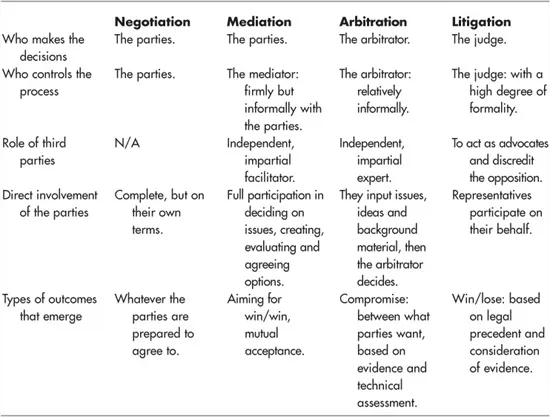
Mediation is often confused with arbitration and people are often not clear what its key characteristics are. Table 1 explains how mediation works and Table 2 clarifies the differences between the various types of dispute resolution.
Table 1 Explaining mediation
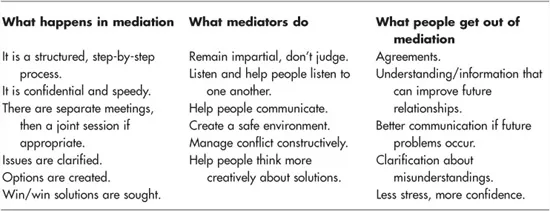
Table 2 Mediation and other types of dispute resolution
Taking the grief out of grievance
All the organizations we work with tell us that staff grievances and complaints are steadily increasing and that managers are finding it difficult to cope. Most procedures for responding to conflict—such as grievance, disciplinary, anti-bullying, customer complaint and harassment procedures—involve a combination of formal and informal approaches, with managers heavily involved in both. The informal measures usually suffer from being ill-defined and inconsistently delivered.
Organizations, like managers, need a practical, fast, humane way of processing all this disagreement and distress. Mediation skills, and the use of mediation in a more formal sense, will enhance managers’ capacity to defuse and handle grievances as they arise.
THE BENEFITS OF MEDIATING MANAGERS
Not all managers will make good mediators, but the mediation approach will make all managers better. Mentoring, counseling and coaching skills can significantly help individuals to manage difficult situations more effectively. The particular benefit of mediation is that it takes a collective approach rather than an individualistic one. It starts from the premise that everyone involved in a conflict needs to participate in its definition and resolution.
INTERACTIVE MEDIATION
There are a number of approaches to mediation and some different interpretations of the mediator’s role. Mediators differ in three main areas and it is useful to discuss these briefly so that our own approach—which we call interactive mediation, explained in more detail below—is clear and put in context.
Who develops options and forms decisions?
Problem-solving mediators tend to be active in suggesting and evaluating options. The reasoning behind this is that mediators are generally experienced in dispute settlement, they can think outside the parties’ limits and bring their own experience and knowledge to bear. Our fear is that this method leaves the door open for mediator power plays, such as premature closing on issues that become difficult, and a lack of ownership from the parties. Within the workplace it also affirms parties’ feelings of powerlessness and dependency on “expert” help.
Interactive mediators fully involve the parties in generating, evaluating, and closing on the issues. This may involve more work, but it leads to improved self-image, as people are brought forward at their own pace, and greater ownership of solutions that are agreed, as they have been reached voluntarily by the parties themselves.
Are mediators there to solve problems or resolve conflict?
Interactive mediation is a way of working that allows problem solving to happen, but even if no tangible movement on practical issues is achieved, the parties are often able to move on in other ways—in their mutual understanding, approach to future communication, or the way they accept inevitably difficult outcomes. These latter benefits are more important than practical solutions, and often more significant in terms of future relationships, than the quick fix or imposed solutions that a purely problem-solving approach can achieve.
What degree of formality is appropriate?
When you ask mediators about dress codes, styles of address, and the set-up of rooms for mediation, you touch on a whole range of values associated with people’s perception of formality, accessibility, safety, and consistency. Some mediators present themselves and the process as a “cosy chat,” others see mediation as more akin to business consultancy.
We believe that mediators n...
Table of contents
- Cover Page
- Title Page
- Copyright Page
- Contents
- Preface
- Part I: Understanding Mediation
- Part II: Mediation in Action
- Part III: Day-To-Day Mediation Skills
- Appendix: Materials for a Workplace Mediation Service
Trusted by 375,005 students
Access to over 1.5 million titles for a fair monthly price.
Study more efficiently using our study tools.
Frequently asked questions
Yes, you can cancel anytime from the Subscription tab in your account settings on the Perlego website. Your subscription will stay active until the end of your current billing period. Learn how to cancel your subscription
No, books cannot be downloaded as external files, such as PDFs, for use outside of Perlego. However, you can download books within the Perlego app for offline reading on mobile or tablet. Learn how to download books offline
Perlego offers two plans: Essential and Complete
- Essential is ideal for learners and professionals who enjoy exploring a wide range of subjects. Access the Essential Library with 800,000+ trusted titles and best-sellers across business, personal growth, and the humanities. Includes unlimited reading time and Standard Read Aloud voice.
- Complete: Perfect for advanced learners and researchers needing full, unrestricted access. Unlock 1.5M+ books across hundreds of subjects, including academic and specialized titles. The Complete Plan also includes advanced features like Premium Read Aloud and Research Assistant.
We are an online textbook subscription service, where you can get access to an entire online library for less than the price of a single book per month. With over 1.5 million books across 990+ topics, we’ve got you covered! Learn about our mission
Look out for the read-aloud symbol on your next book to see if you can listen to it. The read-aloud tool reads text aloud for you, highlighting the text as it is being read. You can pause it, speed it up and slow it down. Learn more about Read Aloud
Yes! You can use the Perlego app on both iOS and Android devices to read anytime, anywhere — even offline. Perfect for commutes or when you’re on the go.
Please note we cannot support devices running on iOS 13 and Android 7 or earlier. Learn more about using the app
Please note we cannot support devices running on iOS 13 and Android 7 or earlier. Learn more about using the app
Yes, you can access Mediation for Managers by John Crawley,Katherine Graham in PDF and/or ePUB format, as well as other popular books in Personal Development & Conflict Resolution. We have over 1.5 million books available in our catalogue for you to explore.