Mindfulness is more than a buzzword. It is a vital skill to help you survive and get ahead in your career. Executive coach and business trainer Dr Seeger has been practising and teaching mindfulness since before it was fashionable, and in this short, accessible book she shares a lifetime of hard-earned wisdom and practical advice.This book introduces you to the main themes and ideas, giving you a basic knowledge and understanding of the key concepts, together with practical and thought-provoking exercises. Whether you choose to read it in a week or in a single sitting, Mindfulness at Work In A Week is your fastest route to success: - Sunday: Learn to focus your attention and overcome the multi-tasking myth
- Monday: Use mindfulness-based stress reduction (MBSR) to prevent and overcome stress
- Tuesday: Discover how mindfulness can optimise your productivity
- Wednesday: Use mindfulness to overcome the brain's negativity bias and make the workplace happier for yourself and your colleagues
- Thursday: Regulate your emotions and improve your self-control
- Friday: Use mindfulness to create new mental maps which will promote insight and creativity
- Saturday: Understand how using mindfulness can strengthen relationships with your team ABOUT THE SERIES
In A Week books are for managers, leaders, and business executives who want to succeed at work. From negotiating and content marketing to finance and social media, the In A Week series covers the business topics that really matter and that will help you make a difference today. Written in straightforward English, each book is structured as a seven-day course so that with just a little work each day, you will quickly master the subject. In a fast-changing world, this series enables readers not just to get up to speed, but to get ahead.
- 128 pages
- English
- ePUB (mobile friendly)
- Available on iOS & Android
eBook - ePub
About this book
Information
Topic
Personal DevelopmentSubtopic
Workplace Culture
Before we delve into the different aspects of working life to explore how they can be enhanced through mindfulness we need to understand what mindfulness really is. We will introduce you to the best-known definition of mindfulness by the ‘father’ of mindfulness in the West, Jon Kabat-Zinn, and unpack it to reveal its three central tenets. Further, we will learn about different types of mindfulness practices, both formal and informal, as well as their purpose, and identify their wide-ranging benefits that have been established through scientific studies in different contexts, not just clinical research but also work that has been conducted in the workplace.
Next, we will look at the mechanisms through which mindfulness exerts its effects and review the main changes in brain structure and function that have been established through scientific studies so far.
To conclude, you will be introduced to a basic breath meditation as well as some tips for informal practices that you can start integrating into your day as you set off on your path towards increased mindfulness, greater wellbeing and inner peace.
A definition
So what do we mean by the term ‘mindfulness’, which has become so ubiquitous these days, yet remains somewhat elusive and more multi-dimensional than most definitions suggest? The most widely used definition stems from Jon Kabat-Zinn who is to be credited for making this ancient Buddhist practice widely accessible to mainstream society.
Having adapted mindfulness from its spiritual roots to the needs of chronic-pain patients in the form of a structured eight-week Mindfulness-Based Stress Reduction (MBSR) programme back in the late 1970s, Kabat-Zinn describes the practice as a form of ‘paying attention in a particular way: on purpose, in the present moment, and non-judgementally’ (Kabat-Zinn 1994). Unpacking this definition, three key elements of mindfulness can be identified:
1 Mindfulness is something you do intentionally rather than by accident.
2 Mindfulness is about paying attention in the present moment.
3 Mindfulness requires a certain attitude towards what you are doing.
These three central axioms of mindfulness have been captured diagrammatically in the following conceptual model by Shapiro et al. (2006):
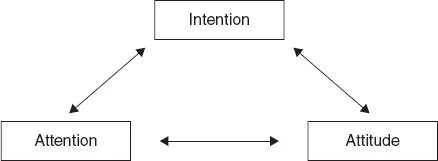
The three axioms of mindfulness – Intention, Attention and Attitude – are not separate stages. They are interwoven aspects of a single cyclic process and occur simultaneously. Mindfulness is this moment-to-moment process.
Let’s look at these three elements in more detail.
Intention
Paying attention does not simply occur; it is a purposeful activity, driven by the powerful intention to inhabit the realm of awareness and to be fully present for one’s experience, whatever this may be. Before each ‘formal’ practice it is important to set an intention, which is different from a goal: it is not about reaching a certain outcome (in fact, you are explicitly urged to let go of any such attachments to outcomes!) but about committing oneself to practising in a certain way; this could be anything from focusing on the breath, to being open to whatever may arise, to being kind to oneself for losing focus for the umpteenth time (because you will!). Intentions drive the practice and give it purpose, coherence and meaning.
Attention
In terms of attention, this is widely considered to be the central component of mindfulness, which is often, somewhat reductively, seen as nothing more than attention training. It is undoubtedly a crucial aspect of mindfulness and one that is trained in all forms of mindfulness exercise, particularly when practising breath meditation. It involves directing one’s focus and sustaining it on the desired object of attention (usually the breath), while renouncing other stimuli.
The important part about paying attention is that it necessarily occurs in the present moment. This may sound banal, but how often do you really practise this? Our mind tends to wander, casting itself back to some episode in the past that is still lingering and usurping mental space, or is consumed by plans and to do lists that take us far away into the future. Being present for all of our experience, which, after all, only ever unfolds in the present moment, is the greatest gift that we can learn to give ourselves through practising mindfulness. Present-moment awareness is very simple in principle, but, in practice, it goes against many years of hardwired mental habits of ‘time travelling’, as it has facetiously been called in the literature. Paying attention in the present moment entails noticing what is going on both within us, our thoughts, feelings and physical sensations, as well as in the outside world.
Attitude
When you notice what is going on inside and around you, it is important to do so non-judgementally, without criticizing yourself for whatever arises in your mind or wishing things to be different. It is entirely normal to experience...
Table of contents
- Cover
- Title
- About the Author
- Dedication
- Contents
- Introduction
- Sunday: What is mindfulness?
- Monday: Paying attention mindfully
- Tuesday: Enhancing your performance
- Wednesday: Controlling your stress levels
- Thursday: Regulating your emotions
- Friday: Mindful decision-making
- Saturday: Don’t worry, be happy
- 7 × 7
- References
- Answers
- Copyright
Trusted by 375,005 students
Access to over 1.5 million titles for a fair monthly price.
Study more efficiently using our study tools.
Frequently asked questions
Yes, you can cancel anytime from the Subscription tab in your account settings on the Perlego website. Your subscription will stay active until the end of your current billing period. Learn how to cancel your subscription
No, books cannot be downloaded as external files, such as PDFs, for use outside of Perlego. However, you can download books within the Perlego app for offline reading on mobile or tablet. Learn how to download books offline
Perlego offers two plans: Essential and Complete
- Essential is ideal for learners and professionals who enjoy exploring a wide range of subjects. Access the Essential Library with 800,000+ trusted titles and best-sellers across business, personal growth, and the humanities. Includes unlimited reading time and Standard Read Aloud voice.
- Complete: Perfect for advanced learners and researchers needing full, unrestricted access. Unlock 1.5M+ books across hundreds of subjects, including academic and specialized titles. The Complete Plan also includes advanced features like Premium Read Aloud and Research Assistant.
We are an online textbook subscription service, where you can get access to an entire online library for less than the price of a single book per month. With over 1.5 million books across 990+ topics, we’ve got you covered! Learn about our mission
Look out for the read-aloud symbol on your next book to see if you can listen to it. The read-aloud tool reads text aloud for you, highlighting the text as it is being read. You can pause it, speed it up and slow it down. Learn more about Read Aloud
Yes! You can use the Perlego app on both iOS and Android devices to read anytime, anywhere — even offline. Perfect for commutes or when you’re on the go.
Please note we cannot support devices running on iOS 13 and Android 7 or earlier. Learn more about using the app
Please note we cannot support devices running on iOS 13 and Android 7 or earlier. Learn more about using the app
Yes, you can access Mindfulness At Work In A Week by Clara Seeger in PDF and/or ePUB format, as well as other popular books in Personal Development & Workplace Culture. We have over 1.5 million books available in our catalogue for you to explore.