Modern-Day Vikings provides a window into what one world traveler called the most American of European countries: Sweden. Yet, surface similarities between the two nations conceal essential differences. Christina Robinowitz and Lisa Werner Carr provide insights and strategies for successful interactions with Swedes, whether business or social. True to its title, Modern-Day Vikings traces some of Sweden's most ingrained cultural traits back to its Viking heritage: self-sufficiency, fairness, egalitarianism and democracy. The authors also examine Sweden's famous "cradle-to-grave" social model and explore the values underlying modern Swedish culture, such as lagom (moderation), the law of Jante (personal modesty), communication styles and business practices.
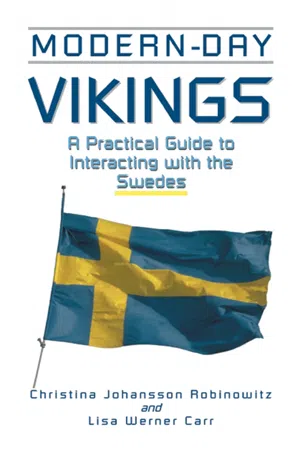
eBook - ePub
Modern-Day Vikings
A Pracical Guide to Interacting with the Swedes
- 216 pages
- English
- ePUB (mobile friendly)
- Available on iOS & Android
eBook - ePub
About this book
Information
1
From the Vikings to the Welfare State: A Millennium in Sweden
Praise no day until evening, no wife until buried, no sword until tested, no maid until bedded, no ice until crossed, no ale until drunk.*
Could a ninth-century admonition against jumping to conclusions really carry any weight in the twenty-first century? The answer is yes; a modern Swede is still likely to agree with the spirit set forth by these words from the Hávamál, part of the poetic Edda of Viking lore. Many non-Swedes, particularly Americans, have found Swedes to be extremely cautious. The Swedes, on the other hand, consider their behavior nothing more than rational and sensible—pragmatic qualities that they value highly.
This sense of caution is exemplary of a characteristic of the Swedes today that originates in their distant past. The Swedes’ modern history alone stretches back more than a millennium, making for plenty of cultural baggage as well as treasures.
In this chapter, we present an overview of Swedish history from the pre-Vikings to the conception of the welfare state, with the aim of establishing the foundation for the cultural exploration to follow. Cultural values such as independence, equality, and cooperation don’t develop overnight, or even over a century. To really begin to understand the Swedes, you have to dig much, much deeper.
The Viking Age: Prehistory to 1050
Scandinavia as we know it today is composed of three countries: Sweden, Denmark, and Norway.† Many non-Swedes think that Sweden’s history began with the Vikings, but archeological finds dating from the Stone Age to the Iron Age reveal that Sweden’s earliest inhabitants appeared about eight thousand to ten thousand years ago, trailing the glaciers that were receding northward up the Scandinavian peninsula.
The ancestors of today’s Swedes were hunter-gatherers and fishers. They used the sea and the country’s numerous lakes and rivers to travel and trade throughout their region and, later, the world. An agrarian society developed as climatic changes made it easier to work the soil. By the time the Viking culture emerged, the people of the region were farmers. They cultivated grain and vegetables during the short summer season and raised livestock. Around A.D. 500, the settlements near Lake Mälaren, outside present-day Stockholm, emerged as the seat of power for the tribe known as the Sveas—the group for which Sweden was later named: Sverige (realm of the Sveas).
The historical era remembered as the “Viking Age” was a concentrated period of exploration, commerce, combat, and colonization by the people of Scandinavia that lasted about three hundred years, from 790 to 1066.
Scandinavia at that time was not yet divided into the freestanding nations of Denmark, Norway, and Sweden; people lived in autonomous tribes led by local kings or chieftains. Collectively, however, chroniclers on the continent referred to them as the Northmen, or the Norse (hence Nordic). Throughout the period these people spoke a mutually intelligible Germanic language known today as Old Norse.
Not all Norse were Vikings. Vikings were local chieftains, warriors, or other prominent men who periodically left their farms and settlements seeking adventure, trade, and plunder. A chieftain often enlisted other men to serve on his ship for a voyage that could last months or even years in exchange for a share of the profits. Many who left never returned; others returned with tales and treasure.
So what made farmers into marauders? To go “viking” was a way to make a living combining piracy, trade, and colonization. “In an agrarian world they needed land for their children and grass for their stock; in an era of opening trade routes, they craved silver and the chattels that silver could provide; in a hierarchical, warlike, and still partly tribal society, their leaders sought fame, power, wealth, and sustenance through action” (Jones 1984, 2).
The origin of the word Viking is still debated. Many historians believe it comes from the Norse vík, meaning “bay, fjord, or creek”; thus a Viking was one who sailed from or lurked in a vík. Others point to the Norse verb víkja, which meant to move fast or to recede into the distance—an interpretation many communities looted by the Vikings would certainly understand (Jones 1984, 76). Some confusion stems from the fact that historical sources often use the words Norse and Viking interchangeably to describe the barbarians from the north.
For the most part raiding proved easier than trading. The Vikings of western Scandinavia launched three centuries of terror with the raid on the English monastery of Lindisfarne in 793. The isolated monasteries of the British Isles were not only extremely wealthy but also poorly defended. Priests didn’t fight back, making them easy targets for hit-and-run attacks. “Deliver us, O Lord, from the fury of the Norsemen” became part of the common English prayer.
The Norse were outstanding shipbuilders, and the Vikings took to the sea and rivers in their multioared dragon boats to explore every corner of Europe, and often beyond. The Vikings used their ships to make regular raids on their favorite victims. In some cases they demanded protection money in lieu of attack; other times they plundered wildly and at will, killing anyone who resisted and providing inspiration for the English word berserk.
Underlying the Vikings’ fearlessness in battle was the pagan Norse faith known as Asa, which scorned fear of death. Indeed, dying in battle ensured entry to Valhalla, the Vikings’ afterworld paradise. And warriors knew their heroic deeds would likely be commemorated by their survivors, carved (using the runic alphabet) into slabs of stone, rune stones that can still be found across Scandinavia one thousand years later, or regaled in the poetic verses of skalds, or poets.
As opposed to the Vikings of western Scandinavia, the Vikings of Sweden took little part in the raids on Britain, although they could be just as violent. Instead, their ambitions took them eastward. Swedish merchants and marauders traveled the Volga River into the interior of Eastern Europe, establishing trading posts at Riga, Novgorod, and Kiev. Known as the “Rus”—referring to the travelers’ fair, ruddy complexions or coming from the Finnish word for Sweden, Ruotsi, depending on the expert one asks—they gave their name to a nation they are credited with founding: Russia. From Kiev, the Swedish Vikings attacked Constantinople so relentlessly that the authorities there eventually gave in and hired them as bodyguards, thus opening a permanent trade route between Russia and the Byzantine Empire.
The Swedes traveled eastward to the Aral and Caspian Seas and were thus exposed to trade goods from as far away as China, and south to Baghdad and the Mediterranean. As a result, Persian glass, Chinese silk, wine and exotic spices, and silver coins and jewelry made their way to Sweden, acquired in exchange for weapons, amber, honey, wax, fur, and even slaves.‡
That brings us to the third element of Viking culture: colonization. Some of the Vikings who came to foreign lands to trade or raid decided to stay, their temporary camps becoming permanent settlements. During the late eighth century, Norwegian Vikings colonized the Scottish Islands, the Isle of Man, and Ireland; in the ninth century, fleeing political unrest, a group of them moved on to populate Iceland. During the tenth century, nearly half of England lay under the domination of Danish Vikings. Many Finns, Russians, and Ukrainians today count Swedish Vikings among their ancestors.
Bloodlust aside, Norse society was ahead of its time in many ways. The Vikings who settled Iceland founded the world’s first democratic assembly, the Althing, in 930. When the men were at sea, women were in charge at home. A husband would literally turn the keys to the farm over to his wife when he left, making her responsible for managing it. As a result, Norse women had greater freedom and authority than was customary at this time in other cultures. Norse women could own and inherit property and were free to divorce.
Because each of them had a stake in the voyage’s success, the Vikings were surprisingly egalitarian aboard ship. One tale relates that when the prince of the Franks sent an envoy to bargain with the chief of a group of Viking raiders approaching Paris, the envoy returned perplexed. “I found no one to talk with,” he explained. “They said they were all chiefs” (Vesilind 2000, 9).
Today’s Swedish banker, teacher, or engineer is unlikely to be mistaken for an axe-wielding Viking, but he or she may still share some of the traits that made the Vikings successful, such as an attitude of individual integrity combined with a willingness to work toward a common goal. As the opening phrase from the Hávamál suggests, the Viking will not judge the success of his journey until he has returned home safely with a shipload of treasures. Nor will his descendants jump to conclusions, but instead demand ample evidence.
The Middle Ages: 1066–1500
As noted previously, the Norse were not a Christian people during the Viking era, but they were religious. Their faith was strongly rooted in the worship of powerful gods, including Odin, god of war; Thor, god of thunder; and Frey, god of fertility—for whom Wednesday, Thursday, and Friday are named, respectively. Human and animal sacrifices were made on their behalf and prayers offered to them to ensure the success of every venture.
The Scandinavians were slow to accept Christianity, and the Swedes were the last Germanic people to officially adopt it. Because they were a “heathen” people, the Vikings’ nasti-ness was sometimes blamed on their religion—priests were shocked that the raiders had “no respect for the sanctity of religious houses and the pacifism of their inmates” (Jones 1984, 132). It is more likely, however, that the Vikings targeted churches and monasteries for their wealth, as described above, rather than for religious purposes.
The first Christian missionary, Ansgar, successfully established a church in the Viking stronghold of Birka in the ninth century, but the murder of a later missionary in 936 sent the Christians packing. By the time the Viking Age came to a close, however, Christianity was at last making inroads into Sweden. The first Christian Swedish king was baptized in 1000, although it took another 150 years for the faith to really take hold. Paganism continued openly until the 1120s (Jones and Pennick 1995, 137).
In 1210 a union between church and state was formed that remained until 2000, when the Lutheran Church of Sweden and the government finally and officially separated. Until that time, every Swedish citizen was counted as a member of the Church of Sweden unless he or she specified otherwise.
It was the influence of the church that brought Sweden into the “civilized” European fold. In the 1200s, the country wrote down its laws for the first time. Slavery was abolished in 1355 because of church teachings stating that all men are equal in the eyes of God.§ The church grew quite powerful, acquiring vast tracts of land and establishing itself in the city of Uppsala, just miles from the site where Viking kings were crowned and buried.
At the end of the Viking era and into the early Middle Ages, a nobility began to emerge in the area now known as Sweden. Feuding among and within various dynasties was frequent as the families of Christian King Erik and his rival Sverker fought for control of the emerging nation.
At the same time, Sweden vied with its neighbors for control of the Baltic Sea. The Baltic had become increasingly important with the expansion and growing influence of the German Hanseatic League, based in Lübeck. Sweden had had a presence in Finland since the Viking days, but the Russian region of Novgorod was interested in a stake of its own. In 1323 Sweden and Russia signed a treaty dividing control of Finland, thus linking its destiny with that of both Sweden and Russia for the next six hundred years and beyond. Sections of western Finland remain Swedish-speaking, and Swedish is Finland’s second official language.
By the end of the fourteenth century, the Scandinavians had tired of German domination of trade. In 1397 Sweden, Norway, and Denmark formed the Union of Kalmar in an attempt to team up against the Germans. It was the only time in history when these three nations were ruled under one crown, that of Queen Margareta of Denmark.
The union was successful at keeping the Germans at bay, but the alliance was a loose and uneasy one. Although Denmark dominated the union, the infighting was ferocious. On one side, there was conflict between the monarchy and the nobility; on the other, peasants and merchants constantly threatened rebellion. In 1434 a Swedish nobleman attempted to seize power in Stockholm. He was killed, but his nationalism survived and began to spread. Border skirmishes against the Danes became more frequent and were often secretly backed by the Hanseatic League.
The Foundation of Sweden: 1500–1600
The Union of Kalmar officially persisted, but by 1500 the Swedish nobles openly demanded more power and autonomy from Denmark. They had already formed a national assembly, the first step toward self-rule. In 1520 they voted to burn down the fortress of the pro-Danish Roman Catholic archbishop of Sweden, a nobleman named Gustav Trolle (who himself was imprisoned).
Danish King Christian II now had an excuse to act. He traveled to Stockholm, where the merchants, desperate to save their city from destruction, opened their doors to him. Christian II responded by inviting the noblemen of Stockholm to a banquet. At the end of this feast, however, he ordered all of those who had opposed him beheaded. More than eighty noblemen were murdered in what came to be known as the “Stockholm Bloodbath.”
One young nobleman to escape this fate was Gustav Vasa. While his father, two uncles, and brother-in-law were being killed, he was in Denmark, a hostage of King Christian II. Vasa managed to escape captivity and flee back to Sweden, where he traveled the country to elicit support to overthrow the Danes, but his efforts were unsuccessful. Discouraged, he set out on skis for Norway to win help there. By then, however, news of the Stockholm Bloodbath had reached the Swedish region of Dalarna, where the people had long been unhappy under Danish rule. The people of Dalarna sent their two fastest skiers to catch Vasa and bring him back to lead a successful revolt. This event is commemorated each year in a ski race called Vasaloppet.
In 1523, Gustav Vasa, often called the “Father of Sweden,” was crowned king of Sweden, and the Union of Kalmar came to an end. Considered an enlightened ruler, Vasa brought about far-reaching reforms during his thirty-seven-year reign. He centralized power in Sweden and established a hereditary monarchy. He reorganized the government, the monetary system, and the army. Refused papal recognition of his reign, he supported the Swedish Reformation to Lutheranism that was already under way. He had debts to pay: defeating Christian II had been expensive, and he still had conflicts to settle among the remaining noblemen. But like his Viking forefathers, he knew where the money was: he confiscated the property of the Roman Catholic Church in Sweden.
What happened to Norway after Sweden broke away from the Union of Kalmar? It remained under the thumb of its more powerful Danish neighbors. Denmark would retain control of what is today southern Sweden until 1658 and remain united with Norway until 1817.||
Sweden as a World Power: 1618–1717
Sweden, a major superpower? Most Americans are unaware that like many other European countries, Sweden also took a turn as a great imperialist nation. This period began with the ascent to the throne in 1611 of King Gustav II Adolf (also known as Gustavus Adolphus), a grandson of Gustav Vasa and a military genius. He brought his grandfather’s talent and enthusiasm to the task of strengthening Sweden’s position in Europe.
Sweden’s military expansion began with its participation in the misnamed Thirty Years’ War, which started in 1630. The war eventually led to Sweden’s conquest of most of the Baltic States, including huge territories as far away as Poland. (One of the king’s dreams was to make the Baltic “a Swedish lake.”) Sweden was double its current size. Gustaf II Adolf developed Sweden’s military capabilities by exploiting one of the cou...
Table of contents
- Cover Page
- Title Page
- Copyright Page
- Dedication
- Contents
- Acknowledgments
- Introduction
- Chapter 1: From the Vikings to the Welfare State: A Millennium in Sweden
- Chapter 2: The Rise of the Swedish Model
- Chapter 3: The Four S’s: Sex, Suicide, Socialism, and Spirits
- Chapter 4: National Pride: A Matter of Romance
- Chapter 5: The Individual and the Group: Self-Sufficiency and Solidarity
- Chapter 6: The Lagom Phenomenon
- Chapter 7: Jantelagen: Who Do You Think You Are?
- Chapter 8: Equality above All
- Chapter 9: The Seasons and Their Power: Summer, Winter, and Holiday Swedes
- Chapter 10: Communication: The Sound of Silence
- Chapter 11: Manners: Swedish Customs Simplified
- Chapter 12: Doing Business in Sweden: Competition versus Consensus
- Conclusion: Full Speed Ahead
- Bibliography
- Index
- About the Authors
- Footnotes
Trusted by 375,005 students
Access to over 1.5 million titles for a fair monthly price.
Study more efficiently using our study tools.
Frequently asked questions
Yes, you can cancel anytime from the Subscription tab in your account settings on the Perlego website. Your subscription will stay active until the end of your current billing period. Learn how to cancel your subscription
No, books cannot be downloaded as external files, such as PDFs, for use outside of Perlego. However, you can download books within the Perlego app for offline reading on mobile or tablet. Learn how to download books offline
Perlego offers two plans: Essential and Complete
- Essential is ideal for learners and professionals who enjoy exploring a wide range of subjects. Access the Essential Library with 800,000+ trusted titles and best-sellers across business, personal growth, and the humanities. Includes unlimited reading time and Standard Read Aloud voice.
- Complete: Perfect for advanced learners and researchers needing full, unrestricted access. Unlock 1.5M+ books across hundreds of subjects, including academic and specialized titles. The Complete Plan also includes advanced features like Premium Read Aloud and Research Assistant.
We are an online textbook subscription service, where you can get access to an entire online library for less than the price of a single book per month. With over 1.5 million books across 990+ topics, we’ve got you covered! Learn about our mission
Look out for the read-aloud symbol on your next book to see if you can listen to it. The read-aloud tool reads text aloud for you, highlighting the text as it is being read. You can pause it, speed it up and slow it down. Learn more about Read Aloud
Yes! You can use the Perlego app on both iOS and Android devices to read anytime, anywhere — even offline. Perfect for commutes or when you’re on the go.
Please note we cannot support devices running on iOS 13 and Android 7 or earlier. Learn more about using the app
Please note we cannot support devices running on iOS 13 and Android 7 or earlier. Learn more about using the app
Yes, you can access Modern-Day Vikings by Christina Johansson Robinowitz in PDF and/or ePUB format, as well as other popular books in Social Sciences & Cultural & Social Anthropology. We have over 1.5 million books available in our catalogue for you to explore.