Do you want to get to the stage - soon - where you are truly financially independent, able to use your money in the way you'd like, and be completely confident in your ability to take care of yourself and your family? That is a universal desire, but many of us regard wealth and financial independence as a goal which we'll likely never achieve - there are just too many bills that need paying and there is a widespread belief that the money game is rigged. Even people who win the lottery or inherit money often seem to wind up losing it. The evidence suggests you can't win a game that you don't understand - even if you start out winning - because you never understood the game in the first place.So how can you win with money? How can you create independent wealth and hold on to it? This inspiring book by self-made multi-millionaire Rob Moore explains the rules of the game, shares simple tricks for managing money better, details how to create a plan for an ambitious future, and shows you the very best way to become a millionaire - to think and behave like one!
eBook - ePub
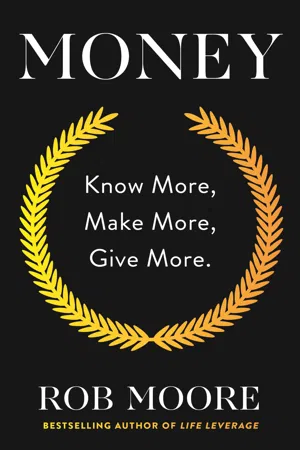
Money
Know More, Make More, Give More: Learn how to make more money and transform your life
- 400 pages
- English
- ePUB (mobile friendly)
- Available on iOS & Android
eBook - ePub
Money
Know More, Make More, Give More: Learn how to make more money and transform your life
About this book
Information
SECTION 1
Introduction
Thank you for having the faith in me to help you on your journey to money. I congratulate you for investing in yourself wisely. You are your best asset and pay yourself the best interest and return.
As a thank you I have some special gifts for you, very valuable and leverage-able – you’ll find them at the end of the book. I am certain you will be one of the smaller percentage who reads this book from start to finish. After all, those who don’t read have no advantage over those who can’t read.
1
So you own a Ferrari?
The thing I remember most about growing up with my dad was how big the old brown £10 notes were that he held in his huge hands and kept in his back pocket. He’d always have a big bunch of them, folded in half with the Queen’s head always facing in the same direction. He’d pay for everything in cash. He always liked getting a deal or discount, and he used to take me with him when he’d buy his new pubs, hotels and restaurants, and the fixtures, fittings and stock. He’d let me get a wholesale box of flumps when we went to the cash and carry, and I’d eat about 300 of them on the way home, looking up to my dad who I admired and wanted to be just like. Then I’d feel sick … but not because of the money!
My dad taught me to work and earn money from around the age of four. My first job was ‘bottling up’ at the pub, where I’d go down into the cellar, which was like a hidden cave – cold, damp and deep underground. I’d carry up the crates, barely able to see over them, with all the bottles that needed replacing on the shelf and in the fridge. He taught me how to get the maximum number of bottles crammed into the crate and to do it in the shortest possible time – I could replace most of the stock at 6am on a Saturday morning, after a packed-out Friday night, in around half an hour. Dad would pay me 50p and I could do this on Saturday and Sunday, as Mum wouldn’t allow it on schooldays. I’d take the pound I’d earned over the weekend, probably around £956,000 now with inflation, to the local pound store and buy a framed picture of a car. They had all my favourites – Lamborghini Countach, Corvette, Ferrari Testa Rossa, Porsche 911, the old Mercedes Gullwing and more. I yearned for these pictures, and one by one bought them all and hung them on my bedroom wall. Back to the relevance of this in a moment. Dad also let my sister and me hoover and clean the bar. The carpet in the pub was brown and garishly patterned, and the great benefit of this was that if you dropped coins on it you couldn’t see them easily. It’s almost like my dad planned this, being from Yorkshire, and it was the perfect flycatcher for £1 coins dropped by the punters. Early on weekend mornings we’d get up, sing ‘hunt for money, hunt for money’, and find a nice little pouch of coins that we were allowed to keep. Dad used to say that wherever money was lying around I’d find it ‘like a fly-to-shiiiite’. (That’s a northern England ’uddersfield accent, in case you’re wondering.)
As I grew up this desire to earn money grew too. The benefit of being brought up in pubs and hotels was that it forced both independence and enterprise at a very young age. We would often be left alone in the flats above the premises, and I loved the freedom this gave us. We had to fend for ourselves, and by the time I went to secondary school I’d learned to cook, clean, wash and iron, and bareknuckle fistfight my sister, amongst other valuable life skills. In my early teens I put a business proposal to my mum saying that if she wanted to ‘leverage’ the ironing out to me (I don’t think I used the word leverage then), then I would do a large item for 20p, and pants and smalls for 10p. She accepted my proposal and I had my second start-up. I ironed my way through my teens while watching Headbangers Ball on MTV. Once I passed my driving test, dad used to send me shopping for pub essentials, and let me keep the change. I’d save it all and count it regularly.
Let’s fast-forward about seven years to me aged 24. I’d been to university; I’d had a great time but had drunk away all my own and my parents’ money. I had all these dreams and grand ideas, but Dad had fallen very ill, so my plans to take on the world were put on ice for a few months so I could come and help out back at my parents’ pub in Peterborough. Four years later I was still there, and had amassed some debt – considerable personal, bad, deep debt. The mess I’d got myself into (more details of this later) came to a head when I was out with a friend one summer morning, likely with a filthy hangover, and a Ferrari F430 Spider drove past. The driver had the roof down, his tunes blaring and his nose in the air. Now, to that date, the car that I’d coveted more than any other was the Ferrari F430 Spider. It was like all the memories and emotions and desires through my childhood had been designed into that beautiful car: elegant lines, raspy exhaust, of course in ‘rosso’ red. As the car flew past I could see and feel all these images and emotions and desires in slow motion, and I turned to my friend and barked harshly:
‘See that twat, he’s a drug dealer.’
And then we went on our way to the pub.
And right there is a single sentence, the comment I made that day, that shows the absolute low point I had reached in terms of my attitude towards, and beliefs around, money, manifested in debt, bitterness and judgment. Once an open-minded, limitless child and then teenager, taught to value, earn and respect money, with big dreams to turn ideas into cash, I had changed into an envious, defeatist neg-head with a confused relationship with money and more maxed-out credit cards than you could fit in Bill Gates’s wallet, who stereotyped people by their possessions.
And what’s worse is I didn’t even know the guy driving the Ferrari.
That statement summed up in seven words everything that was wrong with me, about money. Though I didn’t know it at the time, those seven words summed up everything that was wrong with the media, about money. Those seven words summed up the huge gulf between the wealthy and the poor, more in mindset than in skillset. And the strange irony continued when, between the ages of 30 and 31, I became a millionaire, and the first Ferrari I bought was that exact same F430 Spider in ‘rosso’ red. Now, before you judge me for good or bad, like I judged that Ferrari owner (though he could have rented it for the day), stay with me as we go on a journey from good upbringing around money to spiralling debt and bitterness and back again to sustained wealth.
My story is very much woven into yours. I’ve been poor and I’ve been rich, and you’ve been at least one of those two. I’ve made money and lost money, as have you. I started with no money, and that is the same for all of us once we pop out of the womb. I’ve had all the negative beliefs around money any other first-world-poor person (see the next chapter for more on this) has had, or still has, and I face the same challenges and opportunities as anyone else who is fortunate enough to have been raised in a land of opportunity such as the UK, the US or any other developed, first-world country.
When I judged in one instant the man who was driving (ironically) the car of my dreams, I was in that exact moment projecting onto him my personal, individual perceptions, beliefs and attitudes. This had nothing to do with him. I didn’t know him, but I thought I knew people just like him. Now he could have been a future version of me who worked for and earned his money, dreams and Ferraris. He could have been a drug dealer. He could have been test-driving the car. He could have been hiring it for the day. He could have been a dentist, therapist or philanthropist. He could have been the salesman giving it a run in before a test drive with someone like me (now). But that’s all irrelevant because there are all types of Ferrari drivers, and you can’t stereotype them like I shamefully did. I will share all my personal negative beliefs about people with money that I had for 25 years (that were merely a manifestation of myself) later. I will also share every single belief that I’ve come across in educating over half a million people in wealth, and it is likely that you will relate to some of them. Maybe this is what has drawn you to this book? When I was ‘first-world poor’, I could not prove what Ferrari drivers were really like because I didn’t know any. Now I know many, and indeed am one myself, though if you know me you’ll know I crash them as easily as I drive them (more on that later).
2
First-world poor
An important distinction when discussing money, wealth and poverty is differentiating between ‘first-world’ poor and ‘third-world’ poor. I am truly lucky to have been born into a family that could afford running water and didn’t have to walk 30 miles for it. I am truly lucky to have vaccinations and sanitization, a good healthcare system, a good policing system and a (mostly fair) capitalist free market society. I am lucky to have safety, ownership of my possessions and access to the world wide web of information and leverage of the Internet. How ungrateful would I be to blame and complain with this amazing opportunity and luck to be born into a good family, society and government? How shameful would it be to moan about a lack of opportunity? Many times in my poorer days I blamed or complained about these things, as I’m sure you have too. This type of behaviour repels wealth.
It is not true that we are all born equal. In the third world and even areas of the developed world, people are born into extreme poverty through no fault or choice of their own. They are pre-destined to be without basic human amenities and without the educational tools to access the free information online that we all enjoy in the first-world. Everyone else, however – you, me and most people we know – are born with equal and abundant opportunities. In addition to security and amenities, the Internet is virtually free and provides access to a limitless amount of information that we can use for self-improvement, as long as we have Wi-Fi. Moving through this book, the ‘poor’ will be referenced often, and this reference is towards the ‘first-world’ poor.
Those of us fortunate enough to have access to limitless opportunity could and should help those in the third world have their own fair share of opportunity, and we can help them if we choose to. We can become vastly wealthy and use this wealth to serve others in equal balance to serving ourselves. This book will cover that important part: the responsibility of how you can use money for good when you have it. But first you’ve got to make enough. So heed this advice from one who knows:
If you are born poor it’s not your mistake,
but if you die poor it’s your mistake.
Bill Gates
3
The land of the free market and opportunity
In the developed world and capitalist societies, you have what I consider to be an effective monetary system that creates fair (perfect) competition and freedom to set up your own enterprise, in conditions that support profit and growth. Of course Marxists will challenge this view, but I challenge back for even the most devout socialist to stick with me here. Most people complain that times are hard, the ‘system’ isn’t fair, the time isn’t right or the risk is too high. They cite taxes, greedy corporations and tycoons and other external factors as the reason they can’t set up their own enterprise or make more money.
The free market, which we enjoy and I am grateful to have been raised in, is an economic system in which prices are determined by unrestricted competition between privately owned businesses. Buyers and sellers are enabled and incentivized, and can make the deals they want without any interference, except by the forces of demand and supply, and fair regulation. Businesses need and enjoy a free market so there are no restrictions or clawbacks on the profits they can make. The idea is that prices will self-regulate in line with supply and demand, increasing or decreasing in line with the current need.
The free market and the free price system make goods from around the world available to consumers and to you. Without the free market, you may not be able to access consumables or commodities, or you may be paying £97 for a pint of milk if there were unfair competition, unfair markets, monopolies, dictatorships or other non-free market conditions.
The free market gives the largest possible scope and opportunity to entrepreneurs, who risk time, capital and loss of secure earnings from a job to allocate resources to sell to and satisfy the future desires of the mass of consumers. The free market creates fair competition, which serves the consumer as efficiently as possible. Savings and investment can then be reinvested to develop capital goods and increase the productivity and wages of workers, thereby increasing their standard of living. The free competitive market also rewards and stimulates technological innovation, as the innovator is allowed a head start in satisfying consumer wants and needs by having more demand than supply. It then allows competition, which balances fairness, as profits and prices reduce to balance self-interest and service to the consumer (free markets, perfect competition and other monetary and economic concepts will be detailed in Section 4).
This is not anywhere near the case in the third world, or in dictatorships, communist societies, countries with a less-evolved government or in formal employment (where your boss can also be a dictator like I’m sure I’ve been accused of in the past!). This is my longwinded way of saying that we are fortunate enough to live in a land and society of immense opportunity, so let’s all stop bitching and complaining and get out there. Create great products and services with fair profit margins that serve the pursuit of wealth and give great value to customers, clients and consumers. And sell shed loads of them.
4
What is Money?
In Money, we present a new concept, belief system and philosophy around money. The wealthiest people throughout history all have three things in common in the way that they have amassed vast and lasting wealth. One of those is an understanding of what money really is (and isn’t). They are able to transcend any feelings of guilt or shame, or beliefs from their culture, religion or upbringing that they have towards money. They are able to rise above the hysteria and gain true understanding of the nature and meaning of money. One of the aims of this book is for you to gain this clarity of purpose too. Because once you really know what money is – a secret held by only a select few over the centuries – you too can amass money and wealth that could go from a minus number to having the same digits as a telephone number.
This book will give you a real, accurate and deep understanding of what money is, its purpose and history, as well as the system behind it, the natural and economic laws that govern it, how it flows and operates and how to leverage that knowledge to make more, grow more and give more. You will discover the balance of spiritual and material, the balance of attraction and action.
The Money philosophy provides a mindset, skillset and emotion overhaul and reprogramming. It is a monetary philosophy and a way of life to help you live to your highest purpose and vision, using money as the fuel and as a force for good, claiming your fair share and creating a lasting difference and legacy.
We all have deeply ingrained beliefs about money, impressed upon us by our surroundings as we grow up; these have shaped our worldview of money and wealth, and how much we have or lack, perceive or receive. This book will bust all the myths, lies, exaggerations, distortions, hidden secrets, agendas and one-sided falsehoods, and give counter-arguments to all the beliefs you may have held onto that could have (or actually have) held you back from more wealth and money.
Money is a book that states a positive claim to the great benefits personally and globally for making more, growing more and giving more. Money is a positively biased book on the benefits of ...
Table of contents
- Cover
- Title
- Dedication
- Contents
- If it wasn’t for you
- Section 1: Introduction
- Section 2: The ‘disruptive entrepreneur’
- Section 3: Major money myths
- Section 4: What is money?
- Section 5: Money values, beliefs and emotions
- Section 6: Money mastery
- Section 7: Strategies and systems
- What are you going to do now?
- Notes
- Copyright
Trusted by 375,005 students
Access to over 1.5 million titles for a fair monthly price.
Study more efficiently using our study tools.
Frequently asked questions
Yes, you can cancel anytime from the Subscription tab in your account settings on the Perlego website. Your subscription will stay active until the end of your current billing period. Learn how to cancel your subscription
No, books cannot be downloaded as external files, such as PDFs, for use outside of Perlego. However, you can download books within the Perlego app for offline reading on mobile or tablet. Learn how to download books offline
Perlego offers two plans: Essential and Complete
- Essential is ideal for learners and professionals who enjoy exploring a wide range of subjects. Access the Essential Library with 800,000+ trusted titles and best-sellers across business, personal growth, and the humanities. Includes unlimited reading time and Standard Read Aloud voice.
- Complete: Perfect for advanced learners and researchers needing full, unrestricted access. Unlock 1.5M+ books across hundreds of subjects, including academic and specialized titles. The Complete Plan also includes advanced features like Premium Read Aloud and Research Assistant.
We are an online textbook subscription service, where you can get access to an entire online library for less than the price of a single book per month. With over 1.5 million books across 990+ topics, we’ve got you covered! Learn about our mission
Look out for the read-aloud symbol on your next book to see if you can listen to it. The read-aloud tool reads text aloud for you, highlighting the text as it is being read. You can pause it, speed it up and slow it down. Learn more about Read Aloud
Yes! You can use the Perlego app on both iOS and Android devices to read anytime, anywhere — even offline. Perfect for commutes or when you’re on the go.
Please note we cannot support devices running on iOS 13 and Android 7 or earlier. Learn more about using the app
Please note we cannot support devices running on iOS 13 and Android 7 or earlier. Learn more about using the app
Yes, you can access Money by Rob Moore in PDF and/or ePUB format, as well as other popular books in Business & Wealth Management. We have over 1.5 million books available in our catalogue for you to explore.