"Highly recommended: On Editing is indispensable reading for anyone who is or wants to be a writer. Every desk should have a copy!"
- Dr Samantha J. Rayner, Director of the Centre for Publishing, UCL "On Editing is a feast with many courses. When you have finished this book, you will feel encouraged, empowered, and indomitable. If you are writing-or editing-a novel, you could do no better than to have this book by your side. Comprehensive, easily digestible, it is a classic in the making."
- Shaye Areheart, Director of the Columbia Publishing Course
Writing a novel is a magical but often difficult journey; and when your first draft is complete, that journey's not over. As the editing process gets underway, authors often find themselves in unfamiliar territory. What does it mean to 'map your plot'? How do you know if you're 'head-hopping'? When is your novel ready to send out to agents, and how do you make each submission count? Written by the team behind one of the world's most successful literary consultancies, On Editing will show you how to master the self-edit. You will learn to compose, draft, and edit while sharpening your writing and ensuring that your novel is structurally sound, authentic, well-written, and ready for submission. On Editing will help you harness your creative potential, transform the way you think about your writing, and revolutionise your editorial process. "It's easy for writers to be overwhelmed by the technicalities of writing, editing and getting published, but Helen Corner-Bryant and Kathryn Price share their decades of experience nurturing writers in On Editing. They know all the problems and how to fix them - including many you might not even think of - and explain it all in a clean, jargon-free, way that demystifies the whole process, with infectious enthusiasm that will have you ready, eager and bursting with the confidence to take your writing to the next level."
- Writing Magazine
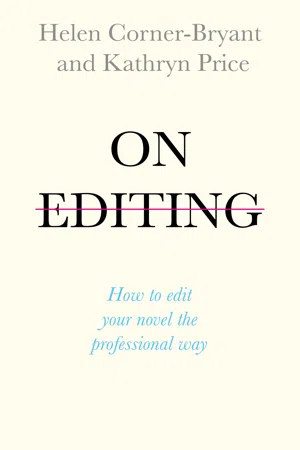
- 256 pages
- English
- ePUB (mobile friendly)
- Available on iOS & Android
eBook - ePub
About this book
Information
Part I
Editing your novel
1
Getting started
When you decide to pursue your writing professionally, things get serious. But there are plenty of insider tricks you can use to keep your energy high and your creative juices flowing. By thinking carefully about genre whilst keeping your Big Idea in mind, you can clarify your vision for the novel and improve your chances of successfully targeting readers. If you start the editing process with this level of focus, the rest should follow smoothly.
So you’ve written a novel…
…Or maybe you’re in the middle of editing one; or you’re just about to begin a first draft. The chances are, if you’ve picked up this book, you’re serious about writing and you don’t need teaching how to ‘be a writer’. You’re thinking about taking it to the next level – hopefully, publication.
There are many reasons people write, and whilst publication/financial reward tends to be high on the list, it’s not always the biggest motivation, at least initially. Though everyone’s heard about authors who’ve hit the big time (at some point most writers allow themselves to daydream about success – and why not?!) these tend to be the exception rather than the rule. Authors write, first and foremost, because they’re inspired: like most creative endeavours, it’s something you’re driven to do.
But the next step, becoming good at it, demands a mixture of imagination, talent, hard work, and craft. The craft is what this section of the book aims to teach: the ability to analyse what you’ve produced with an objective eye; the potential problems to watch out for, and some options for how to fix them.
This book can be used at any stage of the writing process: as a set of guidelines and tools to enable you to start writing from scratch, or as a set of principles to follow when working back through your text and redrafting. Wherever the techniques and tools are applied, you will be using publishing-level principles to produce writing you can be proud of.
Throughout the book, we illustrate some of the techniques by reference to other published works – these are all listed at the back of the book should you wish to investigate them further.
What’s the Big Idea?
If you’re thinking ahead to publication, you’ve probably done some research and submitted your book a few times already. You might be starting to realize how market-driven the industry is; the extent to which publishers need to know where what you’ve written might fit on their lists and, eventually, in bookshops. And the bottom line: how well it might sell. It can be hard, in these circumstances, to hold onto your original reasons for writing: your passion, your motivation, your Big Idea.
The term high concept is often used to describe a novel that feels genuinely fresh and ground-breaking; that publishers and readers simply can’t ignore. However, it’s not a quality you can force or copy, so it’s best to focus on exploring an idea that’s close to your heart. Sometimes studying trends can be helpful, but publishing timescales are so long that what’s fashionable now might be saturated by the time your book makes it to the shelves (a year to 18 months in the future; longer if you’re still looking for an agent). But if your novel is born from a genuine love for the subject and characters, this will shine through in the writing even if the subject isn’t currently popular.
Writers are often asked where they get their inspiration, and generally it’s a difficult question to answer, because there’s no magic formula. You might be having a conversation about something stupid your dog did, and suddenly there’s a picture book concept sparkling in your mind. You might be reflecting on the death of a loved one and find yourself dreaming about a parallel universe where people can’t die. Great ideas come from a combination of experience, observation, and imagination, so the best idea to work on is the idea that’s wholly YOURS – the one that only you could have written.
That said, you don’t have to have lived through something yourself to be able to write about it – sometimes basing your fiction on fact can make the act of writing harder – but you do have to be able and willing to put yourself in someone else’s place. Perhaps the real pre-requisite for writing fiction is a having a knack for watching, understanding, and unpicking the world around you: an interest in what makes people tick; what makes them extraordinary.
Knowing your genre
You may have already given this some thought. But perhaps not – just as some new authors begin without the end goal of publication in sight, so many will start out without a clear sense of what they’re writing. The idea and the characters were what got them started; considerations like plot and genre came second.
Having a clearly defined genre can be helpful when it comes to pitching to publishers and booksellers; on the other hand, breaking the mould can result in a book that feels new and zeitgeisty. However, it’s a question of making an informed choice. If your book feels like a little bit of a lot of things – commencing as romantic fiction, dipping into fantasy, concluding with a supernatural twist – this can be a sign of poor planning and lack of market understanding. And you risk missing out on tapping into a genre audience: imagine if you’re a fan of romance coming to this book, only to be confounded by the direction it takes. You probably won’t recommend it and might even give it a bad review.
Just as a lack of genre definition within one book can be off-putting, so an author who dabbles in too many genres within their oeuvre can ring alarm bells. Authors who submit a crime novel but mention that they also write comedy for children and historical fiction might appear to be casting their net wide in the hope that at least one of these projects will appeal. This can suggest a lack of faith in your writing and commitment to your chosen genre/audience. If you do get one of these books accepted, your publisher may expect you to continue writing in the same vein for a few years – that’s how you build a fan base. So you – and they – need to know that you are writing what you most want to write.
The best way to decide on genre is usually to think about what you prefer to read. Research and background reading will be a pleasure rather than a chore; you’ll already understand the demands and conventions of the market; you’ll probably have an innate sense of how existing authors get it right and wrong. If you don’t like, or know, your chosen genre, this can make it difficult to see what works and why. We’ve spoken with authors who’ve decided (for instance) to write children’s fiction despite having never read a contemporary children’s book. Their knowledge of the genre is based on what they read when they were young, so it’s now very dated. Or, sometimes authors tell us that they don’t want to muddy their own story by reading too much. That’s a reasonable argument, but if you haven’t read recent fiction in your genre, how can you know whether your writing is likely to appeal to its current readership?
This doesn’t mean you can’t write in a genre you’re unfamiliar with, but you’ll need to do a lot more research. If you’re inspired by an idea that seems most at home in the sci-fi section, but you’re not a sci-fi fan, you have the choice either to make your premise fit into another genre – which can be uncomfortable – or to make yourself as much of an expert as you can in that area, bearing in mind the myriad subgenres that often comprise one major genre. Resources like fanzines, journals, online enthusiasts, conventions etc can be almost as useful as published novels.
You may be reading this section with a sinking heart, realizing that you haven’t given the genre much consideration. It may not matter – sometimes genre blurring can be good, and certain genres are more forgiving of crossover material than others. With the growth of online writing media, writers and readers are increasingly making their own rules. Fifty Shades of Grey started out as Twilight fanfiction, and ended up spawning a huge erotica subgenre, and, indeed, fanfiction of its own.
But let’s say you decide that you need to pin down your book’s genre more securely. Perhaps the main thrust is cosy crime, and there are a couple of scenes which, now you think about it, seem too gory for this market. Can you cut or amend the sections that don’t fit? Or, maybe you wanted to write a gritty thriller but realize that the language and tone you’ve used feels too florid and sentimental. Again that’s a relatively straightforward editorial process: making sure your lexicon is in line with your genre. Often, it’s a question of choosing a primary genre – the strongest element in the book – and letting that guide your structure and focus, with cross-genre material playing a secondary role.
Ultimately, if the story works brilliantly then it’s not going to matter if it breaks a few rules. However, knowing what those rules are means you can be clear about what you hope to achieve. Genre isn’t just a tiresome set of strictures designed to make books fit into pigeon holes: it’s a way of setting expectations and (sometimes) of turning those expectations on their head. It’s a way of defining stories that puts your fictional world in context, so you can feed off the imaginations of the wonderful writers who’ve come before you. And, if you’re successful, it’s a way of tapping into a huge and loyal fan base to boost your sales.
‘The dog ate my homework’, and other excuses
Whether you’re just beginning a new draft or you’re already editing, it can seem like a mammoth task (and that’s before you start the process of submitting, rejection, filtering feedback, rewriting and resubmission). Writing may be something you love passionately, but as soon as you start taking it seriously it can begin to feel like hard work. That’s the reality of wanting to master your craft.
It sounds counter-intuitive to find reasons to avoid something that you love, but it happens a lot, even to successful published writers. The human brain is remarkably good at refusing to do as it’s told. Fortunately there are habits you can get into, tricks you can use, and good working practices to help you maintain energy and focus, and give your writing the time it deserves.
Make space for yourself
Virginia Woolf wrote memorably about this need in A Room of One’s Own. You might not require a whole room, but you do want a place where the chatter of modern life – children, laundry, partners, TVs, phones, emails – can be kept at bay.
Write
This might sound obvious, but it’s amazing how many authors will say, but I haven’t written anything for a while… Even if you only have half an hour, even if you have nothing to say, do it every day, whether you want to or not. Make it a part of your daily routine; get your family on side so that they support you and treat your writing time as sacrosanct.
Find a writing group or buddy
Writing can be lonely, and forging links with other writers can keep your inspiration and energy high. They can give you feedback (though the same rules apply as to getting feedback from family and friends – not all feedback is created equal, and for this reason it’s useful if a writing group contains a mix of professional and non-professional authors); they can brainstorm ideas with you; and be your cheerleaders. Often, the very fact that someone is expecting you to have written something by this time next week will force you to do it! You can find a list of UK writers’ groups at www.nawg.co.uk, check with your local library or bookshop to see if they know of one in your area, or start your own.
Set yourself goals
These don’t have to be big: it might be as achievable as write a chapter by the end of this month or as ambitious as finish a novel by Christmas. It might be setting yourself a target word count for each day’s writing. Don’t worry if you think you’re churning out garbage – that’s what the editing process is for. The main thing is to take the mountain you’re trying to climb and turn it into manageable hillocks.
Trick your brain
Try finishing your day’s work in the middle of a scene that you’re loving – you’ll come back to it the next day raring to go. Or, if you’ve finished a scene, start a new one that you can then rejoin afresh. If you’re at the editing stage, don’t feel you have to start at the start – ease yourself into the revision with some new material you know you need to write. This will help you recapture the excitement you felt when you were creating the original draft.
Listen to your emotions
If you’re finding a scene difficult, it might be because it’s heading in the wrong direction. Maybe the character is acting in a way that isn’t true to them because you need them to for the sake of plot. If something feels wrong, there’s a good chance that it is wrong.
Ride your energy
Experienced authors sometimes edit as they go, but when you’re still learning it’s often better to maintain momentum rather than stopping too frequently to read over and change what you’ve written. (For this reason, it can also be counterproductive to seek feedback too early.) On the other hand, if you’ve been working on the same thing for a while, perhaps over several drafts, and your enthusiasm is waning, don’t force it: take a break, and work on something different. If you’re not feeling passionate about the idea this may come through in the writing.
Attend a writing course or workshop, or seek professional feedback
There are many writing courses, consultancies and assessment services, often of varying quality, so do some research before settling on one that feels right for the level you’re at, the genre you’re writing in, and the way you like to work (some services involve little or no written feedback and some provide detailed editorial notes; some involve a read-through of the entire manuscript and some don’t; some automatically offer face-time and for some this costs extra). Going to conferences can also be a good way of meeting other writers, getting yourself and your writing into the public arena, and connecting with the industry.
Enter competitions
These are daunting, but a useful proving ground for both your work and your resilience. The more you submit, the more accustomed you’ll get to rejection and receiving criticism, and the more you’ll begin to treat it as an exercise in professionalism rather than a personal, emotional rollercoaster. And ...
Table of contents
- Cover
- Title
- Contents
- Foreword
- Acknowledgements
- Meet the authors
- Part I Editing your novel
- 1 Getting started
- 2 Creating (and controlling) your characters
- 3 Viewpoint – the eyes of your story
- 4 Plot and structure – finding your story’s shape
- 5 Brilliant beginnings and cracking conclusions
- 6 Dialogue and description – bringing your story to life
- 7 Pacing, tension, overwriting and cutting
- 8 Show not Tell
- Part II Submitting your novel
- 9 How to submit your manuscript to the trade
- 10 Working with your agent and publisher
- Bibliography
Trusted by 375,005 students
Access to over 1.5 million titles for a fair monthly price.
Study more efficiently using our study tools.
Frequently asked questions
Yes, you can cancel anytime from the Subscription tab in your account settings on the Perlego website. Your subscription will stay active until the end of your current billing period. Learn how to cancel your subscription
No, books cannot be downloaded as external files, such as PDFs, for use outside of Perlego. However, you can download books within the Perlego app for offline reading on mobile or tablet. Learn how to download books offline
Perlego offers two plans: Essential and Complete
- Essential is ideal for learners and professionals who enjoy exploring a wide range of subjects. Access the Essential Library with 800,000+ trusted titles and best-sellers across business, personal growth, and the humanities. Includes unlimited reading time and Standard Read Aloud voice.
- Complete: Perfect for advanced learners and researchers needing full, unrestricted access. Unlock 1.5M+ books across hundreds of subjects, including academic and specialized titles. The Complete Plan also includes advanced features like Premium Read Aloud and Research Assistant.
We are an online textbook subscription service, where you can get access to an entire online library for less than the price of a single book per month. With over 1.5 million books across 990+ topics, we’ve got you covered! Learn about our mission
Look out for the read-aloud symbol on your next book to see if you can listen to it. The read-aloud tool reads text aloud for you, highlighting the text as it is being read. You can pause it, speed it up and slow it down. Learn more about Read Aloud
Yes! You can use the Perlego app on both iOS and Android devices to read anytime, anywhere — even offline. Perfect for commutes or when you’re on the go.
Please note we cannot support devices running on iOS 13 and Android 7 or earlier. Learn more about using the app
Please note we cannot support devices running on iOS 13 and Android 7 or earlier. Learn more about using the app
Yes, you can access On Editing by Helen Corner-Bryant,Kathryn Price in PDF and/or ePUB format, as well as other popular books in Languages & Linguistics & Creative Writing. We have over 1.5 million books available in our catalogue for you to explore.