The Third Edition of the field-defining book Originated by Reg Revans in the 1940s, the Action Learning Model was refined and then reintroduced by lead author Michael Marquardt to organizations globally as a powerful tool for improving organizational performance. Today, Marquardt is widely considered to be the modern "father" of the Action Learning approach. For this new edition, Marquardt has teamed up with three Action Learning experts from Asia and the UK who bring a broader global approach to what has become THE seminal book in the field. Each chapter has been updated for alignment with today's practice and implementation of Action Learning in organizations, including fresh information on virtual Action Learning, guidance on implementing Action Learning and becoming a Certified Action Learning Coach, and many new case studies.
eBook - ePub
Optimizing the Power of Action Learning
Real-Time Strategies for Developing Leaders, Building Teams and Transforming Organizations
- 304 pages
- English
- ePUB (mobile friendly)
- Available on iOS & Android
eBook - ePub
Optimizing the Power of Action Learning
Real-Time Strategies for Developing Leaders, Building Teams and Transforming Organizations
About this book
Information
Action learning has quickly emerged as a tool used by organizations for solving their critical and complex problems. It has concurrently become a primary methodology utilized by companies around the world for developing leaders, building teams, and improving corporate capabilities. Action learning programs have become instrumental in creating thousands of new products and services, saving billions of dollars, reducing production and delivery times, expanding customer bases, improving service quality, and positively changing organizational cultures. Recent surveys by the American Society for Training and Development indicate that two-thirds of executive leadership programs in the United States used action learning. A study by the Corporate Executive Board (2009) noted that 77 percent of learning executives identified action learning as the top driver of leadership bench strength. Business Week identified action learning as the “latest and fastest growing organizational tool for leadership development” (Byrnes, 2005).
Since Reg Revans introduced action learning in the 1940s, there have been multiple variations of the concept, but all forms of action learning share the elements of real people resolving and taking action on real problems in real time and learning while doing so. The great attraction of action learning is its unique power to simultaneously solve difficult challenges and develop people and organizations at minimal costs to the institutions. Rapidly changing environments and unpredictable global challenges require organizations and individuals to both act and learn at the same time.
Global Leadership Development with Action Learning at Boeing
The Boeing Company, the world’s leading aerospace company, is a global market leader in missile defense, human space flight, and launch services, with customers in 145 countries, employees in more than 60 countries, and operations in 26 states. Boeing adopted action learning as the methodology for its Global Leadership Program, since action learning enabled the company to build critical global competencies while solving its most critical problems. Results from a comprehensive assessment of the program indicated that action learning has been remarkably successful in developing a forum for senior-level executives to learn while being challenged with real corporate issues related to the international environment in which they were placed.
What Is Action Learning?
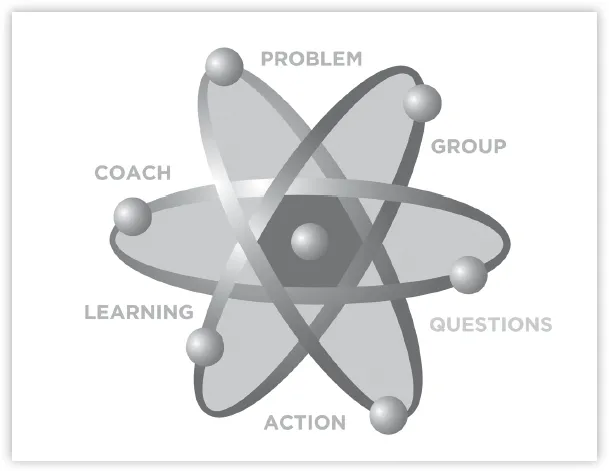
Briefly defined, action learning is a powerful problem-solving tool that has the amazing capacity to simultaneously build successful leaders, teams, and organizations. It is a process that involves a small group working on real problems, taking action, and learning as individuals, as a team, and as an organization while doing so. Action learning has six components, each of which is described below and presented in greater detail over the next six chapters of this book.
The Six Components of Action Learning
▸ A problem. Action learning centers on a problem, project, challenge, opportunity, issue, or task, the resolution of which is of high importance to an individual, team, or organization. The problem should be significant and urgent, and it should be the responsibility of the team to solve it. It should also provide an opportunity for the group to generate learning opportunities, build knowledge, and develop individual, team, and organizational skills. Groups may focus on a single problem of the organization or multiple problems introduced by individual group members.
▸ An action learning group or team. The core entity in action learning is the action learning group. Ideally the group is composed of four to eight individuals who examine an organizational problem that has no easily identifiable solution. The group should have members with a diversity of background and experience to acquire various perspectives and encourage fresh viewpoints. Depending on the problem, group members may:
▸ Be volunteers or be appointed
▸ Be from various functions or departments
▸ Include individuals from other organizations or professions
▸ Involve suppliers as well as customers
▸ A working process of insightful questioning and reflective listening. Action learning emphasizes questions and reflection above statements and opinions. By focusing on the right questions rather than the right answers, action learning groups become aware of what they do not know as well as what they do know. Questions build group cohesiveness, generate innovative and systems thinking, and enhance learning results. Leadership skills are built and implemented through questions and reflection. Insightful questions enable a group first to clarify the exact nature of the problem before jumping to solutions. Action learning groups recognize that great solutions will be contained within the seeds of great questions.
▸ Actions taken on the problem. Action learning requires that the group be able to take action on the problem it is working on. Members of the action learning group must have the power to take action themselves or be assured that their recommendations will be implemented (barring any significant change in the environment or the group’s lacking essential information). If the group only makes recommendations, it loses its energy, creativity, and commitment. There is no real meaningful or practical learning until action is taken and reflected on, for one is never sure an idea or plan will be effective until it has been implemented. Action enhances learning because it provides a basis and anchor for the critical dimension of reflection. The action of action learning begins with reframing the problem and determining the goal, only then determining strategies and taking action.
▸ A commitment to learning. Unless the group learns, it may not be able to creatively solve a complex problem. And although solving an organizational problem provides immediate, short-term benefits to the company, the greater, longer-term, multiplier benefits are the long-term learnings gained by each group member and the group as a whole, as well as how those learnings are applied on a systems-wide basis throughout the organization. Thus, the learning that occurs in action learning may have greater strategic value for the organization than what is gained by the tactical advantage of solving the immediate problem. Accordingly, action learning places the same emphasis on the learning and development of individuals and the team as it does on the solving of problems, for the smarter the group becomes, the quicker and better will be its decision-making and action-taking capabilities.
▸ An action learning coach. Coaching is necessary for the group to focus on the important (i.e., the learnings) as well as the urgent (i.e., resolving the problem). The action learning coach helps the team members reflect on both what they are learning and how they are solving problems. Through selective interventions and insightful questions, the coach enables group members to improve their performance and develop their leadership skills. The coach helps the group reflect on how they listen, how they may reframe the problem, how they give each other feedback, how they are planning and working, and what assumptions may be shaping their beliefs and actions. The learning coach also helps the team focus on what they are achieving, what they are finding difficult, what processes they are employing, and the implications of these processes.
Action learning power is at its peak when all six of these components are in operation, that is, when there is both learning and action. Unfortunately, much of what is called action learning involves only action (Carson, 2016; Cho & Egan, 2010; Raelin, 2009). Although these so-called action learning groups may be provided real-life problems, there are no structures or systems that ensure that time and effort is spent in learning, and thus little or no learning occurs. To the extent that organizations employ variations of action learning that do not utilize all six components, they lose much of the potential of action learning, not only in the strategic actions developed but also in the individual, team, and organizational development aspects. Neglecting or omitting any of the six components will result in little or no learning as well as little or no action.
Leadership Development at Shell through Action Learning
Shell utilizes action learning programs to improve the abilities and thinking of leaders in three specific areas:
▸ Skills in business-oriented thinking, change management, and implementing change
▸ Team skills, including how to create and manage effective teams
▸ Analytical and synthesizing skills in areas such as finance, marketing, and operations
Single-Problem and Multiple-Problem Action Learning Groups
Action learning groups may be formed for the purpose of handling either a single problem or several problems. Table 1-1 provides an overview of the distinction between single-problem (also referred to as in-company action learning) and multiple-problem (often called open group or “classic” action learning) programs. Organizations may choose either or both types of action learning approaches, although the single-problem form of action learning is much more popular in corporate settings. The multiple-problem approach tends to be used when individuals from many different environments voluntarily choose to come together to help one another.
In the single-problem group, all the group members focus their energies on solving a single problem. In this type of action learning, both the group membership and the problem are determined by...
Table of contents
- Cover
- Title
- Copyright
- Table of Contents
- Preface
- Acknowledgments
- About the Authors
- Part 1: Emergence of the Power of Action Learning
- Part 2: Applying the Six Components of Action Learning
- Part 3: Unleashing the Power of Action Learning
- References
- Index
Trusted by 375,005 students
Access to over 1.5 million titles for a fair monthly price.
Study more efficiently using our study tools.
Frequently asked questions
Yes, you can cancel anytime from the Subscription tab in your account settings on the Perlego website. Your subscription will stay active until the end of your current billing period. Learn how to cancel your subscription
No, books cannot be downloaded as external files, such as PDFs, for use outside of Perlego. However, you can download books within the Perlego app for offline reading on mobile or tablet. Learn how to download books offline
Perlego offers two plans: Essential and Complete
- Essential is ideal for learners and professionals who enjoy exploring a wide range of subjects. Access the Essential Library with 800,000+ trusted titles and best-sellers across business, personal growth, and the humanities. Includes unlimited reading time and Standard Read Aloud voice.
- Complete: Perfect for advanced learners and researchers needing full, unrestricted access. Unlock 1.5M+ books across hundreds of subjects, including academic and specialized titles. The Complete Plan also includes advanced features like Premium Read Aloud and Research Assistant.
We are an online textbook subscription service, where you can get access to an entire online library for less than the price of a single book per month. With over 1.5 million books across 990+ topics, we’ve got you covered! Learn about our mission
Look out for the read-aloud symbol on your next book to see if you can listen to it. The read-aloud tool reads text aloud for you, highlighting the text as it is being read. You can pause it, speed it up and slow it down. Learn more about Read Aloud
Yes! You can use the Perlego app on both iOS and Android devices to read anytime, anywhere — even offline. Perfect for commutes or when you’re on the go.
Please note we cannot support devices running on iOS 13 and Android 7 or earlier. Learn more about using the app
Please note we cannot support devices running on iOS 13 and Android 7 or earlier. Learn more about using the app
Yes, you can access Optimizing the Power of Action Learning by Michael J. Marquardt,Shannon Banks,Peter Cauwelier,NG Choon Seng in PDF and/or ePUB format, as well as other popular books in Business & Management. We have over 1.5 million books available in our catalogue for you to explore.