Managing people just got easier
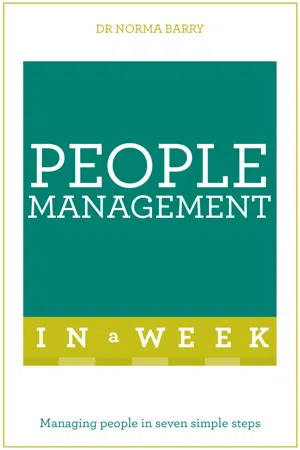
The book gives you a sound understanding of the concept of people management; the role of people managers; people motivational theories; the various people management styles and their appropriateness; the tools available to people managers to help them do their jobs effectively; techniques for managing performance; and an insight into how people managers candevelop their teams.Management, along with leadership, is one of the most studied topics in organizations. There is a wealth of literature covering the subject and there are many views on what makes a good manager and what their role is, together with how effective teams are managed and developed. Many hold the view that management is best learned through doing. Nevertheless, this book provides practising, junior and aspiring managers with a fundamental understanding of the principles and challenges of managing people, together with guidance on how to be an effective people manager. It should help you underpin your practice with sound, simply presentedsummaries of various theories and techniques.Whether you choose to read it in a week or in a single sitting, this is your fastest route to success: - Sunday: Understand how people management relates to leadership, and the features and tools of a people management role.
- Monday: Explore the various managerial levels and roles and the responsibilities and qualities of people managers.
- Tuesday: Gain an overview of people management styles and their advantages and disadvantages in different situations.
- Wednesday: Examine the external and internal organisational contexts of people managerial jobs.
- Thursday: Use your power and influence effectively to motivate teams, tackle poor performance and provide positive feedback and encouragement.
- Friday: Develop your coaching and mentoring ability and learn to identify and utilise your team's specific skills.
- Saturday: Maintain successful performance through effective delegation, planning and strategy, and good communication.
- 128 pages
- English
- ePUB (mobile friendly)
- Available on iOS & Android
eBook - ePub
About this book
Information
Over the past four days we have covered what is meant by people management, the role of people managers, motivational theories and the features of various people management styles, together with their advantages and disadvantages. It is now time to focus on tools to support you in your task of managing people.
There are numerous tools available which primarily relate to people management, performance management, quality management, strategy development, project management, process and organizational change, and environmental management. Some of these are linked to accreditation processes, to which we will refer briefly.
Today we are going to discuss the basic aspects of the main tools that a people manager can access under the management components listed above. Some of these are interrelated, such as people and performance management.
You will gain a knowledge of:
• the main tools that are available to support you in becoming an effective people manager
• how these tools will improve the overall performance of your team, and your credibility and reputation within the business.
Management tools and techniques
People managers develop primarily through learning on the job. However, numerous tools and techniques are available to help them deal with particular issues or develop certain areas within the work group. These can be useful for developing people, managing change, developing strategies and plans, managing projects, delivering quality-assured goods and services, and ensuring good environmental management.
People development tools
A people manager can access a number of psychometric tests to inform him or her on how a staff member should be motivated and managed, and the role he or she should play in the work group in order to benefit the team and the business as a whole. These tests are also useful for assessing development areas and deciding how these should be tackled. We will be discussing the training and development of people on Saturday, but today we are going to explore how the knowledge of psychometric testing can help in this respect.
There are two types of psychometric tests:
• those that assess an individual’s numerical, verbal or reasoning ability, frequently referred to as aptitude tests
• those that focus on personality to uncover a person’s preferred style of behaviour or motivation.
You may wish to use psychometric tests in relation to recruitment for vacancies in the team, to inform coaching sessions, for team building or for career development purposes. There are many testing tools available, so you need to be clear about what is needed from the test in order to select the most relevant type.
Aptitude tests
Numerical, verbal and reasoning tests are helpful in assessing the particular aptitudes, abilities and intelligence of candidates for employment or promotion. There is a wide range of tests available and they, in effect, are structured, systematic ways of assessing a person’s numerical, logical and verbal reasoning. They are usually used as part of the overall assessment process for recruitment or promotion. These tests are administered under examination conditions and can involve solving problems, undertaking tasks or answering multiple-choice questions. The most common forms of these tests are shown in this table.
| Test | Method and ability assessed |
| Numerical reasoning | A number of arithmetical problems and mathematical questions, possibly presented in charts and graphs that need interpretation. These are used to assess people’s ability to handle and interpret numbers. |
| Logical reasoning | These tests expect the candidate to identify rules and patterns from information provided in diagram sequences containing various shapes in order to find the next one in the sequence. The ability to think logically and analytically is tested. |
| Non-verbal reasoning | Diagrams and pictures are used to assess the candidate’s capability of analysing and solving problems through this means. |
| Verbal reasoning | This type of test consists of a number of relatively short paragraphs of written text, from which the candidate is expected to assess the accuracy of a number of statements based on the information. It is used to assess ability in understanding, analysing and interpreting complex written information. |
| Verbal logic | Verbal logic tests involve solving a number of puzzles of different types. They test ability to think logically, analytically and numerically, and extract meaning from complex information. |
Personality tests
Personality tests are very useful for people managers to understand their own behaviours, motivations and empathy, as well as those within the work group. Understanding your personality and that of others is fundamental to motivating ...
Table of contents
- Cover
- Title
- About the Author
- Contents
- Introduction
- Sunday: What is people management?
- Monday: What do people managers do?
- Tuesday: Motivating people in the workplace
- Wednesday: People management styles
- Thursday: Tools for people management
- Friday: How people managers manage performance
- Saturday: How people managers develop their teams
- 7 × 7
- Answers
- Copyright
Trusted by 375,005 students
Access to over 1.5 million titles for a fair monthly price.
Study more efficiently using our study tools.
Frequently asked questions
Yes, you can cancel anytime from the Subscription tab in your account settings on the Perlego website. Your subscription will stay active until the end of your current billing period. Learn how to cancel your subscription
No, books cannot be downloaded as external files, such as PDFs, for use outside of Perlego. However, you can download books within the Perlego app for offline reading on mobile or tablet. Learn how to download books offline
Perlego offers two plans: Essential and Complete
- Essential is ideal for learners and professionals who enjoy exploring a wide range of subjects. Access the Essential Library with 800,000+ trusted titles and best-sellers across business, personal growth, and the humanities. Includes unlimited reading time and Standard Read Aloud voice.
- Complete: Perfect for advanced learners and researchers needing full, unrestricted access. Unlock 1.5M+ books across hundreds of subjects, including academic and specialized titles. The Complete Plan also includes advanced features like Premium Read Aloud and Research Assistant.
We are an online textbook subscription service, where you can get access to an entire online library for less than the price of a single book per month. With over 1.5 million books across 990+ topics, we’ve got you covered! Learn about our mission
Look out for the read-aloud symbol on your next book to see if you can listen to it. The read-aloud tool reads text aloud for you, highlighting the text as it is being read. You can pause it, speed it up and slow it down. Learn more about Read Aloud
Yes! You can use the Perlego app on both iOS and Android devices to read anytime, anywhere — even offline. Perfect for commutes or when you’re on the go.
Please note we cannot support devices running on iOS 13 and Android 7 or earlier. Learn more about using the app
Please note we cannot support devices running on iOS 13 and Android 7 or earlier. Learn more about using the app
Yes, you can access People Management In A Week by Norma Barry in PDF and/or ePUB format, as well as other popular books in Business & Human Resource Management. We have over 1.5 million books available in our catalogue for you to explore.