Sunday
Explore factors that influence, both positively and negatively and discover how influencing is selling Monday
Understand the power of personality and charisma and ensure you are putting the right message acrossTuesday
Use the Assertiveness Sentence technique to sound more confident in any situationWednesday
Discover the three elements of communication and how to use them to build rapid, effective rapport with othersThursday
Learn to recognize the internal filters that we all have and utilize them in patterns of persuasionFriday
Use NLP models to influence at an unconscious level, including the technique of 'chunking' to gain agreement Saturday
Learn how to use proven persuasion techniques such as emotional 'triggers', scarcity, the law of reciprocity, the power of three, and the AIDA formula
- 128 pages
- English
- ePUB (mobile friendly)
- Available on iOS & Android
eBook - ePub
About this book
Information
The best influencers are superb communicators – this is the key skill that will deliver the best results for you.
Whether you’re communicating with others face to face, over the telephone or in writing, you need to be clear, positive and persuasive. Your message does not have to be verbal: even the way you dress delivers a message about you that may enhance or damage your ability to influence others.
Today we will explore how to improve your communication using proven, effective techniques. You will learn about rapport, why it’s essential to have it in order to influence others, and how to build it effortlessly and rapidly. You will understand what makes everyone unique, and why it’s so important to have a flexible communication style in order to influence the maximum number of people.
You will also learn how to calm down an angry person easily and assertively, without taking on board their emotional state. You will discover the language to use and the actions to take to get people on board with your way of thinking. You will even learn how to ‘read’ people’s eye movements and understand what they really mean.
There is only one version of you
Each one of us is as individual as a fingerprint. Although we might be similar to others, there will always be differences that contribute to our uniqueness. The way we make sense of the world around us – and how we think, feel and behave as a result of that – has an effect on how we communicate with others and how we like others to communicate with us. By understanding how this process works, you can start to develop flexibility in your communication style, which will enable you to become far more persuasive.
The following diagram represents the ‘core model’ of neuro-linguistic programming (NLP) and illustrates how we take in information from around us (external events), pass it through our own individual set of ‘filters’, make sense of it, react to it emotionally and physically, and finally behave in a way that feels appropriate to us.
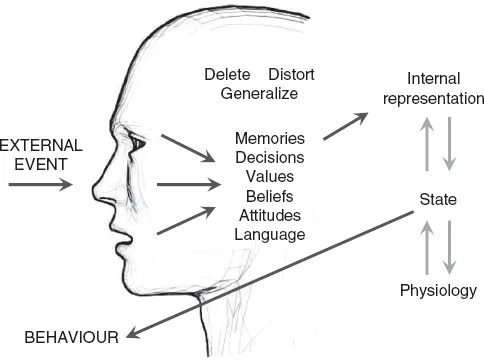
The NLP model of what we do with external information
We take in what is going on around us through our five senses. However, if we tried to process all this information, it would be more than our conscious mind, with its limited capacity, could handle. By contrast, the unconscious mind has a virtually unlimited capacity; it contains thoughts, memories and desires as well as automatic skills that are under the surface of our conscious awareness but which still have a great impact on our behaviour.
Filters and our ‘map of the world’
To protect our conscious mind from overload, we all have a set of ‘filters’, made up of such things as memories, decisions, values, beliefs, attitudes, language and a lot more. We create and amend these filters as we progress through life, based on our ongoing experiences. Because everyone’s experiences of life are different, everyone’s set of filters is unique to them. (Filters are explored in more depth in Thursday’s chapter.)
The role of the filters is to delete, distort or generalize information coming in, in order to make sense of it. The information then becomes an ‘internal representation’ of what is going on outside us – in other words, it becomes a thought. Attached to the thought is a state of mind, or emotion, so the thought could, for example, be happy, sad or angry. Aligned to the emotional state of mind is the physiology, or body language.
As a result of this whole process, we create an internal ‘map of the world’, which we use to find our way around the ‘territory’ out there. The output from this core model is our behaviour, which will always make perfect sense to us but may not be perceived in that way by other people.
Given, then, that everyone is unique, it is a challenge to influence other people and gain their co-operation. To achieve this, we need to find a way to ‘build a bridge’ across to their personal map of the world. We do this by building rapport.
What is rapport?
The word rapport stems from the French verb rapporter, which lit...
Table of contents
- Cover
- Title
- About the Author
- Contents
- Introduction
- Sunday: What is influence?
- Monday: Conveying the right image
- Tuesday: Becoming a voice of authority
- Wednesday: Speaking the language of influence
- Thursday: Filtered thinking
- Friday: Flexible influencing
- Saturday: Proven persuasion techniques
- 7 × 7
- Answers
- Copyright
Trusted by 375,005 students
Access to over 1.5 million titles for a fair monthly price.
Study more efficiently using our study tools.
Frequently asked questions
Yes, you can cancel anytime from the Subscription tab in your account settings on the Perlego website. Your subscription will stay active until the end of your current billing period. Learn how to cancel your subscription
No, books cannot be downloaded as external files, such as PDFs, for use outside of Perlego. However, you can download books within the Perlego app for offline reading on mobile or tablet. Learn how to download books offline
Perlego offers two plans: Essential and Complete
- Essential is ideal for learners and professionals who enjoy exploring a wide range of subjects. Access the Essential Library with 800,000+ trusted titles and best-sellers across business, personal growth, and the humanities. Includes unlimited reading time and Standard Read Aloud voice.
- Complete: Perfect for advanced learners and researchers needing full, unrestricted access. Unlock 1.5M+ books across hundreds of subjects, including academic and specialized titles. The Complete Plan also includes advanced features like Premium Read Aloud and Research Assistant.
We are an online textbook subscription service, where you can get access to an entire online library for less than the price of a single book per month. With over 1.5 million books across 990+ topics, we’ve got you covered! Learn about our mission
Look out for the read-aloud symbol on your next book to see if you can listen to it. The read-aloud tool reads text aloud for you, highlighting the text as it is being read. You can pause it, speed it up and slow it down. Learn more about Read Aloud
Yes! You can use the Perlego app on both iOS and Android devices to read anytime, anywhere — even offline. Perfect for commutes or when you’re on the go.
Please note we cannot support devices running on iOS 13 and Android 7 or earlier. Learn more about using the app
Please note we cannot support devices running on iOS 13 and Android 7 or earlier. Learn more about using the app
Yes, you can access Persuasion And Influence In A Week by Di McLanachan in PDF and/or ePUB format, as well as other popular books in Business & Business Communication. We have over 1.5 million books available in our catalogue for you to explore.