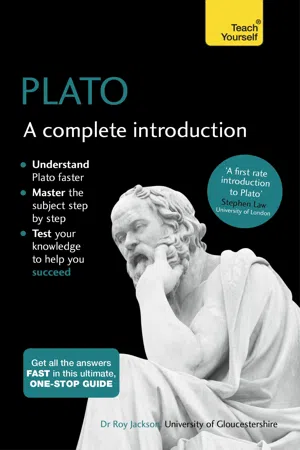
Written by Dr Roy Jackson, who Senior Lecturer at the University of Gloucestershire, Plato: A Complete Introduction is designed to give you everything you need to succeed, all in one place. It covers the key areas that students are expected to be confident in, outlining the basics in clear jargon-free English, and then providing added-value features like summaries of key books, and even lists of questions you might be asked in your seminar or exam.The book uses a structure that mirrors the way Plato is taught on many university courses, with chapters including: the pre-socratics; Socrates; who was Plato?; can virtue be taught?; piety; the philosophical life; obeying the law of Athens; the Soul; knowledge as recollection; the forms; Plato's state; education and morality; Plato and art; the Later Period; Aristotle, Plato's great pupil; Neoplatonism; Plato and religion; Plato's legacy.
- 272 pages
- English
- ePUB (mobile friendly)
- Available on iOS & Android
eBook - ePub
Plato: A Complete Introduction: Teach Yourself
About this book
Information
Topic
PhilosophySubtopic
Ancient & Classical Philosophy1
The Presocratics and the beginning of philosophy

The historical figure that features most prominently in virtually all of Plato’s writings is Socrates. However, before there was Socrates, there were other philosophers – collectively known as the Presocratics – who were not only the first to engage in philosophy as such, but also proved to be influential to the thought of Socrates and Plato. This chapter, therefore, takes a look at just some of these Presocratics and considers what philosophy is and how we distinguish it from Greek myth. Some of the concepts presented by these Presocratics are obscure and difficult to follow, so don’t worry if you struggle a bit with this first chapter (you can, if you wish, safely move straight to Chapter 2) since you’ll be joining the ranks of many philosophers who have likewise battled with these thinkers.
The birth of Western philosophy
If you were to look at a map of the eastern Mediterranean and were asked to point to the birthplace of Western philosophy, there is a strong possibility your finger would land in Greece and then, more specifically, Athens. This would certainly be a quite natural response for, after all, this is the birthplace of Socrates and Plato and, in fact, to some extent it is correct to say that philosophy did begin there in the sense that it was Greece where it developed into the structured school of thought that we know today. But no school of thought arrives to us fully formed as if from a vacuum. Before we had Socrates we had a group of thinkers now commonly referred to as the Presocratics – those that lived before and, in some cases, during the life of Socrates. When we look at these Presocratics our finger will dance over this map, while only momentarily resting on Greece. In fact, the first of these Presocratics, and the beginnings of ancient ‘Greek’ philosophy, would actually be in what is today Turkey. But, before we look at these early philosophers, it is worth considering what existed even before there was philosophy. To the time of myth.
The time of myth
In order to understand what philosophy is, and who philosophers were, it helps to determine what philosophy is not. Before the birth of philosophy, the Ancient Greeks were by no means intellectually silent. Before philosophy, there was myth. We can all of us re-tell, at least in parts, a Greek myth or two as they continue, quite rightly, to be part of the school curriculum. We have been brought up with the captivating stories of Helen of Troy, the Trojan Horse, the Minotaur, Icarus and Daedalus, King Midas and so on. The Greek word mythos can certainly be translated as ‘story’ and, for the modern reader, it is perhaps common to associate the word ‘myth’ as a work of fiction, as a good yarn and nothing more. But for the Ancient Greeks, the myths were an important channel in attempting to explain key questions such as why are we here? why is there anything rather than nothing? The myths teach us about what it means to be human and provide moral and political guidance.
Hesiod and Homer
Before the coming of the philosophers in the 8th and 7th centuries BC, Greek poets such as Hesiod and Homer attempted to explain mankind’s role in the known world by tracing the origins and actions of the gods.
The two epic poems Iliad and Odyssey are traditionally ascribed to a single author – Homer – yet it is more likely that, rather than one individual, it was a band of writers and singers who themselves drew upon an older tradition of centuries of songs about a long time ago, dealing with one military campaign at around the 13th century BC, or perhaps even longer ago than that, in which the pastoralist Greeks besieged and destroyed the non-Greek city of Troy in Asia Minor (modern Turkey). These epics with such heroes as Odysseus and Achilles are central to the Greeks’ sense of being Greek, as opposed to the barbaroi (those who spoke languages that seemed as meaningless to the Greeks as uttering ‘ba-ba’), despite the fact that the Greeks themselves had a keen interest in the neighbouring civilizations of Persia and Egypt and, to some extent, were jealous of their civilization and culture. They are wonderful works that help us to understand to this day the matters of who we are, about the transience of life and the fragility of love.
In his work Theogony, Hesiod sets out to answer the question of why things are as they are. Theogony is essentially a creation story, and it is concerned with the origins of the world (cosmogony) and of the gods (theogony) beginning with the primordial deities (the protogenoi): Chaos (goddess of air) first of all, followed in quick succession by Gaia (the Earth goddess), Tartarus (god of the Underworld) and then Eros (goddess of love).
While we might refer to Homer and Hesiod as ‘poets’, that word – as largely understood today – does not quite sum up who these people were and what their writings represent to the Ancient Greek mind. Perhaps a better description would be something like ‘shaman’ or even ‘prophet’ – they who were inspired by those divine to utter their words, hence:


‘… and they [the Muses] breathed into me wondrous voice, so that I should celebrate things of the future and things that were aforetime. And they told me to sing of the family of blessed ones who are for ever, and first and last always to sing of themselves.’
Hesiod, Theogony, 2008
The Muses in the quote above were the nine daughters of Zeus and Mnemosyne (goddess of memory), and they represented the sources of all knowledge, related orally for centuries in the ancient culture, that was contained in poetic lyrics and myths. For example, Calliope was the source of epic poetry, Clio of history and Urania of astronomy. Hesiod himself was apparently a poor shepherd (possibly he lived just north of Lesbos island, in what is today Turkey), guarding his sheep when the Muses ‘breathed into’ him knowledge in a way that seems familiar to the experience of religious prophets and mystics. Hesiod, therefore, is a vehicle for the Muses rather than the source.
It is this ‘illumination’ or ‘revelation’ that allowed Hesiod to tell the story of the coming into being of the Greek gods and the natural world, and Hesiod can be credited with referring to gods that were previously unknown.
At the beginning of Theogony, Hesiod says:
‘Tell me this from the beginning, Muses who dwell in Olympus, and say, what thing among them came first.
First came Chaos [the Chasm]; and then broad-breasted Earth [Gaia]’
Hesiod, Theogony, 2008
The Greek term khaos is sometimes translated into English as ‘chasm’, which is perhaps a better translation than ‘chaos’, as it is not necessarily a reference to disorder, but rather a formless or a void state that precedes the creation of the universe, or cosmos (Greek, kosmos). Essentially, that which precedes the existence of the universe is nothingness, the abyss, and it is from nothingness that Earth is formed – but this inevitably begs the question how? Philosophically speaking, this is problematic, for how can something come from nothing? Why is there ‘some-thing’, and what existed before the ‘some-thing’? To answer with ‘no-thing’ seems intellectually unsatisfactory. ‘Nothing’ is an ‘illegal’ concept in the sense it cannot be conceived (just try thinking of ‘nothing’) and, by invoking the Muses, it looks like Hesiod is copping out here to the extent that he does not give an answer through observation or reason, but is ‘inspired’ by the Muses. An interesting epistemological question is whether ‘inspiration’ counts as knowledge at all, and many religious believers, mystics and, for that matter, philosophers would claim that it does give us a form of knowledge that cannot be provided through observation or reason, but why Hesiod is not regarded as a philosopher is becau...
Table of contents
- Cover
- Title
- Dedication
- Contents
- Praise for Plato: a complete introduction
- About the Author
- Reference convention
- How to use this book
- 1 The Presocratics and the beginning of philosophy
- 2 Who was Socrates?
- 3 Who was Plato?
- 4 The Forms
- 5 Knowledge, opinion and ignorance
- 6 How are we to live?
- 7 The Philosopher-King
- 8 Love and friendship
- 9 In praise of love: Symposium
- 10 Gorgias
- 11 Timaeus
- 12 The war between philosophy and poetry and the Myth of Er
- 13 Plato’s legacy
- Plato’s writings
- Answers
- Copyright
Trusted by 375,005 students
Access to over 1.5 million titles for a fair monthly price.
Study more efficiently using our study tools.
Frequently asked questions
Yes, you can cancel anytime from the Subscription tab in your account settings on the Perlego website. Your subscription will stay active until the end of your current billing period. Learn how to cancel your subscription
No, books cannot be downloaded as external files, such as PDFs, for use outside of Perlego. However, you can download books within the Perlego app for offline reading on mobile or tablet. Learn how to download books offline
Perlego offers two plans: Essential and Complete
- Essential is ideal for learners and professionals who enjoy exploring a wide range of subjects. Access the Essential Library with 800,000+ trusted titles and best-sellers across business, personal growth, and the humanities. Includes unlimited reading time and Standard Read Aloud voice.
- Complete: Perfect for advanced learners and researchers needing full, unrestricted access. Unlock 1.5M+ books across hundreds of subjects, including academic and specialized titles. The Complete Plan also includes advanced features like Premium Read Aloud and Research Assistant.
We are an online textbook subscription service, where you can get access to an entire online library for less than the price of a single book per month. With over 1.5 million books across 990+ topics, we’ve got you covered! Learn about our mission
Look out for the read-aloud symbol on your next book to see if you can listen to it. The read-aloud tool reads text aloud for you, highlighting the text as it is being read. You can pause it, speed it up and slow it down. Learn more about Read Aloud
Yes! You can use the Perlego app on both iOS and Android devices to read anytime, anywhere — even offline. Perfect for commutes or when you’re on the go.
Please note we cannot support devices running on iOS 13 and Android 7 or earlier. Learn more about using the app
Please note we cannot support devices running on iOS 13 and Android 7 or earlier. Learn more about using the app
Yes, you can access Plato: A Complete Introduction: Teach Yourself by Roy Jackson in PDF and/or ePUB format, as well as other popular books in Philosophy & Ancient & Classical Philosophy. We have over 1.5 million books available in our catalogue for you to explore.