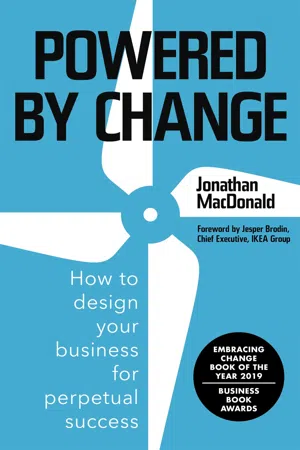
**THE SUNDAY TIMES BUSINESS BESTSELLER** Voted the EMBRACING CHANGE BOOK OF THE YEAR at the BUSINESS BOOK AWARDS When the winds of change blow, some build a wall and others build a windmill In a business environment where change is the only constant, the stark reality is that it has never been harder to see what's happening around us, interpret information efficiently or develop successful strategies. This is down to both the increasing speed of change and the prevalent mindset about change, where change is seen as the enemy. Powered by Change presents a radical new methodology for using change as a fuelling mechanism to generate outstanding business success: the Windmill Theory. Power your business The Windmill Theory enables leaders and organisations to think and act in a way that capitalises on a constantly changing environment. Constructed of four blades working in perpetual harmony with one another, it creates an empowered business that turns the winds of change into business success.Filled with examples and stories from around the world, from global corporates to start-up ventures, Powered by Change delivers some astonishing insights and clear, actionable steps to achieve the ultimate competitive advantage.Use this book to fuel your business for the future.
eBook - ePub
Powered by Change
How to design your business for perpetual success - THE SUNDAY TIMES BUSINESS BESTSELLER
- 256 pages
- English
- ePUB (mobile friendly)
- Available on iOS & Android
eBook - ePub
Powered by Change
How to design your business for perpetual success - THE SUNDAY TIMES BUSINESS BESTSELLER
About this book
Information


Chapter One
The Reality of Perpetual Change
There’s an ancient proverb that states: “When the winds of change are blowing, some build a wall; others build a windmill.” It’s a saying that’s thousands of years old, but it could not be more relevant to what’s happening all around us today.
Life and business, people and politics, economics and technology—all facets of our twenty-first-century capitalist existence—are constantly changing. How we respond will determine our survival or failure as individuals, as companies, and as a society at large. In a transient business environment where consultants McKinsey & Company estimate that only one-third of transformation strategies actually succeed, it has never been harder to see accurately what’s happening around us, interpret that information efficiently, and develop effective strategies that are executed in a successful way. This book is designed to help do just that, because the alternative is bleak. Quite simply, more than half the top businesses of today are unlikely to survive.
Why is this so? After all, commentators have been warning for some time about new paradigms, the need for business agility, and how only those truly agile and adaptive companies will survive. Despite that, we have already seen in this young century the decline—and in some cases demise—of names from Yahoo! to Nokia to BlackBerry to Kodak. Each spent billions of dollars on brand-building, senior executive teams with great track records, and costly external advisers—yet still fell foul of those inevitable winds of change.
Much has been written about what unites these failures and what lessons their falls from grace contain. Yet such analysis simply reinforces the fallacy that the inability to adapt to change is something that only a mere handful of businesses are guilty of.
In fact, the very opposite is true. Despite the colossal size and reputations of the world’s largest corporations, only a few are going to survive the changes that are to batter their business models and strategies over the next 50 years. There are three reasons for this.
| 1. | A greater degree of change is on the way than has occurred in the past. |
| 2. | The rate of ongoing change is going to be a lot faster than we have previously experienced. |
| 3. | History shows that companies are poor at coping with and responding effectively to change. |
Consider this: 88% of the companies that were in the Fortune 500 list of the world’s largest corporations in 1965 are not in that list today. Over an even shorter sample period of time, corporate resilience is not much better, with 74% of the Fortune 100 list having disappeared since 1980.1
The reason we are so bad at adapting to change is that we constantly misunderstand the nature and speed of such change. Change is seen as a threat, so our mindset focuses on strategies to react and adapt to it rapidly, with the aim of protecting what we have at all costs. In reality, the rate of change is quickening so rapidly that I confidently predict that in the future, the 88% statistic I quoted will apply to a timeframe of just five years, rather than the 50-year period of the past.
I truly believe that this is a monumental problem facing all companies, but our businesses are either choosing to ignore it altogether or are tackling it with fundamentally the wrong approach. Businesses should be learning to anticipate change, they could be setting the agendas rather than merely following them, and above all they must be committed to genuinely innovating, rather than copying. As our record in clairvoyance and fortune-telling leaves much to be desired, this requires a complete reappraisal of how humankind is wired to view and respond to change, as well as an acknowledgment that throughout history the mere presence of change has actually been the only constant.
“Change is the only constant.”
It’s hard to argue against that statement looking through the rear-view mirror, isn’t it? So why do we as humans, entrepreneurs, and leaders have such a problem with organizing ourselves not in a three-year program of change, a five-year plan, or even a ten-year vision, but in readiness for always-happening, never-stopping perpetual change?
The answer has much to do with the fact that change doesn’t happen at a uniform rate but in an exponential fashion. As every day goes past—since the Big Bang or any other dawn of time of your choice—the pace of change each day has gotten faster. Consider the way that nature is structured in evolutionary terms; with one cell dividing into two, that duo becoming four, that quartet turning into eight, and eight cells doubling to sixteen. A 16-fold growth just four steps after there was only one cell.
Nothing naturally happens in a perfectly linear way, and in fact, the way that change accelerates and is organic is something that we have been programmed as humans to want to resist.
This resistance is our natural comfort zone because we like feeling in control of our situation, even if the evidence would suggest that the reality is that we never truly are. It’s a worrying trait of humankind, in our careers, and in business, because comfort is something that, despite feeling good at the time, means we are decoupled from the true rate of change. As it is so popular to resist the winds of change, the question then becomes whether that is perhaps a valid decision to take. I personally don’t believe that it is, if the desire to create and build future success exists. The way to really view the future when we look at the contexts of modern business, society, and technology is an acknowledgment and acceptance of the fact that today is actually the slowest pace of change we will ever experience.
The change in the next 10 years in terms of technical development, computerization, and all other associated capabilities is likely to be the same as the entire set of such changes over the last 50 years.
Change is exponential and change accelerates.
The mere thought of that may make our minds and bodies groan, limited as they are by a linear timeframe. It may seem like a huge exaggeration to envisage transformation five times greater or faster than the progress of the last half-century: the invention of fiber optics, e-mail, IVF, barcodes, the internet, the World Wide Web, mobile phones, and a deluge of digitally connected devices.
Yet our current reality is that we’re already at a time where the average smartphone has the same computing power as the whole of NASA did in 1969.2 Our minds simply cannot conceive of what 2026 will be like if the rate of such change increases exponentially. All the evidence suggests though that this is exactly what will happen, and therefore there is no historical, present, or future validity in deciding to resist change.
With resistance futile, survival—and indeed the potential for us and our businesses to truly thrive—will rely on us moving from a mindset of one-off change management to one of how we manage the perpetual change that is accelerating across trends, industries, macroeconomic forces, societies, behaviors, and markets. This change comes in many forms, from globalization to the explosive growth in artificial intelligence and robotics technology. It incorporates geopolitical upheaval, such as the emergence of China as one of the world’s leading economies, and also includes environmental and societal challenges including climate change and sustainability. Then there are aging demographics, talent and skills shortages, changing terrorism threats, and the exponentially growing danger that every business potentially faces from cybercrime. These are changes that affect businesses small to large but there will be others pertaining to different segments, from tax changes for start-ups to different inheritance provisions for family firms. This is the business world we operate within. It’s not just about a new technology; it’s about every single factor in the external landscape that impacts on every part of an organization internally.
Everything that we know and have known is changing faster, and it is the ability to respond to these changes that determines our future and our success.
Walls or windmills?
Perpetual change is our reality, but it would seem that the business reaction is usually one of inaction. Businesses are inured to being told they are living and operating in an era of constant change. They want a break from corporate transition programs; they think they have much more time than they do. They are tired of change and ideally seem to want an easy period in which to make hay while the sun shines now.
I hold a very strong belief that the ability of an organization, group of people, or individual to survive and thrive in a world of perpetual change depends on whether they are building a windmill to use the winds of change as a powering mechanism, or erecting a wall in an attempt to resist the forces they face.
This is more often than not a legacy issue. It is critical that CEOs and leaders initiate transformations in culture that make their organizations more change-responsive—even if they will no longer be around to see the continued fruit of their work. Too often I have come across business leaders and company executives who are simply riding out the last few years of their pre-retirement tenure or before they move on, hoping against hope that they will be out of the door before the onslaught of change demolishes everything that they have presided over. Sadly, they often don’t seem to care that by doing this they are betting against the entire potential future of their company or brand, and are exchanging a few years of personal comfort for the long-term pain of those who try to follow the path they have laid down.
That is why it is so important to have the mindset, understanding, and tools that allow us, and our success, to be truly powered by change. Because that’s the only future that exists.
This is not just another business book warning about the inevitability of change; it is a definitive survival handbook. In reading it, you have a choice. You can throw it to one side and think you already know the answers and that you’re doing everything you need to survive. Or you can read on and learn how to grow your business hugely. You can understand what it would take to retain your best members of staff and find ways that you can continually release products and services that change the market. You can decide that you want to be able to sleep at night knowing that you are doing something that actually, really, truly matters. Then you can build on the lessons shared and heed the warnings of those who failed last time around. You can develop into a leader who can future-proof your business—not because you reject and repel change but because you accept its inevitability and embrace the new and exciting journeys that it can take you on.
Are you goi...
Table of contents
- Cover
- Chinese Proverb
- Praise for Powered by Change
- Title Page
- Imprint Page
- Contents
- About the Author
- Foreword by Jesper Brodin, Chief Executive, IKEA Group
- Part One: The Windmill Theory
- 1 The Reality of Perpetual Change
- 2 Powered by Change: A Personal Story
- 3 Evolutions and Revolutions
- 4 Structuring Our Responses
- Part Two: How to Build Windmills
- Blade One: Purpose
- 5 Elevation
- 6 Specification
- 7 Integration
- Blade Two: People
- 8 Skill and Will
- 9 Productive Paranoia
- 10 The Paradox of Exploitation versus Exploration
- Blade Three: Product
- 11 Candles versus Mirrors
- 12 Transposition
- 13 Mess-Finding
- Blade Four: Process
- 14 Frameworks
- 15 Filtration
- 16 Coordination
- Conclusion
- Acknowledgments
- Citations & References
Trusted by 375,005 students
Access to over 1.5 million titles for a fair monthly price.
Study more efficiently using our study tools.
Frequently asked questions
Yes, you can cancel anytime from the Subscription tab in your account settings on the Perlego website. Your subscription will stay active until the end of your current billing period. Learn how to cancel your subscription
No, books cannot be downloaded as external files, such as PDFs, for use outside of Perlego. However, you can download books within the Perlego app for offline reading on mobile or tablet. Learn how to download books offline
Perlego offers two plans: Essential and Complete
- Essential is ideal for learners and professionals who enjoy exploring a wide range of subjects. Access the Essential Library with 800,000+ trusted titles and best-sellers across business, personal growth, and the humanities. Includes unlimited reading time and Standard Read Aloud voice.
- Complete: Perfect for advanced learners and researchers needing full, unrestricted access. Unlock 1.5M+ books across hundreds of subjects, including academic and specialized titles. The Complete Plan also includes advanced features like Premium Read Aloud and Research Assistant.
We are an online textbook subscription service, where you can get access to an entire online library for less than the price of a single book per month. With over 1.5 million books across 990+ topics, we’ve got you covered! Learn about our mission
Look out for the read-aloud symbol on your next book to see if you can listen to it. The read-aloud tool reads text aloud for you, highlighting the text as it is being read. You can pause it, speed it up and slow it down. Learn more about Read Aloud
Yes! You can use the Perlego app on both iOS and Android devices to read anytime, anywhere — even offline. Perfect for commutes or when you’re on the go.
Please note we cannot support devices running on iOS 13 and Android 7 or earlier. Learn more about using the app
Please note we cannot support devices running on iOS 13 and Android 7 or earlier. Learn more about using the app
Yes, you can access Powered by Change by Jonathan MacDonald in PDF and/or ePUB format, as well as other popular books in Business & Management. We have over 1.5 million books available in our catalogue for you to explore.