Most literature on business, communication and success is focused on extroverts, who feel comfortable networking, talking and being the centre of attention. But at least 30% of the population are introverts, and they are now finding their voice. Quiet Impact - How to Be a Successful Introvert is already an international phenomenon. Using the latest psychological research, and Dr Loehken's own extensive experience coaching introverts in the workplace, it is packed with practical advice which is easy to implement.Dr Loehken identifies 10 strengths specific strengths that introverts often have (such as independence, perseverance and writing), and also identifies ten specific hurdles they often have to overcome (such as hyperstimulation, intellectualism and fear of conflict).
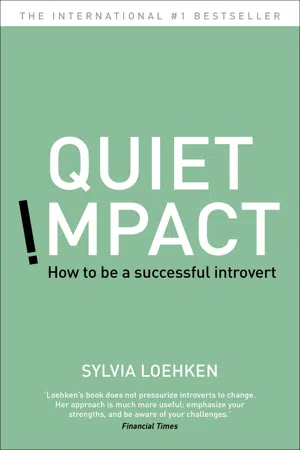
- 224 pages
- English
- ePUB (mobile friendly)
- Available on iOS & Android
eBook - ePub
About this book
Information
PART I
Who you are.
What you can do.
What you need
1.
Why quiet?!
John studies IT (information technology) at a technical college with an excellent reputation. He has two friends he likes meeting – to go to the cinema with, for example, or to play sport with. He uses social media like Twitter and Facebook to keep in touch with school friends and various people he has met on internships. At the moment he’s doing a placement with one of the best-known German car manufacturers. But John is less successful when it comes to love and romance: there aren’t many women at the college, and John hardly ever goes to parties or concerts – he finds the noise level and the crowds of people too stressful. In the meantime, he’s wondering whether he should try out a dating website to find the right girl for him.
John is getting on well with his course: he’s passing his exams and he prepares himself well for essay work. But he doesn’t like presenting papers to big seminar groups – and he is terrified of oral tests. He likes running in his free time, and sometimes he gets ideas for his second hobby while jogging: he photographs views in which landscape and technology combine to make something new, for example bridges and industrial buildings.
But what is a quiet person?
Introversion and extroversion
People can be divided into introverted and extroverted personalities. Almost anyone can make sense of these terms and will associate certain qualities with them. On closer examination – whether in real life or literature – the boundaries between introversion and extroversion become somewhat blurred. The fact is that there is a great deal of flexibility in the manifestations and definition of introversion – or extroversion.
Personality factor
This quality is first of all dependent on personality. We are born with a tendency to be introverted or extroverted – and thus also with certain characteristics and needs that help to shape us. Introvert and extrovert qualities can be seen even in children. The terms are easier to understand if they are not seen as opposites, but as extreme points on a continuum. Everyone displays both introvert and extrovert qualities. And everyone is also born with a certain flexibility, a kind of comfort zone on the introvert–extrovert continuum that suits them. Most people find themselves in a moderate central area but with a tendency towards the introvert or the extrovert end. Everywhere in the spectrum is healthy – only extreme positions can cause problems. This affects people who are placed at the extreme ends of the continuum, regardless of whether it is the introvert or the extrovert end. However, it is extremely unhealthy to live outside your personal comfort zone all the time. If an acoustically sensitive introvert like John, for example, constantly exposes himself to high noise levels, it costs him a lot of energy – and it is not possible to generate new energy either. If he were forced to sell cars all the time, rather than spend his placement in the admin side of the company, he would be unhappy and drained in the long run. In extreme cases, living outside your comfort zone for too long can actually make you ill.
Secondly, introversion and extroversion are dependent on the situation: in other words, like the direction of a railway track, where everyone has the ability to turn inwards or outwards to suit the situation. We human beings are wonderfully adaptable – one of our distinguishing features is an ability to flexibly adapt our thoughts and actions to a particular situation. At any point in our lives we can act in one way or another. This has nothing to do with introversion and extroversion, but with intelligence or possibly discipline – for example, when we deliberately decide on an approach that would be quite different if we had acted impulsively. And the part we play in a situation shapes our decisions about how we communicate. Then quite different questions can affect our behaviour: are we strong or weak in relation to other people? What is expected of us? How do we want to present ourselves?
For this reason, on his mother’s birthday, John will chat to his younger cousins cheerfully, as a cool older role model. He’ll be polite to his elderly aunts and answer their questions patiently. On his placement company’s trade fair stand he’ll tend to be reticent when he has to deal with people he doesn’t know. But he will also make an effort – when all is said and done, it’s his professional role. Even a strongly extrovert personality must have moments that leave them speechless or when they deliberately hold back. A lot of extroverts I know enjoy (and even need!) quiet moments at turbulent times. All in all, this flexibility is fortunate: the fact is that the introvert–extrovert track gives us room for manoeuvre and a wealth of different approaches.
Thirdly, the culture around us demands more or less the ability to adapt in the direction of introversion or extroversion. A country like Japan sees being quiet, alone and thoughtful as very important. Shared silence is part of a normal conversation between acquaintances. Introverts from other countries find this a very pleasant experience. But in the USA, a classic ‘extrovert culture’, where silence falling between two people who are talking to each other is usually seen as embarrassing or at least unpleasant, it counts as normal to spend all one’s time in groups, both privately and professionally. And so in many European countries introverts will have to worker harder to adapt to their surroundings by behaving more extrovertly than they would have to in Japan, which has an ‘introvert-friendly’ culture.
The time factor
And fourthly and lastly, shifts occur with the passage of time. As people get older they tend to move towards the middle of the continuum, becoming ‘more moderate’ in their introversion or extroversion. This makes introversion more accessible t...
Table of contents
- Cover
- Title
- About the Author
- Contents
- Introduction
- Part I: Who you are. What you can do. What you need
- 1. Why quiet?!
- 2. Introvert strengths: the hidden treasure
- 3. Introvert needs: introvert obstacles
- Part II: How to have a happy private life and be successful professionally
- 4. My home is my castle: shaping your own private space
- 5. Public and human: shaping your workplace
- Part III: How to make your presence felt and be sure you are listened to
- 6. Testing your courage: how to establish and cultivate contacts
- 7. Conflict between a person and a state of affairs: how to negotiate
- 8. In the spotlight: how to speak in public
- 9. Rules of the pack: how to speak up in meetings
- Licence to be quiet: the prospects for a fulfilling life as an introvert
- For further reading and on-screen research
- Thank you!
- Copyright
Trusted by 375,005 students
Access to over 1.5 million titles for a fair monthly price.
Study more efficiently using our study tools.
Frequently asked questions
Yes, you can cancel anytime from the Subscription tab in your account settings on the Perlego website. Your subscription will stay active until the end of your current billing period. Learn how to cancel your subscription
No, books cannot be downloaded as external files, such as PDFs, for use outside of Perlego. However, you can download books within the Perlego app for offline reading on mobile or tablet. Learn how to download books offline
Perlego offers two plans: Essential and Complete
- Essential is ideal for learners and professionals who enjoy exploring a wide range of subjects. Access the Essential Library with 800,000+ trusted titles and best-sellers across business, personal growth, and the humanities. Includes unlimited reading time and Standard Read Aloud voice.
- Complete: Perfect for advanced learners and researchers needing full, unrestricted access. Unlock 1.5M+ books across hundreds of subjects, including academic and specialized titles. The Complete Plan also includes advanced features like Premium Read Aloud and Research Assistant.
We are an online textbook subscription service, where you can get access to an entire online library for less than the price of a single book per month. With over 1.5 million books across 990+ topics, we’ve got you covered! Learn about our mission
Look out for the read-aloud symbol on your next book to see if you can listen to it. The read-aloud tool reads text aloud for you, highlighting the text as it is being read. You can pause it, speed it up and slow it down. Learn more about Read Aloud
Yes! You can use the Perlego app on both iOS and Android devices to read anytime, anywhere — even offline. Perfect for commutes or when you’re on the go.
Please note we cannot support devices running on iOS 13 and Android 7 or earlier. Learn more about using the app
Please note we cannot support devices running on iOS 13 and Android 7 or earlier. Learn more about using the app
Yes, you can access Quiet Impact by Sylvia Loehken in PDF and/or ePUB format, as well as other popular books in Business & Business Communication. We have over 1.5 million books available in our catalogue for you to explore.