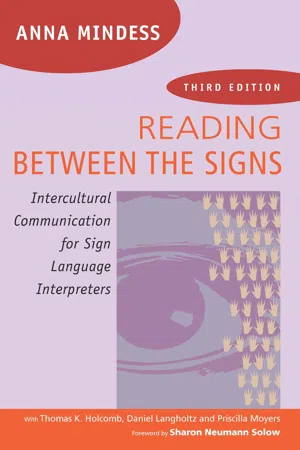
In Reading Between the Signs, Anna Mindess provides a perspective on a culture that is not widely understood - American Deaf culture. With the collaboration of three distinguished Deaf consultants, Mindess explores the implications of cultural differences at the intersection of the Deaf and hearing worlds. Used in sign language interpreter training programs worldwide, Reading Between the Signs is a resource for students, working interpreters and other professionals. This important new edition retains practical techniques that enable interpreters to effectively communicate their clients' intent, while its timely discussion of the interpreter's role is broadened in a cultural context. NEW TO THIS EDITION: New chapter explores the changing landscape of the interpreting field and discusses the concepts of Deafhood and Deaf heart. This examination of using Deaf interpreters pays respect to the profession, details techniques and shows the benefits of collaboration.
eBook - ePub
Reading Between the Signs
Intercultural Communication for Sign Language Interpreters
- 312 pages
- English
- ePUB (mobile friendly)
- Available on iOS & Android
eBook - ePub
About this book
Information
Topic
EducationSubtopic
Inclusive EducationBackground
1
Introduction
… a Foreign Service Institute linguist … while watching the evening news, discovered that a Vietnamese interpreter had simply given up when trying to bridge the gap between a CBS reporter and a Vietnamese villager. The TV audience watched the reporter ask a question, heard it go back and forth between the interpreter and the villager, and then heard the answer back in English. What the interpreter had done was simply ask the villager to count to ten, which he did. Then the interpreter reported what the villager might have said had he been able to understand the abstract ideas in the original question.
—GLEN FISHER
International Negotiation
This incident from the Vietnam War era provides a striking example of the challenges interpreters confront daily. Why did the interpreter in this case abdicate responsibility for accurately conveying the message? Glen Fisher concludes that the interpreter “faced an impossible task. The life experiences of the reporter and the villager, and their languages as reflections of culture, presented too great a contrast” (Fisher 1980, 60–61).
As sign language interpreters, we can empathize with the interpreter described above, although it is hoped that we do not choose the same solution when faced with the challenge of large cultural differences. Cultural differences can be glaring enough to bring a meeting to a halt or so subtle that participants in a conversation do not even realize they are making erroneous judgments about each other. Why and how does culture affect our work, and what can we do when it seems to be at the core of communication difficulties? These are questions I hope to answer in this book.
How many of these situations have you encountered in your work as an interpreter?

Too often, we sign language interpreters work alone, running from one challenge to another, without the benefit of others with whom to share our ideas, frustrations, and triumphs. Even if we do have a partner and switch off to give our arms and brains a break, rarely do we take the time to debrief each other after the assignment, to discuss what worked and what didn’t. One reason may be a reluctance to share details with our colleagues, not only because our professional code of conduct requires us to preserve the confidentiality of the parties involved but also because we may be embarrassed to admit our uncertainties and errors. Yet without this mutual sharing, we may fail to recognize crucial patterns that would help us become better interpreters. Since many of us repeatedly interpret similar interactions between hearing and Deaf people, it is inevitable that we encounter similar cultural mismatches. We could greatly benefit, therefore, from sharing our firsthand knowledge as a step in helping us anticipate conflicts and brainstorm strategies to deal with them.
If we rarely share our experiences with other sign language interpreters, we almost never talk with professionals who work in the area of cross-cultural communication. A few of us may be so isolated that we do not even recognize that it is not only Deaf culture that has quirks and idiosyncrasies. Every culture in the world has ways in which it appears strange or wrong to others. By studying the characteristics of world cultures, therefore, we will see that Deaf culture shares many features of Japanese, Chinese, Israeli, French, and other cultures.
In order to successfully function as bicultural mediators, not only must we be familiar with the elements of Deaf culture, but also we must pay equal, if not greater, attention to the other half of the bilingual-bicultural seesaw, American hearing, or mainstream, culture. Perhaps we have taken a class or workshop in Deaf culture, but how many of us have made a study of our own American culture? One’s own cultural characteristics are hard to see because we are so accustomed to them; like our skin, they are a part of us.
Admittedly, it is an oversimplification to speak of the dichotomy between “American Deaf Culture” and “mainstream American Culture.” The “bilingual-bicultural” model does not do justice to the complex society we live in. We are well aware that there are many cultural and linguistic groups with their own sets of values and behaviors who need to be recognized and respected. In chapter 6, we will examine in depth some of these perspectives. Any generalizations are employed for the sake of practicality, with no intent of exclusion or disrespect.
You may feel that you are already sensitive to the distinctions between Deaf and hearing cultures because you have been fascinated with them for many years. Those sign language interpreters who learned American Sign Language (ASL) as a first language in Deaf families have been dealing with their dual identity all their lives. Those of us who were not born into Deaf families and learned ASL later, by choice, probably did so because at some level we were aware that, as Edward T. Hall says in The Silent Language, “One of the most effective ways to learn about oneself is by taking seriously the cultures of others. It forces you to pay attention to those details of life which differentiate them from you” (Hall 1959, 32).
My Story
We all have our own stories of what drew us to the intersection of the Deaf and hearing worlds. I found sign language through theater. I was in my early twenties and trying to make it as an actress in the then-burgeoning experimental theater movement in Los Angeles. One night during the intermission of a mime show, I saw a couple of audience members signing and was intrigued. Later, after I went to a performance of NTD (the National Theater of the Deaf) and witnessed the expressiveness of sign language, I decided to study it to enlarge my acting repertoire. I was directed to CSUN (California State University, Northridge), where I was lucky to have as my first teacher Lou Fant, the undisputed master of our craft and one of the founders of our profession, who also shared my theatrical ambitions.
The moment I really got hooked, however, was on a hot, sticky night in a packed high school auditorium. I was still a novice signer. Another of my early sign language teachers, Joyce Linden, had heard that I occasionally performed mime pieces and had invited me to participate in a “Talent Show,” where most of the performers and audience members would be Deaf. I had accepted, not realizing what august company I would be in. (One of the other performers that night was Dorothy Miles, the gifted poet and actress and former member of NTD.) When it was my turn to appear onstage, I began to perform my mime piece about a witch who changes herself into different forms. Almost immediately, I felt bathed in a wave of warm, appreciative energy coming from the audience. What struck me most was their responsiveness. It was as if they noticed every tiny movement, even the scrunching of my eyebrows!
After that I began to meet Deaf actors, like Julianna Fjeld, who were fighting for opportunities for Deaf performers in Hollywood. Opportunities to act in movies and TV were a lot less available in the 1970s than they are today. Although my signing skills were hardly fluent, I felt welcomed by the Deaf actors I met through our mutual love for theater. I acted in a few Deaf plays, then decided that since I wasn’t making a living in theater and was becoming fascinated by sign language, I would try to become an interpreter.
After several years interpreting in colleges and universities in the Los Angeles area, I moved to the San Francisco Bay area and became a freelance interpreter, enjoying the variety of assignments plus the exciting, yet anxiety-provoking, element of the unknown, which freelance interpreters encounter daily. Years later, I successfully completed the six-week legal training program back at CSUN and now include legal interpreting in my freelance mix of medical, business, video relay, and occasional performing arts settings.
I have always been interested in different cultures. As far back as I can remember, I would gravitate to a voice with a foreign accent in order to gain some perspective on my world by looking through other eyes. I discovered intercultural communication while working on my master’s degree at San Francisco State University. Prior to my first class in that subject, I had always assumed (as I believe some sign language interpreters still do) that our profession is so unique that no one else can empathize with the challenges we face. When I started studying the contrasts between world cultures, however, bells rang and lights flashed in my head. “Why, those are just the kinds of misunderstandings sign language interpreters deal with every day!” I concluded with excitement.
After graduating, I pursued additional training in intercultural communication and read everything I could find on the subject. I began to write articles and conduct workshops for other sign language interpreters to share my discoveries and my perspective. Then I was fortunate enough to live in France for a while, where I met some French Deaf people and began learning LSF (Langue des Signes Française). I also observed my own process of culture shock and acculturation.
Over the years, in interactions with my Deaf friends, I have continued to rediscover that we have different ways of approaching certain things. Although it is fun to be able to discuss the aspects of “your way” compared to “my way,” awareness itself does not inoculate us against emotional reactions. Even if I have a good intellectual understanding of the ways our cultures differ, I may still wince or feel taken aback by a direct personal comment, for example. When I jump to an emotional conclusion, my head has to explain to my gut what just happened, as I am sure my Deaf friends do with my behavior. Such is the power of cultural differences.
Audience
This book is aimed at a specific audience: sign language interpreters and those students who hope to become interpreters. It presupposes certain areas of awareness on the part of the reader: a fluent knowledge of ASL and a basic familiarity with the types of settings in which interpreters commonly work. It is assumed that the reader does not need to be convinced that ASL is a “real language” or that Deaf people are a linguistic/cultural minority. I also heartily welcome readers from the growing community of Deaf Interpreters and address topics specifically related to this vital aspect of our profession in the new last chapter.
Students who are still learning ASL may benefit from the general discussions of world cultures and the specific sections on American mainstream culture, American Deaf culture, and discussions of other cultural groups. They may also gain an understanding of how these differences are played out through the specific interpreting situations I describe.
Although readers from related fields such as intercultural studies or foreign language interpreting may find much of interest here, they may need to avail themselves of a more basic introduction to Deaf culture, which can be found in books such as For Hearing People Only by Matthew S. Moore and Linda Levitan (2003), Introduction to American Deaf Culture by Thomas K. Holcomb (2013), The Mask of Benevolence by Harlan Lane (1992), Inside Deaf Culture (2005) and Deaf in America (1988) by Carol Padden and Tom Humphries, and A Journey into the Deaf-World by Harlan Lane, Robert Hoffmeister, and Ben Bahan (1996).
Focus
The focus of this book will be primarily on the cultural aspects, rather than the linguistic challenges, of our work as sign language interpreters. Although it is never possible to disconnect language and culture, I will discuss neither the complexities of dealing with the passive voice in English nor the best way to translate classifier signs found in ASL. This book concerns itself with the differing worldviews and values found in Deaf and mainstream American cultures and how these affect interpreted situations.
Every interpreting situation is unique, consisting of specific people coming together in a specific setting for a specific purpose. There are general patterns, however, that one encounters repeatedly. When we study the cultural themes underlying certain behaviors, we begin to understand why this is so. Are these cultural differences relatively minor variations that only flavor the message with an alternate spice? Decidedly not. Research has shown that even subtle differences in communicative style between speakers from two different cultural backgrounds can radically affect the participants’ perceptions of each other.
This is a largely unrecognized type of communicative problem and most people, therefore, interpret the other person’s way of speaking according to their own conventions. This means that a person may draw totally incorrect inferences about someone else. For example, s/he may conclude that someone is being rude, irrelevant, boring, or not talking sense at all. Or often hearers become lost in a maze of words or ideas that do not seem to cohere. (Gumperz and Cook-Gumperz 1982, 18)
To what can these types of misreadings of the other person’s motives, personality, and intelligence lead?
It is no exaggeration to say that continuous misperception, misinterpretation and misunderstanding in face-to-face linguistic encounters can develop into stereotypes that are reinforced over time. (Young 1982, 84)
As bilingual/bicultural interpreters we presumably have an understanding of both our Deaf and hearing clients’ cultural presuppositions, worldviews, and the ways in which they structure their discourse in order to achieve their goals. This confers upon us a serious responsibility for seeing to it that mere cultural variations in communicative style do not escalate to the point of unfounded stereotypes. In a positive light, our role also accords us a wonderful opportunity to use our knowledge and skills subtly yet effectively to ensure that our clients’ messages get through to each other, unhampered by erroneous judgments based on cultural differences.
To reemphasize, each interpreting situation is unique, and cultural factors are complex and multilayered; therefore, no book can offer all the possible solutions to our daily load of puzzles. What a work like this can do is stimulate thought and discussion and outline certain areas of special concern, where it would be wise to anticipate cultural differences. I also hope to convey the intercultural perspective, an open-minded flexibility that can help us to better adjust to any situation involving persons of cultural backgrounds different from our own.
Legal Interpreting
In the course of this book, we will examine several common interpreting situations that take place in medical, business, and educational settings. The principles discussed should then be applicable to other interpreting situations. A cautionary note is necessary, however: for the most part, I am intentionally not including legal interpreting situations. This is not to say that cultural factors are not important in the courtroom. On the contrary, it is in legal situations that culture most needs to be taken into consideration. While many of the same principles will apply (e.g., being sensitive to presuppositions on both sides, focusing on intent of the speakers), a multitude of complicating factors are also present: complex and specialized legal language, great power differences between the participants, assumptions about previous knowledge, the often unspoken, yet serious, implications of the proceedings and strategies for negotiating optimal interpreting conditions within the limitations of courtroom protocol. In short, the subject of how to handle conflicting cultural influences in the courtroom should be pursued in a separate book. My message is this: do not try to apply the ideas in this book to legal situations without specific training in interpreting in such settings and many years of experience as an interpreter. The consequences of one mis-judgment can be too grave.
Scope of the Book
This book will proceed from the general to the specific, which is typical of hearing American discourse style, as we shall discover later. Part 1 will give you necessary background material. We will begin with the topic of culture. Then we will narrow our focus to the field of intercultural communication and look briefly at its history. Some of the many areas that fall under this domain will be examined. Chapter 3 will focus on four major topics in the field of intercultural communication: collectivism versus individualism, high-context versus low-context cultures, time orientations, and variations in rhetorical style. Not only are these some of the basic ways of categorizing world cultures, but also they constitute the major differences between the American Deaf and mainstream cultures. (At the end of this 3rd edition, are three exercises to practice the intercultural perspective and other key concepts.)
In chapters 4 and 5 our attention will be drawn to specific features of American mainstream culture and American Deaf culture. Perhaps you resist the idea that many of your beliefs and actions are culturally influenced. We will examine this common American sentiment. Most people never take a class in their own culture because they learn it naturally. There are several reasons, however, why it is imperative that sign language interpreters explicitly study hearing American culture. First, we must be well versed in the assumptions and conventions of both groups we deal with in order to effectively identify when they are at odds with each other. Sometimes we may even be called upon to articulate to one participant or another why certain ways of doing things in Deaf culture clash with ways of doing things in hearing culture and vice versa.
Second, and perhaps even more important, is the ability to identify cultural influences in ourselves. That they go largely unnoticed makes them all the more powerful. Interpreters are supposed to be unbiased facilitators of communication, but we are not blank slates. We come with our own preconceived ideas, many of which were culturally formed. Wi...
Table of contents
- Cover Page
- Title Page
- Copyright Page
- Dedication
- Contents
- Foreword
- Preface
- Acknowledgments
- Part One Background
- Part Two Practical Applications
- Afterword
- Bibliography
- About the Author and Contributors
- Three Exercises from Reading Between the Signs Workbook
- Index
- Footnotes
Trusted by 375,005 students
Access to over 1.5 million titles for a fair monthly price.
Study more efficiently using our study tools.
Frequently asked questions
Yes, you can cancel anytime from the Subscription tab in your account settings on the Perlego website. Your subscription will stay active until the end of your current billing period. Learn how to cancel your subscription
No, books cannot be downloaded as external files, such as PDFs, for use outside of Perlego. However, you can download books within the Perlego app for offline reading on mobile or tablet. Learn how to download books offline
Perlego offers two plans: Essential and Complete
- Essential is ideal for learners and professionals who enjoy exploring a wide range of subjects. Access the Essential Library with 800,000+ trusted titles and best-sellers across business, personal growth, and the humanities. Includes unlimited reading time and Standard Read Aloud voice.
- Complete: Perfect for advanced learners and researchers needing full, unrestricted access. Unlock 1.5M+ books across hundreds of subjects, including academic and specialized titles. The Complete Plan also includes advanced features like Premium Read Aloud and Research Assistant.
We are an online textbook subscription service, where you can get access to an entire online library for less than the price of a single book per month. With over 1.5 million books across 990+ topics, we’ve got you covered! Learn about our mission
Look out for the read-aloud symbol on your next book to see if you can listen to it. The read-aloud tool reads text aloud for you, highlighting the text as it is being read. You can pause it, speed it up and slow it down. Learn more about Read Aloud
Yes! You can use the Perlego app on both iOS and Android devices to read anytime, anywhere — even offline. Perfect for commutes or when you’re on the go.
Please note we cannot support devices running on iOS 13 and Android 7 or earlier. Learn more about using the app
Please note we cannot support devices running on iOS 13 and Android 7 or earlier. Learn more about using the app
Yes, you can access Reading Between the Signs by Anna Mindess in PDF and/or ePUB format, as well as other popular books in Education & Inclusive Education. We have over 1.5 million books available in our catalogue for you to explore.