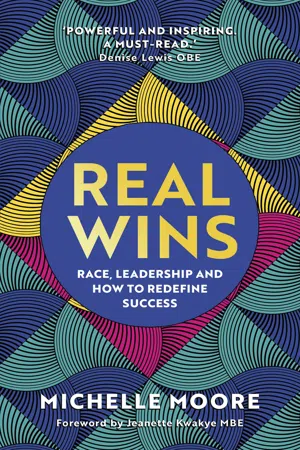
'Powerful and inspiring. A must read' Denise Lewis OBE
'A book that could simply change your life' Colin Salmon, Actor Real Wins is an urgent call to action from one of the most influential women in sport. In her unflinching style, Michelle Moore seeks to redress inequality at all levels and shows us how to challenge stereotypes and tired assumptions to transform our experiences and environments.Through this timely, eye-opening insight into her experiences both on the track and in the boardroom, Michelle shows us how to face our fears, build resilience and find our own unique leadership style. She shares stories from athletes, leaders and many other inspiring people, as she redefines the relationship between identity and success for both individuals and organisations.Giving you the practical strategies of self-awareness and resilience to run your own race, Real Wins will empower you to take responsibility for your own prejudices, actions and ultimate success.
Michelle Moore tirelessly champions a brand of conscious leadership for a new age of sport and business. She is sought out by corporations, government bodies and international sports federations to help drive change and bring about personal and collective transformation.
- 224 pages
- English
- ePUB (mobile friendly)
- Available on iOS & Android
eBook - ePub
About this book
Information
1
Redefining success on your terms
‘Will Michelle Moore, London team, please report to the officials hut immediately.’ I heard the announcement and was worried. ‘What have I done?’ I was at the English Schools National Championships, representing London in the 400m. This was an important national track and field championship where all the regions compete to find the best athletes in the country. It was a big deal and felt like my very own Olympic Games. I had run my heat earlier in the day and had not made it through to the next round. I was a bit down … well, more than a bit; I was disappointed in myself for not running faster. I trudged along to the officials hut at the back of the athletics stadium to be informed that I had run the same time as another athlete and would have to run a race off at the end of the day to see who would go through to the final for the next day. ‘Are you sure you’ve not made some kind of mistake?’ I asked the official in a disbelieving tone. He looked at me over his glasses and said, ‘I know, luv. This has never happened before – you’re making history.’ He laughed and told me the time of the race. The news of the race-off went around the track meet like wildfire, with the other athletes excited by what they deemed to be a bit of drama. This was not helpful and raised my already heightened anxiety levels. I had 90 minutes before race time. I was excited and thankful for another chance. I was 16, and this was my first time away from home competing. It was all a bit scary but exhilarating at the same time. I felt truly alive. I was nervous, knowing the significance of being in an English Schools final could mean big things for my athletics career. Some athletes who make it to the finals can go on to achieve an international Great Britain vest. One of my rivals (now a friend), Donna Fraser, would be there, I was sure. The race-off had caused a stir among my London teammates, but I didn’t want the fuss as I was anxious enough.
‘On your marks,’ the starter bellowed, my heart beating so fast I felt as though I had a microphone in my chest. Just before I got into my blocks, I clocked that my opponent was tall but not as tall as me. She was wearing red shorts. The sweat was starting to glisten on my upper lip, and I could feel it and wiped it away. I kept thinking that I didn’t want to lose, especially in front of so many people who had stayed behind to watch. The gun went off and I got into my running, quickly letting my long stride gobble up the track. I reached the 200m mark with ease. There the London team was going crazy, shouting my name. ‘Come on, Michelle!’ they hollered. Their voices felt close, the wind carrying their voices around the top bend with me. ‘Stay relaxed. Keep those arms pumping. You don’t want to let coach down. You’ve got longer legs than her. Come on, you can do this, Michelle!’ I kept repeating, ‘Come on!’, over and over again in my head, willing myself on.
As we approached the halfway point at 200m I could hear the patter of our feet beating the track down as our loping strides ate up the distance. We were level. My body felt at ease, my arms and legs effortlessly coordinating my actions. I started to coast around the top bend so I could conserve energy for the last 100m. Into the home straight we were neck and neck, but I could feel my legs becoming heavier and heavier. I was thinking, ‘I haven’t even started sprinting yet – what’s going on?’ The previous race and the two sets of warm-ups were taking their toll on my body. My legs felt heavy as if I was running through treacle. Latic acid had come for me, robbing me of my speed. I knew I was running out of time and felt as though I hadn’t even started racing. All of this was going through my head as my stride length becoming shorter and shorter. I could feel my rival’s looming presence next to me and then I felt it – a woosh of air on my cheek as she passed me in the last few metres of the race. I crossed the line and couldn’t believe that I’d lost. It was over. I was devastated. I’d literally ran out of distance and time.
I was desolate but not surprised, as odd as that sounds. I was in shock that I could let myself down so badly. I was inconsolable and humiliated, the combination of the two almost too much to bear. There was nowhere to hide from such a public losing performance. I felt as though I’d let everybody down: my coach, teammates and, above all, myself. I was in turmoil, busy berating myself with self-disdain and disgust for underperforming so dramatically, thereby rendering my training and sacrifice worthless. After my warm-down I traipsed back to the stands. Thankfully, most athletes had left. ‘What happened?’ my teammate Simone asked in the quiet and caring way she always did – which is why we were friends. I hung my head in shame and mumbled my ‘I dunno’ response. My embarrassment was as deep as the well I would’ve loved to have escaped into at that moment. The time for the race was one that I had run many times before, so I know it was well within my talents. I packed up my kitbag, which felt so much heavier than at the start of the day, plugged in my Walkman, and got on the coach, with my head down, my cap on so that everyone knew to leave me alone.
It’s a loss I never truly recovered from, and I still feel it in my chest today some 30 years later. Looking back, I knew that I didn’t have the winning mindset that day, or any other day I would soon come to realize. There had been the tell-tale signs such as being distracted by my opponent and falling into negative self-talk. I’d let the occasion get to me. I never forget that feeling of a wasted opportunity. I hadn’t even given myself the chance to win because I didn’t execute my race plan and had mentally checked out, rather than being in the present moment of the race. The race was a life-defining moment for me. I’d been under the spotlight and choked. I believe to this day that, if I’d given my best performance, the outcome might have been different; even if I didn’t win, I would’ve known that I’d given my best efforts. That’s the biggest regret I had: that I’d not seized the moment to realize all of my promising potential. The experience taught me about truly and deeply understanding the power of a winning mindset. The effects of that one race were long-lasting. My athletics career developed, and I became a decent county athlete, winning an inter-counties 400m race representing South-East England and training at the University of Southern California. But I never achieved the true international career success I dreamed of. My winning mindset was not strong enough, and I’d let the fear of failure determine my future success in all kinds of ways. I gave up athletics eight years later when I decided to focus on my teaching career.
As a speaker I must have told this story a hundred times, and each time I tell it people expect the ending to be victorious. Stories of success over failure are fundamentally what people want to hear. But it is failure that teaches us the most about self-belief and how to compete for your own personal best. The lessons we gain from failure paradoxically become your ‘real wins’.
I’ve won some races and lost some. Sport has been and continues to be a great teacher. From a young age it taught me that to win I needed to leave everything on the track in all of my best efforts while at the same time accepting that I might lose in the process. It was a lesson learned too late for my English Schools race-off, but that lesson is something we can all apply to our lives, though it requires a particular mindset.
Understanding the mindset of an athlete can help you to manage and cope with failure in your everyday lives, and, in turn, helps you to define success on your own terms. The operative words here are ‘own terms’ because success and winning look and feel differently for each of us. By understanding what it means to fail you are able to keep moving forward. That’s why failure is so important and integral to winning at work, on the sports field and in life.
The mindset of success
Conquering a mindset for success for that winning performance in life can be achieved by anchoring positive thoughts and mantras. The concept here is known as illeism, which is the act of talking to or about yourself in the third person. This self-talk strategy helps athletes to distance themselves psychologically from the situation and increases their ability to regulate their emotions. Illeism is often practised by sportspeople, including Anthony Joshua, Raven Saunders, Andre Agassi and Pelé. Research has shown it is a beneficial technique to improve performance. You can use this strategy especially where you lack confidence in certain situations. For example, through applying illeism you can coach yourself to resolve a conflict with a colleague and take it one step further by stepping into a different persona altogether. You can create an alter ego; you can name him/her and step into that assertive and more reassured persona in those moments when you want to feel and appear more confident. This strategy works well with people who are more introverted in their nature and find it tricky to assert their views, especially at important times.
My friend and previous rival on the track, Olympian Donna Fraser, has used illeism in her sporting career and life with powerful effects. Donna has an alter ego called Diane, and when I interviewed Donna, I expected her to tell me about how Diane helped her win on the track, but it went deeper than that. Donna is a breast cancer survivor, and it was the power of positive self-talk in the third person through Diane that helped Donna adopt a positive mindset. In Donna’s words: ‘When I was told about my diagnosis, I cried a bit, but then Diane quickly took over and told me to fix up, look sharp, and from that moment on I applied myself to doing everything I could to help myself live.’ Donna is a huge inspiration to me and many. After a successful career in sport, she now leads the equality and diversity work for UK Athletics. Donna achieved the Freedom of the Borough honour for Croydon in 2019 and an OBE for services to equality in the workplace in 2020.
Illeism isn’t the only psychological trick we learn from sporting greatness. According to the eminent psychology professor Carol Dweck, adopting a growth mindset for success in life is one of the determinant factors in creating a positive inner belief system. A growth mindset describes people who believe that their abilities can be developed through effort and are open to learning and tackling problems. The best sportspeople and most successful people in professional life have a growth mindset. By contrast, those people who have a fixed mindset believe that abilities are fixed, leading them to avoid challenges and to lack confidence to adapt to new circumstances. My race-off defeat was a result of the pressure I had put on myself: rather than allowing myself to rely on the fact that I could complete the race in a time that I’d achieved in the past, my perception of the task had magnified the intensity and stress of the moment. In sports psychology this is about separating motivation from pressure. Let me explain.
There is another important aspect to growth mindset: the need to focus on the process rather than the outcome of your motivation or desires. This applies to the sports arena as much as it does to any significant, testing moment. In a race scenario this is about concentrating on the elements of the execution of the race rather than on your position at the end of the race. Focusing on the victory can add to the pressure the athlete feels whereas sticking to the game plan allows him or her to control the fear associated from the perceived pressures. A high-profile athlete may feel pressure from the media, spectators and others expecting them to do well. If an athlete interprets these elements as a threat to their potential victory, this results in heightened anxiety, which can have a debilitating effect on performance. Taking control of this requires the athlete to change their perception of pressure and to view it as a challenge to overcome. They can then begin to understand that what is being asked of them is their profession: something they have worked hard for and is second nature and therefore achievable.
My interview with the Olympic sprinter and now sports broadcaster Jeanette Kwakye illustrates how a growth mindset and how aspects of illeism operate in real time. Before her World Indoor championship 60m final in 2008 in Valencia her coach asked her to write the headline for the newspapers for the next day. Jeanette wrote: ‘Kwakye breaks British record.’ He then asked her to focus on the race game plan, and that was it. The plan worked, and Kwakye went on to claim silver medal in the final, breaking the British record and becoming British champion, placing Kwakye at number two in the world at that time. Jeanette was able to conquer her fears by externalizing them through the act of writing that newspaper headline, enabling her to stop internalizing the fear which was negatively impacting her mindset. This released her focus on negative feelings, empowering her to break free from their hold on her. Literally giving away your fears to your ‘third person’, or spilling your fears into a diary or an imaginary newspaper headline so they are no longer a part of you, is a powerful mindset shift that can create extraordinary results in your life.
The Great Britain track and field heptathlete Katarina Johnson-Thompson thought about quitting the sport when she failed to win a medal at Rio 2016 Olympic Games. The British media had documented her on-going setbacks with injury and poor performances since 2014. It was agonizing viewing as millions tuned in to see her foul out in the long jump in the Beijing 2015 World Championships, and then, in the Rio 2016 Olympic Games, disaster had struck again with a breakdown in the javelin. At the London 2017 World Championships, the newspaper pages carried pictures of Johnson-Thompson with her head in her hands in the high jump bed, having failed three attempts at what would usually be an easy height for her to clear, thereby dashing all hopes of medal glory.
Johnson-Thompson was clearly and still is a talented athlete, at that time set to follow in the footsteps of heptathlete royalty Jessica Ennis-Hill and Denise Lewis, but she couldn’t quite overcome her anxieties and poor performances. She had to take a leap of faith and made big changes by changing coaches and relocating to France. It paid off, and at the Doha 2019 World Championships she won gold and broke the British record with a score of 6,981 points, which ranked her at number 6 on the all-time heptathlon lists. After her gold medal performance, The Guardian ran the headline, ‘I’ve cried enough to last me a lifetime’, under which Johnson-Thompson reflected on her long road of adversity to the gold medal. Her words resonated deeply with me and reminded me of the young and sometimes emotional athlete I once was. For Johnson-Thompson her journey to gold was littered with many failures. She displayed real courage in the face of such public failure and was prepared to make big changes and sacrifices in turning her life around and finding a new path to her ultimate gold medal glory. She displayed all the characteristics of a growth mindset – something that’s available to all of us. When you have a growth mindset you are open to learning new ways of thinking and taking on board feedback to improve performance, whether that’s on the sports field or in the workplace.
The beautiful thing about failure is that it provides the perfect gift of feedback. As an athlete, each time I competed my coach would tell me exactly what I’d done wrong, so from a very early age I was accustomed to receiving constructive feedback as part of the training to win. Races are won by one thousandth of a second, unless, of course, you’re Usain Bolt and you give your opponents a glorious smile as you pass them in the dying metres of the race. Marginal gains are the micro adjustments you make to your technique and mindset in order to achieve your peak performance in preparation for victory. When I’m working with people helping them to prepare for important job interviews or presentations, I introduce the concept of marginal gains. This can take many different forms. It could be putting yourself into a peak mindset by doing an activity just before you start that gets you into a state of high vibration. This can include everything from listening to music to meditating, and is different for everyone. The biggest marginal gain to be found, however, is in your mindset shift of facing up to your fears. There’s more on this later.
Tools of resistance
The beautiful thing about failure is that it provides the perfect gift of feedback.
Using a sporting mindset can provide many life lessons for managing failure or adversity in your professional working life. To highlight this, in the table below I’ve broken down the elements of my negative mindset traps which contributed to my race-off loss. These traps can be applied to the professional settings you can find yourself in. Included, too, are the countering positive mindset techniques.
Disruptors/negative mindset | Positive mindset |
Table of contents
- Cover
- Title
- Contents
- Dedication
- Foreword
- Introduction
- 1 Redefining success on your terms
- 2 Can you see me? (In)visibility
- 3 Redefining the boundaries
- 4 Standing tall
- 5 The opportunity in leadership
- 6 Identity and activism
- Epilogue: New realms
- ‘Declaration of Independence’ by Michelle Moore
- Endnotes
- Acknowledgements
- About the author
Trusted by 375,005 students
Access to over 1.5 million titles for a fair monthly price.
Study more efficiently using our study tools.
Frequently asked questions
Yes, you can cancel anytime from the Subscription tab in your account settings on the Perlego website. Your subscription will stay active until the end of your current billing period. Learn how to cancel your subscription
No, books cannot be downloaded as external files, such as PDFs, for use outside of Perlego. However, you can download books within the Perlego app for offline reading on mobile or tablet. Learn how to download books offline
Perlego offers two plans: Essential and Complete
- Essential is ideal for learners and professionals who enjoy exploring a wide range of subjects. Access the Essential Library with 800,000+ trusted titles and best-sellers across business, personal growth, and the humanities. Includes unlimited reading time and Standard Read Aloud voice.
- Complete: Perfect for advanced learners and researchers needing full, unrestricted access. Unlock 1.5M+ books across hundreds of subjects, including academic and specialized titles. The Complete Plan also includes advanced features like Premium Read Aloud and Research Assistant.
We are an online textbook subscription service, where you can get access to an entire online library for less than the price of a single book per month. With over 1.5 million books across 990+ topics, we’ve got you covered! Learn about our mission
Look out for the read-aloud symbol on your next book to see if you can listen to it. The read-aloud tool reads text aloud for you, highlighting the text as it is being read. You can pause it, speed it up and slow it down. Learn more about Read Aloud
Yes! You can use the Perlego app on both iOS and Android devices to read anytime, anywhere — even offline. Perfect for commutes or when you’re on the go.
Please note we cannot support devices running on iOS 13 and Android 7 or earlier. Learn more about using the app
Please note we cannot support devices running on iOS 13 and Android 7 or earlier. Learn more about using the app
Yes, you can access Real Wins by Michelle Moore in PDF and/or ePUB format, as well as other popular books in Business & Human Resource Management. We have over 1.5 million books available in our catalogue for you to explore.