How do organizations keep the workers they want? Until now, employee retention strategies have been based on instincts rather than research. With no firm body of knowledge to use as a guide, employee turnover has been a problem for all organizations. Rethinking Retention in Good Times and Bad is the first book to offer a top-to-bottom, organization-wide retention action plan. Many organizations lose employees and profits because they don't know which processes to put into place to cut employee turnover. They speak of building retention cultures but don't know who should do what and when. This hands-on tactical guide gives those answers, providing specific strategies and tactics backed by the author's own research and on-site experience. Rethinking Retention in Good Times and Bad is essential reading for all types of organizations—large or small, public or private, with high concentrations of low-skilled or high-skilled workers and across multiple industries. If you are losing workers you want to keep—in good economic times and bad—this book will tell you how to put retention solutions in place across your company.
Part I: The Rethinking Retention Model: Principles and Strategies
One The Rethinking Retention Model
Imagine you are reading this book in the summer of 2007. Surrounded by a blazing economy, you would find data here regarding the high number of jobs versus workers across most industries as well as the challenges U.S. companies face to hire and retain good or even serviceable workers.
But the U.S. economy made a hairpin turn near the end of 2007, moving from very healthy to officially in recession in a matter of months. This stark contrast of economies offers a good look at employees’ quitting patterns during down economic times.
For most of 2007, the U.S. economy was riding high and few economists were predicting danger ahead. The recession began in December of that year but wasn’t officially announced until a full year later.1 During that 12-month lapse the United States became a different country.
By the mid-point of 2008 the economy showed the following changes since year-end 2007:
The Dow Jones Industrials had dropped more than 14%2
Inflation had increased over 4%3
Gas prices had shot up an even dollar4
The Consumer Confidence Index had fallen 44%5
Major layoffs had increased by 22% compared to the same period of the previous year and had put nearly 1 million Americans out of work6
These are the times when executives expect workers to hold onto their jobs.
Toward the fall, our government furthered our worry by passing legislation to bail out banks, mortgage companies, automakers, and an insurance company for a total cost of nearly $1.4 trillion.7 We were told that our financial system would have collapsed without government support. Then in November, President-elect Obama warned that “we could lose millions of jobs next year”.8
By the end of 2008, the omnipresent media was telling American workers what the year had been like for their peers. Compared to 2007, 43% more had been laid off and unemployment had increased to 7.2%, a jump of 26% over the previous year.9 Surely, American workers were pleased to have a job ...any job.
But the data tell a different story. The number of voluntary quits did drop during year one of this recession, but only by 11%.10 This meant that your chance of losing an employee you wanted to keep in 2008 was 89% as strong as it was during the strong economy of 2007.
And while concerns grew deeper as the year went on, the difference in voluntary quits between the fourth quarters of 2008 versus 2007 was just 20%.11 So there was an 80%-as-strong likelihood of losing a productive worker in the 4th quarter of 2008 versus the same period in the previous year.
More important, there is good reason to believe that those who walk away from their jobs during recessions are usually your best performers. Open jobs declined by 18% from 2007 to 2008,12 while layoffs and the hike in unemployment put many more applicants on the streets. One study estimates there were nearly three times as many applicants for openings during the recession as there were before it.13 As a result, companies became more selective and applicants found stiff competition for most openings. Those who left you had probably already secured a new job and beaten out the masses to win it. These are the employees with stronger skills and work ethics, the ones you can least afford to lose. Poor performers, on the other hand, were holding on for their paychecks and knew they must be fired in order to earn unemployment benefits.
Viewed from a higher level, this data tells us we can always lose the employees who keep us in business, in good times and bad.
Senior executives seem to know this. In a study, top execs from the largest 1,000 companies in the United States said their greatest staffing concern was retention, and the survey was conducted in September and October of 2008—a high time for media frenzy about the economy, bailouts, and layoffs.14
Forever, organizations have approached employee retention in the same manner as Christopher Columbus, without a map to lead the way. When Columbus left Spain in August of 1492, he set his sails westward toward Asia with hope of securing rich silks and rare jewels there. Capitalist Chris next touched land two months later in the Bahamas. Believing he had crossed the Pacific Ocean, he dispatched his crew to seek out the Great Khan. They came back with sand in their boots.
To his death, Columbus believed he had landed in Asia rather than America. History has since credited him for his courage, as well as for essentially sailing in the right direction.15
For many organizations today, solving employee retention is like hitching a ride on the Niña, Pinta, or Santa Maria. With no proven path to follow, they steer themselves by default toward traditional solutions such as pay, benefits, and employee appreciation week. Lacking Columbus’s good fortune, they head in the wrong direction.
Let’s not be like Chris.
The Price of High Turnover
How much does employee turnover cost? Studies by Pricewaterhouse-Coopers’ Saratoga Institute indicate turnover costs organizations more than 12% of pretax income, all the way up to 40% for some.16 Another study puts turnover’s price tag across the United States at $25 billion annually—and that’s just to train replacements.17 A third study indicates that turnover reduces U.S. corporate earnings and stock prices by 38% in just four high-turnover industries.18
Turnover touches every aspect of organizations because people touch every aspect of these organizations. People answer phones, make sales calls, move products from assembly lines, and make hundreds of decisions every day that impact your customers. No amount of technology will replace the impact of the people you hire, train, and then lose or retain.
So employees are your business. And those who manage businesses both large and small face stiffer competition domestically and abroad. In most industries it’s now harder to make a buck, making your effectiveness at retaining good workers even more critical. In fact, retaining good workers is the tipping point between success and failure for many organizations.
Introducing the Rethinking Retention Model
It’s time to rethink retention. We all wish turnover solutions were as simple as tweaking copays for employees’ health insurance, but unfortunately retention is more vexing and much more complex. Rather than pulling on one rope, it requires pulling many strings.
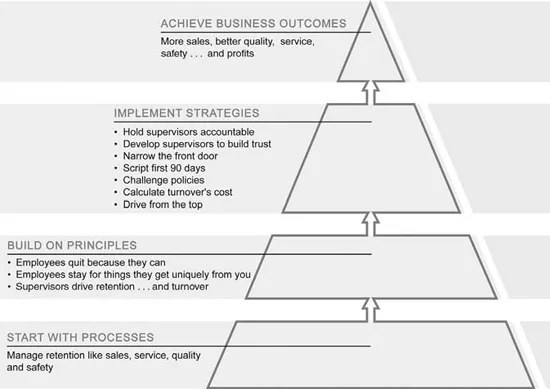
Figure 1.1 provides a graphic representation of an organization-wide model for keeping your best workers longer. Follow this map and employee retention will improve and drive all other key metrics in your favor.
The next sections introduce the principles and strategies that comprise the Rethinking Retention model.
The Principles of the Rethinking Retention Model
There are three basic principles at the foundation of retention.
Point #1: Employees quit jobs because they can. Workplace demographics leave employees with too many job choices, even in down economies. Avoid the dead-end road of basing retention solutions on exit surveys and other reasons you believe employees leave. Instead, build a proactive solution you can control.
Point #2: Employees stay for things they get uniquely from you. Who are you as an employer? What does your organization offer that others do not? Identify it and build hiring, training, and all other processes on the things that are uniquely you.
FIGURE 1.1 The Rethinking Retention Model™
Point #3: Supervisors build unique relationships that drive retention...or turnover. Supervisory relationships are unique levers that deeply impact employees’ stay/leave decisions. Some employees stay for supervisors, some leave because of them, and some just avoid them.
Chapters 3–5 describe these principles in detail.
The Strategies of the Rethinking Retention Model
Once you’ve grasped the principles,the following strategies will help you improve retention, productivity, and all other important metrics.
Point #4: Hold supervisors accountable for achieving retention goals. Supervisors won’t achieve any other goal you assign them if they lose their best performers, so make them accountable and give them “skin in the game” for retention.
Point #5: Develop supervisors to build trust with their teams. Communication, recognition, and development all fall behind trust. Who values information and praise if you don’t believe it?
Point #6: Narrow the front door to close the back door. New hires must align with who you are—your jobs, values, and stan-dards—and give clear indications they intend to stay.
Point #7: Script employees’ first 90 days. First impressions predict how long employees stay, so early activities must be scripted to present your company in ways that are both positive and truthful.
Point #8: Challenge policies to ensure they drive retention.
Blow the dust off last decade’s thinking and drive your rules toward retention.
Point #9: Calculate turnover’s cost to galvanize retention as a business issue. Dollars speak louder than numbers and percents.
Point #10: Drive retention from the top, because executives have the greatest impact on achieving retention goals. Think about how your company manages sales, service, quality, and safety and then build those same methods for retention.
Chapters 6–12 elaborate on these strategies.
The core ingredient of the Rethinking Retention Model is the shared responsibility of operations management and staff support. In most organizations, operations management drives sales, service, quality, and safety, with various staff departments providing tracking, training, and other services. When it comes to retention, however, HR tends to manage this on its own.
Making people management work requires organizations to run on all cylinders, to involve all who can help. Each company has developed successful, shared-responsibility models for managing sales and other key initiatives, so why not replicate these ways with retention?
Driving retention processes from top to bottom is the key. Savvy organizations manage retention with the appropriate amount of accountability and other operations-driven tactics to be fully effective.
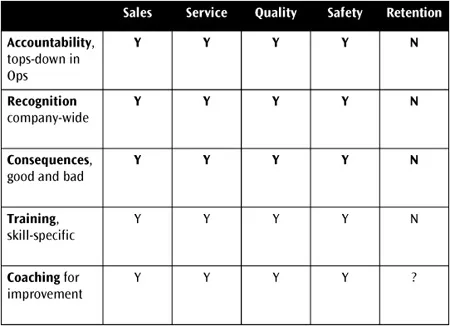
The following chart represents the types of top-down processes our clients usually had in place before our engagements with them, with “Y” representing yes, that they did have these processes in place, and “N” representing no, that they did not:
While a few of these organizations provided coaching for supervisors who failed to keep good workers, no retention processes for accountability, recognition, consequences, or skill-specific training were in place. And most of the retention coaching was provided by HR instead of the supervisor’s manager.
Organizations that manage retention like the ones represented on the chart turn to HR to solve it. The result is usually programs such as career classes or benefits like vision care. So ask yourself: Does my company solve retention with processes driven from the top or with programs driven by HR?
The following chapters discuss research, tactics, roles, and true stories that will help guide you to create your own employee retention action plan.
Two Principles and Strategies for Steering Your Employee Retention Ship
This chapter discusses the information and logic behind the Rethinking Retention model. Later chapters delve into the details of each of the principles and strategies.
The Principles
The first three points of the Rethinking Retention model are principles that lay the foundation for the seven strategies that follow. I offer these principles as facts, with a strong cast of supporting research for each.
Point #1: Employees quit jobs because they can
Exit surveys and various studies indicate employees quit because of supervisors, pay, career development, and for “better opportunities,” or they are fired for attendance or job abandonment. While each of these exit reasons are true at one time or another, the #1 reason employees quit is because our economy and society make it easy for them to do so. Let’s consider this thought further by answering this question: Which of the following reasons would cause your turnover to drop the most?
1. You give all employees a 10% pay raise
2. You offer all employees a career development course
3. The U.S. economy tailspins, reducing the number of open jobs
Smart money would probably bet on answer 3. Studies by the U.S. Bureau of Labor Statistics (BLS) indicate that turnover goes up when the economy is strong and goes down when the economy struggles.1 Said another way, higher turnover can be a price of good economic times.
While turnover has declined during slow economies, good workers still quit.
The 2001 recession reinforced that good workers can still find new opportunities. In the years that im...
Table of contents
Cover Page
Title Page
Copyright Page
Dedication Page
Contents
Introduction
Part I: The Rethinking Retention Model: Principles and Strategies
Part II: Putting Rethinking Retention to Work: Tactics
Conclusion What’s Next?
Appendix A: Case Studies: Hilton’s Call Centers and Curley & Pynn
Appendix B: Top Sections of the Bureau of Labor Statistics’ Website
Appendix C: 2007 vs 2008 Voluntary Quits and Job Openings by Private Industry
Notes
Index
Trusted by 375,005 students
Access to over 1.5 million titles for a fair monthly price.
Study more efficiently using our study tools.
Frequently asked questions
Yes, you can cancel anytime from the Subscription tab in your account settings on the Perlego website. Your subscription will stay active until the end of your current billing period. Learn how to cancel your subscription
No, books cannot be downloaded as external files, such as PDFs, for use outside of Perlego. However, you can download books within the Perlego app for offline reading on mobile or tablet. Learn how to download books offline
Perlego offers two plans: Essential and Complete
Essential is ideal for learners and professionals who enjoy exploring a wide range of subjects. Access the Essential Library with 800,000+ trusted titles and best-sellers across business, personal growth, and the humanities. Includes unlimited reading time and Standard Read Aloud voice.
Complete: Perfect for advanced learners and researchers needing full, unrestricted access. Unlock 1.5M+ books across hundreds of subjects, including academic and specialized titles. The Complete Plan also includes advanced features like Premium Read Aloud and Research Assistant.
Both plans are available with monthly, semester, or annual billing cycles.
We are an online textbook subscription service, where you can get access to an entire online library for less than the price of a single book per month. With over 1.5 million books across 990+ topics, we’ve got you covered! Learn about our mission
Look out for the read-aloud symbol on your next book to see if you can listen to it. The read-aloud tool reads text aloud for you, highlighting the text as it is being read. You can pause it, speed it up and slow it down. Learn more about Read Aloud
Yes! You can use the Perlego app on both iOS and Android devices to read anytime, anywhere — even offline. Perfect for commutes or when you’re on the go. Please note we cannot support devices running on iOS 13 and Android 7 or earlier. Learn more about using the app
Yes, you can access Rethinking Retention in Good Times and Bad by Richard Finnegan in PDF and/or ePUB format, as well as other popular books in Business & Management. We have over 1.5 million books available in our catalogue for you to explore.