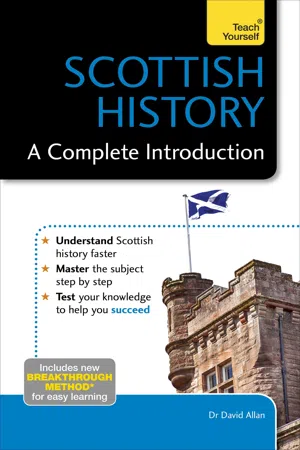
Scottish History: A Complete Introduction is a comprehensive guide to the exciting story of this nation, from pre-history right through to the present day. With the question of Scottish independence once again on the agenda, this book will allow you to trace the events, both peaceful and bloody, that have brought the country to this point. Tracing events from the pre-history of the land and the coming of the Scots to the rise of the Scottish National Party, it provides an informative and accessible introduction to Scotland's history. Whether it is the Jacobite Rebellion, the advances of the Scottish Enlightenment or its role in WWI and WWII, this is the perfect place to start.AUTHOR INSIGHTS
Lots of instant help with common problems and quick tips for success, based on the author's many years of experience.TEST YOURSELF
Tests in the book and online to keep track of your progress.FIVE THINGS TO REMEMBER
Quick refreshers to help you remember the key facts.TRY THIS
Innovative exercises illustrate what you've learnt and how to use it.
- 256 pages
- English
- ePUB (mobile friendly)
- Available on iOS & Android
eBook - ePub
Scottish History: A Complete Introduction: Teach Yourself
About this book
Information
1
The land of the Scots

Contours and contrasts
Scotland is a very small country – ‘wee’, as its inhabitants would say. And despite much local variation, there are really just two topographical zones in this, the northern third of the British mainland.
One, the Lowlands, roughly half by area, comprises the southern and eastern parts of Scotland. The Highlands, often called ‘the Highlands and Islands’ to reflect the substantial off-shore contribution, lie to the north and west of the Highland Boundary Fault, a geological feature which cuts Scotland in two between Arran on the west coast and Stonehaven on the east.
The stark contrast this produces, with a jagged landscape dominated by mountains and water beyond the Fault and a less dramatic mixture of rolling hills and low-lying coastal plains below it, has exercised a profound influence throughout history over the peoples of northern Britain.
In many ways we shall see, they still determine some of the most basic patterns of Scottish life today.
Highland heartland
In the far north and west, the Scottish Highlands possess the oldest landscapes anywhere in the British Isles.
Around 3,000 million years ago, the hard grey rocks that provide the beautiful but largely barren wildernesses of Wester Ross, Sutherland and the Isle of Lewis were first formed volcanically and then plunged deep into the planet’s crust. There they re-crystallized before finally being thrust upwards to form imposing mountain ranges.
So far back in time did this chain of events occur that Scotland, Britain and Europe were not yet even formed. Instead the Lewisian gneisses were uplifted in a part of the earth’s early surface that would subsequently be torn asunder, through the actions of plate tectonics, eventually arriving on opposite sides of a newly created Atlantic Ocean. Eroded over aeons of time, they formed a dramatic but unyielding surface which, with its endlessly varied rock formations and profusion of water features, is wonderful to look at but hard to tame. The generally thin and poor-quality soils that result, tilled only with difficulty, are shared with places now as distant from modern Scotland as Greenland and the eastern seaboard of Canada. But when emigrants from the North-West Highlands arrived on the North American coast after 1750, it was no accident that in Labrador and Nova Scotia the demanding landscape greeting them looked strangely like home and they decided to settle where they landed.
The historical consequences of other somewhat later geological processes are also still felt in Scotland. In certain northern and western districts, the gneisses were overlain with sandstone. A softer sedimentary rock produced by gradual compression of materials deposited by ancient rivers, its faster erosion created majestic outcrops, standing proud of the surrounding landscapes. The weirdly shaped mountains of Assynt and Torridon, a favourite playground of the climbers and hill-walkers who first became vital to the Highland economy in the late 19th century and remain crucial today, are the outstanding evidence of this process.
The remainder of the Highlands comprises either metamorphic rocks, chiefly schists and slates, created around 500 million years ago when the American and European plates closed, or granites, produced by subsequent vulcanism. As elsewhere in Europe, erosion, and in particular glaciation, has cost these formations most of their original height. But, reaching typically to 3,000-4,000 feet, they still lend the Highlands a ruggedly mountainous character – visually spectacular to 21st-century eyes, certainly, but historically difficult to traverse and in most places also economically challenging because resistant to arable cultivation and with few useful minerals to extract.
All along the west coast, the Inner and Outer Hebrides comprise offshore islands created by rising sea levels. On the adjacent mainland, deep clefts contain a mixture of tidal and freshwater ‘lochs’ (lakes), cut mainly by the scouring actions of immense, mile-deep glaciers in the Ice Ages. A crucial result is an abundance of welcoming beaches and easily accessible islands and bays and thus a historical receptiveness to ship-borne travellers. The Scots themselves, the founders of Scotland as a political entity, were an important early instance of a sea-going people exploiting this feature. Later it proved equally alluring to Viking raiders and colonists from Norway.
Lowland low-down
The Lowlands, despite the name, are not homogenous, their landscapes actually varying from mid-sized hills to coastal cliffs and sand dunes.
 | Scots on the Rocks |
Exceptionally diverse geology in an unusually compact geographical area eventually made Scotland central to the emergence of modern earth science. In the 1780s Edinburgh-born James Hutton, based on evidence like the local igneous formations, the granite Cairngorms and the uplifted and warped sedimentary folding exposed in the sea cliffs of Berwickshire, concluded that the earth’s surface must be the unimaginably ancient product of on-going natural processes. John Playfair and Sir Charles Lyell, both from Angus, made this interpretation the basis of 19th-century views of the planet. Sir Roderick Murchison from Ross-shire (a lunar crater is now named after him) identified and labelled several of the major geological periods in the earth’s history.

In practice they divide into two broad areas. On the one hand there is a wide central valley – running from the Firths of Tay and Forth in the east to the Firth of Clyde in the west – sometimes called the Central Lowlands or just the Central Belt. On the other there are the southernmost parts of the Lowlands, from Galloway in the far south-west to Berwickshire in the far south-east, usually, from their proximity to England, known as the Borders, or else, because they are generally hilly, described as the Southern Uplands.

‘Hence we are led to conclude, that the greater part of our land, if not the whole, had been produced by operations natural to this globe.’
James Hutton, The Theory of the Earth (1785)
Even the Central Lowlands are remarkably diverse, however, and not completely flat. Mostly they are reasonably low-lying and dominated overall by three ‘firths’ (wide tidal river mouths), today home to three of the country’s four largest cities, each with significant ports – Glasgow, Edinburgh and Dundee. But there are numerous exceptions. These include the evidence of long-ago volcanic eruptions that give Edinburgh one of the world’s more visually arresting skylines and Stirling Castle the imposing rock from which historically it controlled access to northern Scotland. They also include the igneous rocks out of which Aberdeen (‘the granite city’), just beyond the Highland Boundary Fault, is substantially constructed.
Mainly lying on sedimentary materials, the Central Lowlands were reasonably open to human development. Not just continuous deforestation, drainage and arable farming but also widespread settlement and significant urbanization started in medieval times. The large quantities of accessible rock on or very near the surface explain the historical Scottish preference for building in natural stone not manufactured brick. Workable coal seams and iron ore deposits were also close by. It was upon these that world leadership in heavy engineering, and the emergence of Glasgow as the country’s largest city, would be based in the Victorian age. Later still, in the 1970s, Aberdeen would also boom as Europe’s oil capital on the back of huge offshore finds.
South of a line running approximately from Ballantrae on the...
Table of contents
- Cover
- Title
- Contents
- About the Author
- Maps
- Introduction
- How to use this book
- 1 The land of the Scots
- 2 Scotland before the Scots
- 3 The Scots and the birth of Scotland
- 4 Building a kingdom
- 5 Norman Scotland
- 6 The golden age
- 7 A nation compromised
- 8 The wars of independence
- 9 The late medieval kingdom
- 10 Reformation and rebellion
- 11 Two crowns united
- 12 The conflict of the Covenant
- 13 A restoration and a further revolution
- 14 Union and Jacobitism
- 15 Industry and Enlightenment
- 16 The long Victorian age
- 17 Triumph and disaster
- 18 Retreat and resurgence
- Fact-check answers
- Copyright
Trusted by 375,005 students
Access to over 1.5 million titles for a fair monthly price.
Study more efficiently using our study tools.
Frequently asked questions
Yes, you can cancel anytime from the Subscription tab in your account settings on the Perlego website. Your subscription will stay active until the end of your current billing period. Learn how to cancel your subscription
No, books cannot be downloaded as external files, such as PDFs, for use outside of Perlego. However, you can download books within the Perlego app for offline reading on mobile or tablet. Learn how to download books offline
Perlego offers two plans: Essential and Complete
- Essential is ideal for learners and professionals who enjoy exploring a wide range of subjects. Access the Essential Library with 800,000+ trusted titles and best-sellers across business, personal growth, and the humanities. Includes unlimited reading time and Standard Read Aloud voice.
- Complete: Perfect for advanced learners and researchers needing full, unrestricted access. Unlock 1.5M+ books across hundreds of subjects, including academic and specialized titles. The Complete Plan also includes advanced features like Premium Read Aloud and Research Assistant.
We are an online textbook subscription service, where you can get access to an entire online library for less than the price of a single book per month. With over 1.5 million books across 990+ topics, we’ve got you covered! Learn about our mission
Look out for the read-aloud symbol on your next book to see if you can listen to it. The read-aloud tool reads text aloud for you, highlighting the text as it is being read. You can pause it, speed it up and slow it down. Learn more about Read Aloud
Yes! You can use the Perlego app on both iOS and Android devices to read anytime, anywhere — even offline. Perfect for commutes or when you’re on the go.
Please note we cannot support devices running on iOS 13 and Android 7 or earlier. Learn more about using the app
Please note we cannot support devices running on iOS 13 and Android 7 or earlier. Learn more about using the app
Yes, you can access Scottish History: A Complete Introduction: Teach Yourself by David Allan in PDF and/or ePUB format, as well as other popular books in History & British History. We have over 1.5 million books available in our catalogue for you to explore.