WHAT ARE THE 50 SECRETS OF GREAT LEADERS THAT THE REST OF US SHOULD KNOW?
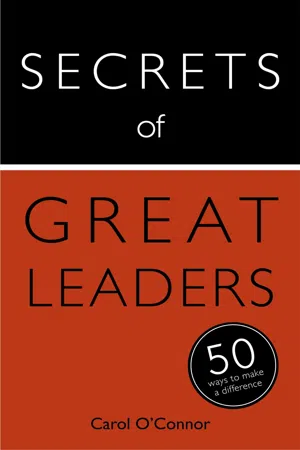
The Secrets of Great Leaders reveals the 50 things you need to know to motivate and inspire those around you. Every one of the 50 secrets in this book contains 3 strategies you can put into practice right now. Some of the ideas will surprise you, all will inspire you. Put these simple strategies together and you have a recipe for professional success, a formula that will unlock your leadership potential. WHAT DO GREAT LEADERS KNOW THAT THE REST OF US DON'T?
Do they have a secret recipe for success? Is there a special alchemy to leading people? Whether you want to motivate your team, master public speaking or establish guiding principles and set priorities, this book provides the tools and techniques you need. With nuggets of wisdom gathered over years of experience, for every type of leadership situation, it gives you everything you need to know. THESE ARE THE REAL LEADERSHIP TIPS YOU NEED TO GET AHEAD ABOUT THE SERIES
Some books promise a lot but fail to deliver as they are hard to use in your daily life. The Secrets series boils down the essentials into short, quick lessons - expert advice on a wide range of challenges that's easy to apply. Every secret contains three strategies that make it simple to put them into action on a regular basis. Whether you want to improve your efficiency, clear your desk, or be on top of your work, these books provide the key secrets you need.
- 256 pages
- English
- ePUB (mobile friendly)
- Available on iOS & Android
eBook - ePub
About this book
Information
 | BASE DECISIONS ON KNOWLEDGE AND DATA |
‘In any moment of decision, the best thing you can do is the right thing, the next best thing is the wrong thing, and the worst thing you can do is nothing.’
Theodore Roosevelt
‘Never make a decision when you are upset, sad, jealous or in love.’
Mario Teguh
‘No sensible decision can be made any longer without taking into account not only the world as it is, but the world as it will be.’
Isaac Asimov
‘The most difficult thing is the decision to act, the rest is merely tenacity. The fears are paper tigers. You can do anything you decide to do. You can act to change and control your life; and the procedure, the process is its own reward.’
Amelia Earhart
‘I think it’s very important that you make your own decision about what you are. Therefore you’re responsible for your actions, so you don’t blame other people.’
HRH Prince William, Duke of Cambridge
This secret makes a good starting point because decision-making is an essential for great leaders. Stories about people in powerful positions dominate the media, with leaders’ reputations often transformed overnight based on how well they make an important choice. They take the heat and, whether they deserve it or not, they take the blame when things go wrong. Amazingly, people still want the job.
Every leader is driven by personal ideals, a desire for power, fame, or other motives. They want to make a difference, influence others or leave their mark. And given the rewards leaders often receive, their followers are entitled to expect results and an effective performance. A leader’s decision-making is the way this can be measured.
Although people don’t expect their leaders to have a crystal ball, they do want them to make an effort to get the facts, be smart and use wisdom. Key questions asked about leaders include:
• Do they analyse current events?
• Do they consult with experts?
• Do they anticipate problems and plan how to solve them?
If their decisions are long-lasting and support the majority, these leaders remain popular. Later, if they’re proved wrong or their decisions gave little benefit or failed, many leaders retain respect because they acted for the best using all the information available at the time. Particularly if they share with their public that ‘These are the lessons learned. We can do better next time’, leaders will be forgiven.
By contrast, leaders who delay an important decision or refuse to act on good information and data are never forgiven. Self-interest – or even the suspicion of this – shows a red flag to the victims of poor decision-makers. Some leaders change jobs every two years to avoid the inevitable blow-up from their rushed or poor decision-making. By moving on, they avoid dealing with the consequences of giving big discounts, offering special deals or hiring the wrong people.
Some leaders avoid making decisions entirely. They are like the tortoise hiding in its shell, hoping decision-making challenges will go away. They never do. Others are like sloths, those slow-moving and sleepy creatures, and they delay taking action for so long that the opportunity for making a good decision passes.
In contrast, strong, able and effective leaders take action based on knowledge and data in support of both major and minor decisions. They see this as a responsibility and an important part of their leadership.
Learning the secret of effective decision-making is one of the most important jobs a leader has.
FOCUS ON WHAT’S IMPORTANT
Important first steps for any decision-maker are to understand why a decision is necessary; why the decision has to be made at this time; and what problem it must solve. For example, if you’re asked to lead a renovation project, before deciding what to do, you need to know what purpose the renovation is supposed to serve. Is it to:
• upgrade the electronics and communications systems?
• enlarge the workspace for additional staff and new projects?
• modernize the workspace to attract and retain good employees?
• meet new health and safety requirements?
Each of these projects will have a different set of priorities and these dictate what you need to do next. Before doing anything, however, you need to write a purpose statement: ‘The purpose of this decision is to…’ Then you look at your budget to see whether there is enough money to meet the decision’s needs. If not, you need to revisit the decision’s purpose and scale down or change your priorities to meet your budget.
This may mean contacting your boss for more information about how to meet the decision’s needs. If you are the lead decision-maker, you may need to ask your financial adviser how to raise more money. If this isn’t possible, this is when you scale down your purpose. For example, an electronics upgrade can be done in planned stages. When you are clear about the decision’s purpose, you are better able to identify the right priorities and deliver what is needed.
GATHER AND STUDY NECESSARY INFORMATION
SWOT is a classic decision-making technique and an acronym standing for strengths, weakness, opportunities and threats. SWOT analyses and organizes information about existing conditions. It also guides your thinking about what could happen in the future. For example, if you have to make a decision about renovating the workplace, and you produce a purpose statement about upgrading the current electronics system, a SWOT analysis will help you identify solutions that support that purpose.
Strengths are what still works in the existing system. Make a list of all the system’s good features. Can you build on any of these? If previously purchased parts were good quality, can you buy from the same supplier?
Weaknesses are what is out of date, broken or never really worked well. List these and also ask what went stale or wrong quickly in the old system. Contact people who used the old system and ask them about its weaknesses.
Opportunities are how a new system can create business and increase contact with existing customers. How can you future-proof a new system to give it longer life?
Threats are the potential danger resulting from the new system. How you can protect the business from them? You can use the PESTELI technique described below to explore threats further.
MAKE YOUR DECISION
PESTELI is an acronym standing for seven external factors that can have a big impact on your decisions: politics, economics, social trends and forces, technology, environment, laws and government, and industry change. By studying each factor’s potential influence on your business, you can future-proof decisions.
1. Political: Think about the influence your local and national politicians have on your business. If there were changes, what would happen? For example, has your local councillor or your MP been of help? Is there any benefit in looking for their help in future?
2. Economic: What would happen to your business if the national economy took either an upturn or a downturn? Is there anything you can do to be ready for this?
3. Social: What influence, if any, do social attitudes have on your business? What if people stop wanting what you offer? Do you have alternative ideas?
4. Technology: If you are making a major upgrade, how can you ensure adaptability?
5. Environmental: This refers to storms, floods and natural disasters of any kind.
6. Legal: Are there any new tax laws in the works, such as a change in VAT or new health and safety laws? Will you need price flexibility, at least for the short term, or will you have to make workplace adjustments?
7. Industrial: Are there any shifts and changes in your industry that can affect your business? Do you follow industry trends so that you can prepare for change?
Putting it all together |
Regular use of decision-making techniques provides a steady source of information in support of both major and minor decisions. Regular practice of these techniques also makes it easier to assess your current circumstances quickly, and gather necessary facts and figures for rapid-fire decision-making. |
Decision-making techniques will help you avoid repeating mistakes by challenging your ideas. Experience can count against you if you’ve become stuck in a fixed routine or have an inflexible attitude. The best decision-makers look for weaknesses in their own plans. They never say, ‘We’ve always done things this way. Why should we change now?’ |
Routine saves time, but if you count on using the same solution without collecting new facts, you put decisions at risk. Effective decisions need preparation and any method or technique that helps to gather information in a systematic way will support you when you find yourself pressured to decide. |
Table of contents
- Cover
- Title
- About the author
- Contents
- Introduction
- 1 Base decisions on knowledge and data
- 2 Follow your instinct
- 3 Master public speaking
- 4 Surround yourself with smart people
- 5 Keep promises and honour agreements
- 6 See the person, not the stereotype
- 7 Set high standards
- 8 Benefit from social media
- 9 Follow the rules you set for others
- 10 Assume you have enemies
- 11 Speak clearly and well
- 12 Plan the long term and work the short term
- 13 Face challenge fearlessly even when afraid
- 14 Use time wisely
- 15 Have a sense of humour
- 16 Build people up
- 17 Be visible and have presence
- 18 Disrupt the status quo
- 19 Earn people’s trust
- 20 Negotiate lasting solutions
- 21 Live with uncertainty
- 22 Give respect to get respect
- 23 Understand different points of view
- 24 Learn from failure
- 25 Make your point and then stop talking
- 26 Listen with your eyes as well as your ears
- 27 Write in a simple style using plain language
- 28 Play for the team
- 29 Motivate yourself and others
- 30 Be courteous to everyone always
- 31 Never give up
- 32 Count the cost of solving problems
- 33 Encourage others to develop and grow
- 34 Be approachable
- 35 Examine your own behaviour
- 36 Encourage debate
- 37 Give people a second chance
- 38 Learn from everyone and everything
- 39 Set targets for personal growth
- 40 Ask for help when you need it
- 41 Set an example
- 42 Watch out – you’re being watched
- 43 Choose a leadership style
- 44 Dare to be different
- 45 Share the glory
- 46 Make friends and form alliances
- 47 Be lucky
- 48 Relax and have fun
- 49 Have a big idea
- 50 Make people your main business
- Index of leader quotations
- Copyright
Trusted by 375,005 students
Access to over 1.5 million titles for a fair monthly price.
Study more efficiently using our study tools.
Frequently asked questions
Yes, you can cancel anytime from the Subscription tab in your account settings on the Perlego website. Your subscription will stay active until the end of your current billing period. Learn how to cancel your subscription
No, books cannot be downloaded as external files, such as PDFs, for use outside of Perlego. However, you can download books within the Perlego app for offline reading on mobile or tablet. Learn how to download books offline
Perlego offers two plans: Essential and Complete
- Essential is ideal for learners and professionals who enjoy exploring a wide range of subjects. Access the Essential Library with 800,000+ trusted titles and best-sellers across business, personal growth, and the humanities. Includes unlimited reading time and Standard Read Aloud voice.
- Complete: Perfect for advanced learners and researchers needing full, unrestricted access. Unlock 1.5M+ books across hundreds of subjects, including academic and specialized titles. The Complete Plan also includes advanced features like Premium Read Aloud and Research Assistant.
We are an online textbook subscription service, where you can get access to an entire online library for less than the price of a single book per month. With over 1.5 million books across 990+ topics, we’ve got you covered! Learn about our mission
Look out for the read-aloud symbol on your next book to see if you can listen to it. The read-aloud tool reads text aloud for you, highlighting the text as it is being read. You can pause it, speed it up and slow it down. Learn more about Read Aloud
Yes! You can use the Perlego app on both iOS and Android devices to read anytime, anywhere — even offline. Perfect for commutes or when you’re on the go.
Please note we cannot support devices running on iOS 13 and Android 7 or earlier. Learn more about using the app
Please note we cannot support devices running on iOS 13 and Android 7 or earlier. Learn more about using the app
Yes, you can access Secrets of Great Leaders by Carol O'Connor in PDF and/or ePUB format, as well as other popular books in Business & Leadership. We have over 1.5 million books available in our catalogue for you to explore.