Your complete introduction to Shakespeare
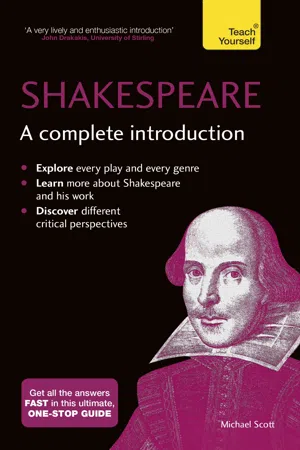
William Shakespeare has been hailed as one of the greatest thinkers of all time, one of the world's finest artists, poets and dramatists. Shakespeare: A Complete Introduction introduces and explains the plays by looking at how they work, taking you on a journey through the genres of comedy, history and tragedy. The best known and most popular plays are discussed in detail and even plays in which Shakespeare may have had only the briefest creative and collaborative interest as a writer, get at least a mention. With material on his poetry and discussions on aspects of his life too, this truly is a complete introduction to Shakespeare.'A very lively and enthusiastic introduction to the full range of Shakespeare's plays' John Drakakis, Professor of English, University of Stirling'A masterpiece of the genre, written as it is with passion, without condescension, without jargon, thoughtful and open to changing critical theories, but always returning to the plays themselves, plays that fully reveal themselves most in performance.' Martin Wine, Professor Emeritus of English at the University of Illinois at Chicago (UIC)
- 416 pages
- English
- ePUB (mobile friendly)
- Available on iOS & Android
eBook - ePub
Shakespeare: A Complete Introduction
About this book
Information
Table of contents
- Cover
- Title
- Dedication
- Acknowledgements
- Contents
- Preface
- 1 Releasing Shakespeare
- 2 The framing of Shakespearean comedy: The Comedy of Errors (1594)
- 3 Critical perspectives 1: Neoclassical and Romantic approaches
- 4 A Midsummer Night’s Dream (1595–6) and Romeo and Juliet (1595–6)
- 5 Shakespeare’s poetic and theatrical language
- 6 Love’s Labour’s Lost (1595) and The Two Gentlemen of Verona (1591–2)
- 7 Living up to its title: As You Like It (1599–1600)
- 8 Twelfth Night; or, What You Will (1601)
- 9 Critical perspectives 2: Theatrical Influences on Shakespeare in performance and interpretation
- 10 Much Ado About Nothing (1598–9) and The Taming of the Shrew (1589–92?)
- 11 The Merchant of Venice (1596–8)
- 12 Critical perspectives 3: Reading history, writing history and the English history plays
- 13 The English history plays 1: The Henry VI plays (1591–2); Richard III (1592–4); King John (1595–7)
- 14 The English history plays 2: Richard II (1595–6)
- 15 The English history plays 3, plus a comedy: 1 Henry IV (1596–7); 2 Henry IV (1597–8); Henry V (1599); and The Merry Wives of Windsor (1597–1601)
- 16 Critical perspectives 4: Tragedy – some modern critical challenges; Titus Andronicus (1591–2)
- 17 Hamlet, Prince of Denmark (1600–1601)
- 18 Othello (1604)
- 19 King Lear (1605–6)
- 20 Macbeth (1606)
- 21 Critical perspectives 5: Searching for and interpreting the text
- 22 Greeks and Romans 1: Timon of Athens (1605) and Troilus and Cressida (1601–2)
- 23 Greeks and Romans 2: Julius Caesar (1599); Antony and Cleopatra (1606–7); Coriolanus (1608)
- 24 Critical perspectives 6: Some ‘isms’; a glossary; and selected biographies
- 25 All’s Well That Ends Well (1605) and Measure for Measure (1604)
- 26 Cymbeline (1609–10) and a note on the poems
- 27 The Tempest (1611) and the collaborative plays: Henry VIII (1613); The Two Noble Kinsmen (1613–4); Pericles (1608); and The Shakespeare Apocrypha
- 28 The Winter’s Tale (1610–11)
- Conclusion
- Appendices
- Copyright
Trusted by 375,005 students
Access to over 1.5 million titles for a fair monthly price.
Study more efficiently using our study tools.
Frequently asked questions
Yes, you can cancel anytime from the Subscription tab in your account settings on the Perlego website. Your subscription will stay active until the end of your current billing period. Learn how to cancel your subscription
No, books cannot be downloaded as external files, such as PDFs, for use outside of Perlego. However, you can download books within the Perlego app for offline reading on mobile or tablet. Learn how to download books offline
Perlego offers two plans: Essential and Complete
- Essential is ideal for learners and professionals who enjoy exploring a wide range of subjects. Access the Essential Library with 800,000+ trusted titles and best-sellers across business, personal growth, and the humanities. Includes unlimited reading time and Standard Read Aloud voice.
- Complete: Perfect for advanced learners and researchers needing full, unrestricted access. Unlock 1.5M+ books across hundreds of subjects, including academic and specialized titles. The Complete Plan also includes advanced features like Premium Read Aloud and Research Assistant.
We are an online textbook subscription service, where you can get access to an entire online library for less than the price of a single book per month. With over 1.5 million books across 990+ topics, we’ve got you covered! Learn about our mission
Look out for the read-aloud symbol on your next book to see if you can listen to it. The read-aloud tool reads text aloud for you, highlighting the text as it is being read. You can pause it, speed it up and slow it down. Learn more about Read Aloud
Yes! You can use the Perlego app on both iOS and Android devices to read anytime, anywhere — even offline. Perfect for commutes or when you’re on the go.
Please note we cannot support devices running on iOS 13 and Android 7 or earlier. Learn more about using the app
Please note we cannot support devices running on iOS 13 and Android 7 or earlier. Learn more about using the app
Yes, you can access Shakespeare: A Complete Introduction by Michael Scott in PDF and/or ePUB format, as well as other popular books in Literature & Shakespeare Drama. We have over 1.5 million books available in our catalogue for you to explore.