Scientific research into sleep has dramatically increased during the past decade, with greater understanding of the hormonal and brain activity during sleep which has a key influence on your health and wellbeing. This expert, accessible book presents a combination of sleep hygiene, evidence-based techniques, psychological skills, and mindfulness practices to help improve your sleep. It examines common myths and stereotypes which may damage your chances of sleeping well, and gives tips for dealing with your sleep problems effectively. Topics include:
How much sleep you really need
Sleep quality and quantity
Underlying issues, such as stressful life events, depression and anxiety
Physical clinical problems, such as snoring, sleep apnea and asthma
Perpetuating factors of sleep issues such as habits, perceptions, attributions, beliefs and thoughts
Insomnia - wired and tired
Psychoeducation to help with sleep problems, with a focus on Acceptance and Commitment Therapy or ACT; CBT-I, along with stimulus control, sleep/bed restriction therapy, worry time, and paradoxical intention
Sleep hygiene, such as de-cluttering, eating, regular behaviours, exercise.
Behavioural sleep interventions for parents with babies and young children
Practical application of mindfulness
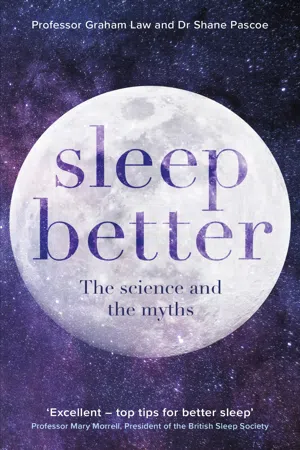
- 144 pages
- English
- ePUB (mobile friendly)
- Available on iOS & Android
eBook - ePub
About this book
Information
Topic
MedicineSubtopic
Sleep Medicine1
‘I should have 8 hours’ sleep’
Barack Obama was asked what he would like most for Christmas after a year of campaigning to be president of the United States. He answered without hesitation: ‘Eight hours’ sleep.’
When I ask people what they know about sleep, the first answer is nearly always: ‘You need 8 hours.’ We are going to look at the evidence in support of this myth and how this belief can influence your sleep. The media promotes it, and you see it in books and on television. Of course, most of you will know of somebody who says they don’t require a full 8 hours. There are reports of the late Margaret Thatcher only needing 4 hours’ sleep per night; people wear the ability to survive on a limited amount of sleep as a badge of honour. The politically convenient perception was that she was tough, the ‘Iron Lady’, and 8 hours was therefore for weaker people, but is this true? Does everyone need 8 hours? Is everyone the same?
The myth came from medical research
As this myth seems to be widely quoted, where did it originate? During the 1980s and 1990s there was a group of scientists, led by Thomas Wehr in Washington DC, who were interested in the length of time humans sleep. One particular experiment they carried out – in which I would not like to have been a ‘guinea pig’ – made eight people live in rooms where they were only allowed 10 hours’ light per day. It was pitch-black for the other 14 hours, and they were not permitted to listen to music or have anything that might interrupt their sleep patterns.
To begin with, these people slept an average of 11 hours per night. The reason for sleeping 11 hours may have been because they were catching up on a sleep ‘debt’ that had built up. After 4 weeks, seven of the participants were sleeping for around 8 hours, broken into two blocks of around 4 hours. Adding these two blocks together has led to the idea that we need 8 hours’ sleep per night.
Surveys over the past few decades have also supported the need for 8 hours per night. The overwhelming majority say that people have an average of 7–8 hours’ sleep per night. By looking at some of the national and international surveys, we can get a clear picture of what is a standard or an average amount of sleep. A study I have worked on as part of my research, known as Understanding Society, shows that adults in the UK sleep on average 7 hours and 10 minutes. However, this is an average and the number of hours of sleep varies hugely between individuals – from 3.5 hours to 11 hours or more. Some 10 per cent of people report having more than 10 hours’ sleep per night, and over one-third say they sleep fewer than 7 hours. It is clear that the eight-hour myth hides significant variation – and an experiment with only eight people will not tell the whole story.
How much sleep do you need?
So how much do we need? It seems we are all different – ‘Nowt as queer as folk’ you might say. When Napoleon Bonaparte was asked how many hours’ sleep people need, he replied ‘Six for a man, seven for a woman, eight for a fool.’
This is one of the most valuable and insightful phrases about the amount of sleep you should have. It shows a disregard for personal differences and the events happening around you in your lives when you try to sleep. Do you believe that the stronger a person is perceived to be, the less sleep they need?
You need to ignore these implied, and sometimes explicit, stereo-types. Each person needs different amounts of sleep. These differences may be due to your genetic composition, lifestyle and levels of activity, health or other factors; also, these needs change for the same person as they get older or during particular phases of life that they experience.
The key to understanding whether or not you have had enough sleep is noticing if there is excessive sleepiness, particularly during the daytime. Sometimes people report very little sleep but have no excessive daytime sleepiness. Therefore it is reasonably straightforward to ascertain that they have in fact had ‘enough’ sleep.
The idea of stating an amount of time you need to sleep is similar to stating the number of calories you should consume. It is well understood that different people need different amounts of energy. The calorie intake differs with age and by sex. During times when you are doing large amounts of exercise, your body needs more energy, but when you are trying to gain or lose weight, there is a different requirement. Also, some people simply need more than others to maintain a constant weight.
Individual differences are also present for sleep. So why should someone say ‘Everyone needs 8 hours’ sleep’? We risk oversimplifying a complex issue, and maybe you could give them an alternative viewpoint.
Summary
The evidence shows that there is some truth in this myth: the average time a population of people sleep for is around 8 hours, and some individuals will need 8 hours’ sleep. This ‘average’ is not necessarily you, though. We do not all weigh an ‘average’ weight or own a house with the ‘average’ house price. As an individual you will have your own requirement, and it is important to work out what that is for you, rather than try to achieve the average amount, which may be too much or too little for you.
Top tips
1Work out how much sleep you need. A good way to start is to keep a sleep diary for a couple of weeks. There are many available online – search ‘sleep diary’. An industry standard is the American Academy of Sleep Medicine’s sleep diary (visit <http://yoursleep.aasmnet.org/pdf/sleepdiary.pdf>). Filling this in for a couple of weeks should give you an idea of how you are sleeping at the moment. It would be good to repeat this as you work your way through this book. The tips in each chapter will help you improve your sleep, and you should see this reflected in your sleep diary.
2When you have a day on which you wake feeling refreshed and do not feel excessively sleepy through the day, the sleep you had is the right amount for you.
3Do not allow yourself to be convinced by others that there is a ‘right’ amount of sleep. It doesn’t matter what your friends do or tell you – only you can know what is right for you.
2
‘You lose weight by sleeping less’
This myth comes about because of our society’s view of sloth: one of the ‘seven deadly sins’, seen as a completely negative behaviour and attitude. Although a single definition of this sin is difficult, the most common one revolves around laziness. How about thinking for a moment how you would represent laziness? You probably imagine someone very overweight and either lying down or asleep. So you can see how we have conflated these two different issues: weight and sleep.
Confused thinking, usually in the form of logical errors, is how myths arise and there are some who think that oversleeping leads to weight gain. Therefore, in reverse, it would seem to make sense that if you sleep less, you will lose weight, but the opposite is correct. People who lack sleep will often, on average, be more overweight. Overall, a good sleep pattern with at least 6 hours’ sleep could lead to a weight loss of 4.5 kilograms (a little under 10 pounds), according to well-conducted scientific trials.
Lack of sleep leads to weight gain
There are a number of reasons why sleeping too little leads to gaining weight. The first relates to tiredness during the daytime. When you feel tired you may choose to drink coffee or a sweet drink. I certainly do that, and when I feel extravagant I will choose a mocha – coffee and chocolate mixed, with a little sugar. This is intended to make you feel livelier, more awake. A further temptation you may have given into is to have a snack: a biscuit, a small piece of chocolate, a wafer-thin mint, a piece of the office cake.
It is common for people to eat to feel better, which is known as emotional eating. A lack of sleep causes your body to crave happy feelings. Your brain’s reward centres light up and crave more rewards. Easy rewards are fat-laden, and sugary, foods and drinks. This is well understood as a style of consumption that can lead to weight gain. There is also an unwanted spiral here. Increasing weight can lead to negative feelings, which in turn lead to a poorer quality of sleep – and so the cycle repeats.
The daytime tiredness will also lead to your having less energy and lower motivation to exercise. Your weight is the result of energy in, through food and drink, and energy out, which includes exercise. If you use less energy because you are too tired to exercise, this leads to a potential for weight gain. Exercise is also a good way to improve the quality of your sleep and your ability to fall asleep. This is another vicious circle: less exercise leads to poorer sleep, which leads to less exercise.
The second reason why sleeping too little leads to weight gain has been explored in clinical trials, which are the best studies that medical science can perform. In one of these, a group of people were asked to go to bed much later than was normal for them, which led to their having a mere 4 hours’ sleep per night. When this group was compared with a group of people who slept normally, the results were amazing: those in the sleep-deprived group had put on weight. This was probably because there was more time in their day: an extra 3 or 4 hours. How did they fill the time? Especially when we are feeling very tired, we eat; and we eat those foods that are crunchy on the outside and soft on the inside, which is the best way to describe the most fattening foods: doughnuts, sausages, cakes, fried potatoes and so on. The group also chose larger portions than they would normally have during the day.
A third reason, partly related to the sleep loss, is hormonal. The key hormones here are called ghrelin and leptin. Ghrelin tells your body when it is ready to eat. It is the ‘go’ hormone and leptin is the ‘stop’ hormone. With the release of leptin your body feels full and no longer wants to eat. Research suggests that sleep deprivation leads to more ghrelin, therefore you want to eat more, and less leptin, which makes you less likely to stop eating.
The reverse of this relationship between food and sleep also leads to poor sleep. For example, large meals, close to bedtime, are likely to cause you to have an interrupted sleep. This will then go back into the pattern of eating more and sleeping less. Finally, lack of sleep leads to you not focusing properly, not taking sufficient care of yourself. Then that strict diet you may have adopted can soon go wrong because you are not awake enough to have any self-discipline.
Summary
Despite what some people think, sufficient sleep may help you to control your weight. When your sleep is out of control, this can lead to emotional eating and less motivation to exercise. Both of these are likely to lead to weight gain. The loss of focus and motivation may also make sticking to a diet and exercise plan more difficult.
Top tips
1Celebrate the fact that by improving your sleep you are also helping to control your weight. What a bonus!
2Think carefully about your sleep patterns and how these may influence your weight management.
3Try to avoid those vicious circles I talked about by maintaining your motivation for sticking with a sensible eating plan with regular exercise. Try looking at the NHS Choices website ‘How to Diet’ article at <www.nhs.uk/Livewell/loseweight/Pages/how-to-diet.aspx>. Also, Shane recommends knowing more about your personality and your individual behaviour when making changes. The Commonwealth Scientific and Industrial Research Organisation (CSIRO) has developed a 5-minute survey to help inform your diet choices – see <https://my.totalwellbeingdiet.com/Diet-Type>.
3
‘I didn’t sleep a wink last night’
Have you ever said ‘I didn’t sleep a wink last night’?...
Table of contents
- 1 ‘I should have 8 hours’ sleep’
- 2 ‘You lose weight by sleeping less’
- 3 ‘I didn’t sleep a wink last night’
- 4 ‘I’d be in trouble without my snooze button’
- 5 ‘I yawn because I’m tired’
- 6 ‘I must sleep in one continuous block of time’
- 7 ‘I tried mindfulness once and it didn’t help me to sleep’
- 8 ‘Your head can explode while you sleep’
- 9 ‘Holding a spoon allows me to nap’
- 10 ‘Coffee doesn’t affect my sleep’
- 11 ‘Don’t wake a sleepwalker’
- 12 ‘I haven’t slept well if I woke during the night’
- 13 ‘My television helps me to sleep’
- 14 ‘If dolphins slept, they wouldn’t be able to breathe’
- 15 ‘Routines are for babies’
- 16 ‘The more I sleep, the more I need to sleep’
- 17 ‘Sleeping is a weakness’
- 18 ‘I can’t sleep without my bed socks’
- 19 ‘Napping is for old people’
- 20 ‘One hour’s sleep before midnight is worth two after’
- 21 ‘I just need an app’
- 22 ‘My baby doesn’t “sleep like a baby”!’
- 23 ‘Cheese gives you nightmares’
- 24 ‘There must be something wrong with me if I sleep more than my friends’
- 25 ‘When I exercise, I sleep better’
- 26 ‘Teenagers are lazy because they sleep too much’
- 27 ‘You shouldn’t keep your mobile phone by your bed’
- 28 ‘A little drink before bed helps me to sleep’
- 29 ‘A psychologist won’t help me to sleep’
- 30 ‘If I slept less I could get more done’
- 31 ‘I can catch up on my sleep any time’
- 32 ‘I’m too busy to have breakfast’
- 33 ‘Never go to sleep on an argument’
- 34 ‘I won’t come to any harm from not sleeping’
- 35 ‘Snoring means I’m sleeping well’
- 36 ‘A banana before bed helps me to sleep’
- 37 ‘The older I get, the more sleep I need’
- 38 ‘My laptop takes up little room in my bedroom’
- 39 ‘I can just take a tablet to help me with my sleep’
- 40 ‘When I’ve caught up on my sleep I can sort out the clutter’
- Conclusion: how to sleep better
- Useful addresses and websites
- Further reading
- Search terms
Trusted by 375,005 students
Access to over 1.5 million titles for a fair monthly price.
Study more efficiently using our study tools.
Frequently asked questions
Yes, you can cancel anytime from the Subscription tab in your account settings on the Perlego website. Your subscription will stay active until the end of your current billing period. Learn how to cancel your subscription
No, books cannot be downloaded as external files, such as PDFs, for use outside of Perlego. However, you can download books within the Perlego app for offline reading on mobile or tablet. Learn how to download books offline
Perlego offers two plans: Essential and Complete
- Essential is ideal for learners and professionals who enjoy exploring a wide range of subjects. Access the Essential Library with 800,000+ trusted titles and best-sellers across business, personal growth, and the humanities. Includes unlimited reading time and Standard Read Aloud voice.
- Complete: Perfect for advanced learners and researchers needing full, unrestricted access. Unlock 1.5M+ books across hundreds of subjects, including academic and specialized titles. The Complete Plan also includes advanced features like Premium Read Aloud and Research Assistant.
We are an online textbook subscription service, where you can get access to an entire online library for less than the price of a single book per month. With over 1.5 million books across 990+ topics, we’ve got you covered! Learn about our mission
Look out for the read-aloud symbol on your next book to see if you can listen to it. The read-aloud tool reads text aloud for you, highlighting the text as it is being read. You can pause it, speed it up and slow it down. Learn more about Read Aloud
Yes! You can use the Perlego app on both iOS and Android devices to read anytime, anywhere — even offline. Perfect for commutes or when you’re on the go.
Please note we cannot support devices running on iOS 13 and Android 7 or earlier. Learn more about using the app
Please note we cannot support devices running on iOS 13 and Android 7 or earlier. Learn more about using the app
Yes, you can access Sleep Better by Graham Law,Shane Pascoe in PDF and/or ePUB format, as well as other popular books in Medicine & Sleep Medicine. We have over 1.5 million books available in our catalogue for you to explore.