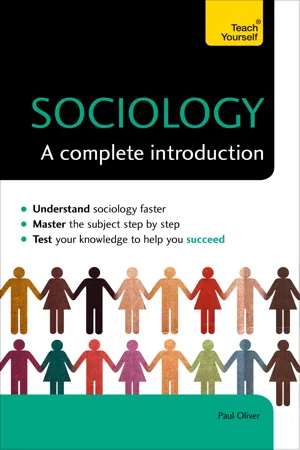
Sociology: A Complete Introduction is designed to give you everything you need to succeed, all in one place. It covers the key areas that students are expected to be confident in, outlining the basics in clear, jargon-free English and providing added-value features like summaries of key experiments and even lists of questions you might be asked in your seminar or exam.The text is split into four parts, with an emphasis throughout on understanding and treating all concepts with clarity and precision. The first part covers theoretical issues including research methods. Part two looks at the social environment, including urbanization, work, politics, religion and the mass media. The final two parts examine global society and the position of the individual.It is structured to mirror the way Sociology is taught on many A Level and university courses with each chapter covering a key introductory area. By the end you'll have a clear understanding of the essential principles of sociology.
- 336 pages
- English
- ePUB (mobile friendly)
- Available on iOS & Android
eBook - ePub
Sociology: A Complete Introduction: Teach Yourself
About this book
Information
Part One
Theoretical issues and sociology
1
Introduction to sociology and the social sciences

This first chapter will act as an introduction to the broad themes of the whole book. It will discuss the nature of sociology as being arguably the foundational discipline of the social sciences. In so doing it will analyse related subjects such as economics and psychology. The chapter will also include a discussion of inter-disciplinary subjects, such as education, which incorporate a significant element of social thought. There will also be a discussion of the nature of the concept of ‘science’ in social science, and whether sociology can be considered analogous in terms of scientific thought to the ‘natural’ sciences.
The origins of sociology
Sociology is a relatively new subject, having developed from the work of European social philosophers of the early 19th century. As the industrial and scientific revolutions gathered pace, there was an increasing assumption that similar rational approaches could be used to analyse human society. At the forefront of these ideas was the French philosopher Auguste Comte (1798–1857), who did not favour a traditional religious interpretation of society but preferred a scientific approach.
Sociology has since evolved into a broad-based subject which analyses all aspects of human behaviour in society. It can treat as its subject matter the behaviour of large groups of people, or of individuals and the way in which they relate to organizations and institutions. Sociology is very much an empirical subject in that it relies upon the collection and analysis of data in order to further an understanding of society. The data, and the methods used to analyse them, may be quantitative, qualitative or a combination of the two.
Sociology is a scientific discipline in the sense that it adopts rational, systematic thought processes to the investigation of society. Sociologists conduct research on many aspects of social phenomena, ranging from factors affecting social stability to the reasons for change in society.
In its early days, sociology was influenced by the Enlightenment and by the approach to rationality and logic typified by such figures as Voltaire (1694–1778) and David Hume (1711–76).
 | Did you know? |
In 1726 the French writer and philosopher Voltaire had exchanged some humorous and perhaps slightly rude remarks with a rich aristocrat called the Chevalier de Rohan. The latter apparently told some of his servants to attack Voltaire. Although Voltaire threatened legal action, the Chevalier used his influence to have Voltaire imprisoned in the Bastille. Voltaire pleaded to be sent into exile instead of being imprisoned, and was hence allowed to travel to England. He spent three years in London where he became popular and well known in literary and philosophical circles. Eventually he returned to Paris where in 1734 he published a book praising the freedom of expression which he had found in London, thus further upsetting the French élite.

The rise of sociology as a discipline coincided with the many changes brought about by the Industrial Revolution in Europe during the late 18th and early 19th centuries. The new manufacturing processes resulted in the transformation of society, notably in relation to employment patterns.
 | Key idea: The Enlightenment |
The Enlightenment was a philosophical and intellectual movement of 18th-century Europe that emphasized the use of reason, observation and science, in contrast to the dogmatic beliefs that had previously held sway.
The growth of industrialization during the 19th century led to a migration of people to the cities, both in Europe and in the United States. The new urbanization, combined with the fusion of people from different cultures and social classes, had many consequences for society.
These changes became of increasing interest to academics, who were working in the new field of sociology, leading to the establishment of university departments devoted to this area of study. William Graham Sumner (1840–1910) gave lectures at Yale University in 1876 on the work of Auguste Comte, and in 1892 the first postgraduate school of sociology was established at the University of Chicago. The latter university became well known for encouraging its sociology students to conduct empirical research in Chicago and its environs, on the many different cultural groups who had made their home there.
 | The Chicago School of Sociology |
In the mid-19th century Chicago was a very small town. However, by the early 20th century its population was measured in millions. This large increase in population was due to rapid industrial expansion, which brought many workers and their families to Chicago. This large-scale migration was partly from Europe, and partly consisted of black people from the southern states of America who were trying to escape the endemic racism there.
Almost inevitably, Chicago was unable to provide the infrastructure to support this influx of people, and during the period of heaviest immigration, facilities such as housing, health care and other social services were inadequate. It is perhaps not surprising that groups of immigrants from the same European or American region tended to live in the same area of Chicago, and hence to sustain the sense of community they had felt in their original home.
The School of Sociology at Chicago had a reputation for recruiting some of the leading social scientists of the period, including W. I. Thomas, Florian Znaniecki and George Herbert Mead. Moreover, the School developed a deliberate policy of researching the city of Chicago itself, and in particular the social diversity brought about by the large-scale immigration.
Researchers in the School used a combination of existing data collected on the city, with new qualitative data that reflected the social problems and social mobility within Chicago. The researchers there became well known for their use of a range of qualitative methodologies, including life history and autobiographical accounts, and ethnographies. The Chicago researchers demonstrated that sociologists did not need to stray very far in search of interesting social data. Very often the people and communities on one’s doorstep could provide data and insights which were of much wider relevance.
The study of sociology was also thriving in European universities, and in 1895 Émile Durkheim (1858–1917) established the Department of Sociology at the University of Bordeaux.
The early sociologists were inclined to employ empirical – and notably quantitative – methods in their studies. They felt that such approaches gave a scientific legitimacy to their research. In a seminal piece of work, Durkheim studied suicide rates among Catholic and Protestant communities. In general, he found lower suicide rates among the former and higher rates among the latter. He explained this by suggesting that in Catholic communities there was normally an increased sense of social solidarity and social cohesion. This would provide a sense ...
Table of contents
- Cover
- Title
- Contents
- About the Author
- How to use this book
- Part One: Theoretical issues and sociology
- Part Two: The Social Environment
- Part Three: The Global Society
- Answers
- References
- Copyright
Trusted by 375,005 students
Access to over 1.5 million titles for a fair monthly price.
Study more efficiently using our study tools.
Frequently asked questions
Yes, you can cancel anytime from the Subscription tab in your account settings on the Perlego website. Your subscription will stay active until the end of your current billing period. Learn how to cancel your subscription
No, books cannot be downloaded as external files, such as PDFs, for use outside of Perlego. However, you can download books within the Perlego app for offline reading on mobile or tablet. Learn how to download books offline
Perlego offers two plans: Essential and Complete
- Essential is ideal for learners and professionals who enjoy exploring a wide range of subjects. Access the Essential Library with 800,000+ trusted titles and best-sellers across business, personal growth, and the humanities. Includes unlimited reading time and Standard Read Aloud voice.
- Complete: Perfect for advanced learners and researchers needing full, unrestricted access. Unlock 1.5M+ books across hundreds of subjects, including academic and specialized titles. The Complete Plan also includes advanced features like Premium Read Aloud and Research Assistant.
We are an online textbook subscription service, where you can get access to an entire online library for less than the price of a single book per month. With over 1.5 million books across 990+ topics, we’ve got you covered! Learn about our mission
Look out for the read-aloud symbol on your next book to see if you can listen to it. The read-aloud tool reads text aloud for you, highlighting the text as it is being read. You can pause it, speed it up and slow it down. Learn more about Read Aloud
Yes! You can use the Perlego app on both iOS and Android devices to read anytime, anywhere — even offline. Perfect for commutes or when you’re on the go.
Please note we cannot support devices running on iOS 13 and Android 7 or earlier. Learn more about using the app
Please note we cannot support devices running on iOS 13 and Android 7 or earlier. Learn more about using the app
Yes, you can access Sociology: A Complete Introduction: Teach Yourself by Paul Oliver in PDF and/or ePUB format, as well as other popular books in Social Sciences & Sociology. We have over 1.5 million books available in our catalogue for you to explore.