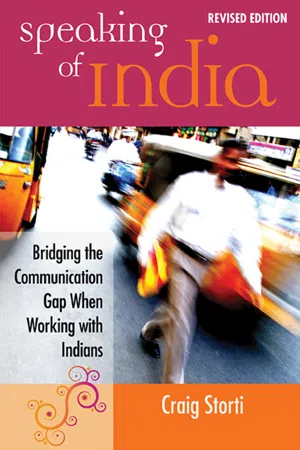
Westerners and Indians are working more closely together and in greater numbers than ever before. The opportunities are vast, but so is the cultural divide. Misunderstandings and frustration due to cultural differences wreak havoc on success. In this revised edition of Speaking of India, author and intercultural communications expert Craig Storti attempts to ease the frustration, and bring cultural understanding in business and life. With a new foreword by Ranjini Manian, author of Doing Business in India for Dummies, the book also features new content on managing remotely, and the results of a five-year cultural survey. With more than a dozen years of experience working between the two cultures, Storti has identified key cultural flashpoints and the result is a powerful series of Best Practices, which is the basis of Speaking of India.
- 224 pages
- English
- ePUB (mobile friendly)
- Available on iOS & Android
eBook - ePub
About this book
Information
CHAPTER ONE
Indians, Westerners, and the Cultural Lens
What I say is this [the Indian man remarked] and this I do not say to all Englishmen: God made us different, you and I, and your fathers and my fathers. For one thing, we have not the same notions of honesty and speaking the truth. That is not our fault, because we are made so. And look now what you do? You come and judge us by your own standards of morality. You are, of course, too hard on us. And again I tell you: you are great fools in this matter. Who are we to have your morals, or you to have ours?
Rudyard Kipling
“East and West”
The portion we see of human beings is very small. Their forms and faces, voices and words . . . [But] beyond these, like an immense dark continent, lies all that has made them.
Freya Stark
The Journey’s Echo
Cultural differences like the ones described in this book have been implicated in many of the frustrations, inefficiencies, and, in some cases, the actual failure of Indian-Western partnerships and joint ventures. According to industry experts at Gartner, half of all outsourcing ventures fail, and while cultural differences alone do not usually cause these failures, they are quite often a major contributing factor. Those ventures that do succeed often do so in spite of cultural problems. How much better it would be if these ventures could be even more successful—and succeed even sooner—if the cultural problems could be identified and eliminated at the outset.

Those ventures that do succeed often do so in spite of cultural problems.
Cultural differences have repeatedly been found to play a significant role in the following problems that affect many offshore ventures:

Fixing the cultural piece will not cause these problems to go away, but it will mitigate many of them and, more important, create the circumstances—mutual understanding and trust—that will enable all those involved to put in place the other measures that sooner or later will send these problems packing.
Which Westerners?
Before we go any further, we should probably be more precise about these Westerners we’ve being going on about. Can we really make meaningful statements about such a large and diverse group? Jacques Barzun, for one, doesn’t think so: “Of all the books that no one can write,” he has observed, “those about nations and the national character are the most impossible” (Kammen 1980, xvii). Bloody but unbowed, we actually propose to go Barzun one better and write a book about an entire group of nations. If it’s impossible to write meaningfully about one country, then surely it is close to madness to write about a collection of countries.
In our defense, we have pared down what we mean by Western countries in these pages to include only the following: the United States, northern Europe (in particular the United Kingdom but also the Netherlands, Germany, and the Scandinavian countries), and the former British colonies of Canada, Australia, and New Zealand. (The latter two are not geographically in the West, of course, but their cultures are certainly more Western, specifically more British, than they are Asian.) We do not include any other Western European countries in our definition, most especially not southern, Mediterranean, or what might be called Latin Europe. This region is indisputably part of the West, but the cultures of Mediterranean Europe are quite different from those of northern Europe. Most generalizations we can safely make about northern Europe and the United States, therefore, do not apply to southern Europe. When we speak of the West, Westerners, and Western countries in these pages, we mean the United States, northern Europe, and the former British colonies (except where otherwise indicated).
The reader may still wonder how we can get away with lumping Germany, say, in the same cultural bloc as England or the United States. The answer is that with respect to the cultural issues that come up the most often in the offshore experience, namely communication style and management style, the Western countries are similar to each other in their overall assumptions and values, if not always in the specific applications of those assumptions. Managers in both Germany and the United States, for example, delegate authority and expect subordinates to make independent decisions, but German managers typically expect to be kept better informed about such decisions than their American counterparts. Moreover, for all the subtle—and even not so subtle—cultural differences among the various Western countries in communication and management style, the overall approach in each country is much closer to that of the other Western countries than it is to that of India.
Which Indians?
In some ways it’s even harder to write about the single country of India than it is to write about all the Western countries described above. Winston Churchill is reputed to have said that India is no more a country than is the equator. And he is in good company, for the overwhelming consensus is that there’s no such place as India—and, by extension, no such thing as an Indian. Westerners will tell you this; Indians will tell you this; and the facts will tell you this. Amaryta Sen, India’s Nobel laureate in economics, is fond of quoting one of his Western teachers, who told him: “Whatever you can rightly say about India, the opposite is also true” (2005, 137).
“The simple fact is that we are all minorities in India,” Shashi Tharoor writes in his book India: From Midnight to the Millenium and Beyond. “There has never been an archetypal Indian to stand alongside the archetypal Englishman or Frenchman” (1997). Just one look at the religious, racial, ethnic, geographic, linguistic, class, caste, and socioeconomic diversity of India is enough to confirm Tharoor’s view, and should be more than enough to scare off any would-be pontificators. It has not frightened anyone, of course (present company included), but it has instilled in all of us a generous dose of humility.
Almost all nations celebrate their diversity, but none with more justification than India. There is north India and south India; east India and west India; Hindu, Moslem, Sikh, and Jain India; desert India, tropical India, and Himalayan India; urban India and rural India; very rich India and dirt-poor India; modern India and traditional India. In any book or article about India it’s not possible to get past the second or third page or the first few paragraphs before running across the obligatory land-of-contrasts passage, explaining why the country is fundamentally unprofileable. “This is a country where 300 million people live in absolute poverty,” one recent example reads
Most of them in its 680,000 villages, but where cell phone users have jumped from 3 million in 2000 to 100 million in 2005, and the number of television channels from 1 in 1991 to more than 150 last year.
India’s economy has grown by 6 percent annually since 1991, a rate exceeded only by China’s, yet there are a mere 35 million taxpayers in a country with a population of 1.1 billion. Only 10 percent of India’s workers have jobs in the formal economy. Its excellent engineering schools turn out a million graduates each year, 10 times the number for the United States and Europe combined, yet 35 percent of the country remains illiterate. (Grimes, 2007)
Fortunately, we plan to describe only a small subset of Indians in these pages—educated urban professionals—who, while they come from all the different Indias, share a common subculture that makes them more like each other than like the Indians of their various homelands. Indeed, in many ways they have more in common with urban professionals in London and Los Angeles than with the bullock-cart drivers they drive past while commuting to downtown Bangalore.
About these Indians it is possible to make accurate and useful generalizations, so long as one remembers the first rule of all generalizations: they must be taken with a grain of salt (including those about the West). Generalizations are only true in general; they may be accurate about a group but not necessarily about any individual member of that group or for any particular set of circumstances. You will never meet a general person, in other words, and you will never be in a general situation. In the end, you have to deal with the person standing in front of you, who in some respects may indeed be just like the general Indian or the general American you have read about in books like this, but who in other ways will be nothing like the stereotype. That doesn’t make them wrong—most stereotypes contain at least a germ of truth—but it does make such stereotypes incomplete and potentially misleading.
Two Types of Indians
Even within the narrow subset of Indians we will describe in these pages, there is an important distinction that needs to be made between those who have spent some time in the West and those who have not. The former, obviously, are somewhat or even very familiar with Western ways, while all the latter know about the West is what they have heard (chiefly from other Indians).
Why is this important? If, as an American or European, you are dealing with an Indian who is living in your country and working in your workplace, or who may be back in India but previously sojourned in your country, you can reasonably assume that that individual understands some things about your culture, certainly more than an Indian who has never been to your country. This Indian, let’s call him Raj, has worked with and alongside Americans or the English, let’s say, has observed how they interact with each other, and knows, therefore, how—ethnocentric as we all are—these Americans or Brits expect him to behave: just like them.
Raj, who is also ethnocentric—or was up until now—begins to notice that a lot of the ways he has always behaved, which he thought of as right and normal back home, are nowhere to be seen in Boston or Birmingham; indeed, when he behaves in those ways people look at him strangely, or worse. As a result, Raj begins to adjust his behavior to be more like what he sees around him every day in the workplace, for that behavior, strange as it appears to him, is clearly normal and appropriate in this environment. Raj, in short, is becoming Westernized, and because he is becoming Westernized, Westerners are finding it increasingly easy to understand and work with him.
Raj will never become completely Westernized, of course; he will most likely adopt Western behaviors in some circumstances but not others and will typically revert to “type” (his Indian self) when he is under a lot of pressure. In other words, while Westerners can reasonably expect fewer cultural misunderstandings with Westernized Indians like Raj, they should still be careful not to mistake a few outward trappings of Western behavior for a complete personality change.
Just how Western a Westernized Indian actually becomes depends on a number of factors: how long the Indian has worked in the Indian business culture (how Easternized he or she is); how old he or she is (younger Indians tend to be more flexible and adaptable); who the Indian actually reports to (whether he or she reports to an Indian boss in the United States or the United Kingdom or to a Western boss); how long the Indian spends in the West; and whether he or she comes alone (in which case they tend to adapt more quickly) or with a group of Indians (with whom the Indian may interact as much or even more than with the Westerners in the workplace).
The second type of Indian is someone who has not spent any time or spent very little time in the West. This person, let’s call her Sumitra, has not seen Americans or Brits in action on their cultural turf, has not observed how they interact with each other in the workplace, does not realize how they are expecting her to behave—like them—and does not understand, therefore, that the way she in fact behaves is not always appropriate, normal, or understood in the West. Sumitra does not adjust her behavior, does not become Westernized, and is not as easy for Westerners to understand and work with. For obvious reasons, Americans and Europeans will have more cultural problems with Sumitra, most likely some of the very problems described in the rest of this book.
Even Westerners who understand all this sometimes hold out the hope that as time goes by and she has more contact with the West, Sumitra, even without the benefit of a stay in Minneapolis or Manchester, will somehow become a little more Westernized. A little, perhaps, but Westerners must remember that the Western workplace has no immediacy or reality for Sumitra, no real claim on her, no matter how much time she spends on the phone with Americans, how many conference calls she sits in on, or how many e-mails she writes. The Indian workplace, meanwhile, is immediate and very real; her future depends on her succeeding in that environment, not in Minneapolis. Indeed, if Sumitra were to become Westernized, it would not do anything for her career.
On this same note we might mention what often happens to our friend Raj when he goes back to India after an extended stint in Cleveland. If he has in fact morphed into a Westernized Indian, then there’s every chance his homecoming will be rocky. Typically, he would have to shed some of his new Western behaviors in order to fit back into the Indian workplace. Meanwhile, his Western colleagues back in Cleveland with whom he still works know nothing of this new Raj (who is actually the old Raj) and don’t understand why he has suddenly “gone Indian” on them.
The Culture Thing
These, then, are the Westerners and the Indians we’ll be describing in these pages. Now we need to take up another fundamental question: Is the ...
Table of contents
- Cover Page
- Title Page
- Copyright Page
- Dedication
- Contents
- Foreword
- Acknowledgments
- Introduction
- CHAPTER 1 Indians, Westerners, and the Cultural Lens
- CHAPTER 2 Communication East and Communication West
- CHAPTER 3 Yes, No, and Other Problems
- CHAPTER 4 Management East and Management West
- CHAPTER 5 The Deference Syndrome
- CHAPTER 6 Talking Points: The Language Problem
- CHAPTER 7 Meetings and Conference Calls
- CHAPTER 8 Women and Men
- CHAPTER 9 Working with Indians on Virtual Teams
- CHAPTER 10 The View from India
- CHAPTER 11 Business and Social Etiquette
- Bibliography
- About the Author
- Index
- Footnotes
Trusted by 375,005 students
Access to over 1.5 million titles for a fair monthly price.
Study more efficiently using our study tools.
Frequently asked questions
Yes, you can cancel anytime from the Subscription tab in your account settings on the Perlego website. Your subscription will stay active until the end of your current billing period. Learn how to cancel your subscription
No, books cannot be downloaded as external files, such as PDFs, for use outside of Perlego. However, you can download books within the Perlego app for offline reading on mobile or tablet. Learn how to download books offline
Perlego offers two plans: Essential and Complete
- Essential is ideal for learners and professionals who enjoy exploring a wide range of subjects. Access the Essential Library with 800,000+ trusted titles and best-sellers across business, personal growth, and the humanities. Includes unlimited reading time and Standard Read Aloud voice.
- Complete: Perfect for advanced learners and researchers needing full, unrestricted access. Unlock 1.5M+ books across hundreds of subjects, including academic and specialized titles. The Complete Plan also includes advanced features like Premium Read Aloud and Research Assistant.
We are an online textbook subscription service, where you can get access to an entire online library for less than the price of a single book per month. With over 1.5 million books across 990+ topics, we’ve got you covered! Learn about our mission
Look out for the read-aloud symbol on your next book to see if you can listen to it. The read-aloud tool reads text aloud for you, highlighting the text as it is being read. You can pause it, speed it up and slow it down. Learn more about Read Aloud
Yes! You can use the Perlego app on both iOS and Android devices to read anytime, anywhere — even offline. Perfect for commutes or when you’re on the go.
Please note we cannot support devices running on iOS 13 and Android 7 or earlier. Learn more about using the app
Please note we cannot support devices running on iOS 13 and Android 7 or earlier. Learn more about using the app
Yes, you can access Speaking of India by Craig Storti in PDF and/or ePUB format, as well as other popular books in Business & Business Communication. We have over 1.5 million books available in our catalogue for you to explore.