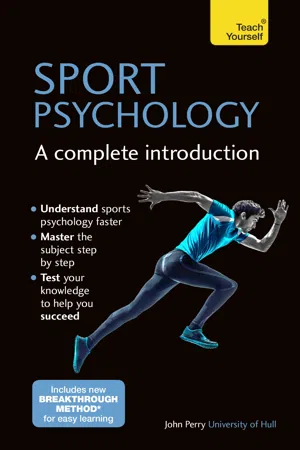
Sport Psychology: A Complete Introduction is designed to give you everything you need to succeed, all in one place. It covers the key areas that students are expected to be confident in, outlining the basics in clear, jargon-free English and providing added-value features like summaries of key experiments and even lists of questions you might be asked in your seminar or exam.The book uses a structure that mirrors the way sports psychology is taught on many university courses, and is split into theory and application. Chapters in the first part include coverage of essential personality traits, including mental toughness, confidence, motivation and character. The chapters on applied sports psychology cover topics such as assessment, working with groups, skills training, coping techniques and working with coaches and children. There is also substantial coverage of measurement questionnaires, skills and routes to practice. Sport Psychology employs the 'Breakthrough Method' to help you advance quickly at any subject, whether you're studying for an exam or just for your own interest. The Breakthrough Method is designed to overcome typical problems you'll face as learn new concepts and skills.- Problem: "I find it difficult to remember what I've read."; Solution: this book includes end-of-chapter summaries and questions to test your understanding.
- Problem: "Lots of introductory books turn out to cover totally different topics than my course."; Solution: this book is written by a university lecturer who understands what students are expected to know.
- 336 pages
- English
- ePUB (mobile friendly)
- Available on iOS & Android
eBook - ePub
Sport Psychology: A Complete Introduction
About this book
Information
Part One
Understanding sport psychology
I thought for a long time about what to include in this section. The purpose is to provide you with an overall view of some of the key theoretical pieces of knowledge that inform modern sport psychology. As such, I have not included an overview of the history of sport psychology, nor have I included a chapter on what sport psychology is. Rather, I have identified some of the most active areas of recent research in the area and tried to explain them with historical and current research.
The result is a discussion of what I consider to be front and centre of sport psychology at the moment: understanding people, stress, mental toughness, confidence, motivation, emotion, character and measurement. That does not mean that this is an exhaustive list. There are many other areas of sport psychology and a full encyclopaedic discussion of these is simply not feasible for an introductory book. The areas I have discussed are all current and developing areas. Some have longstanding theories behind them that we are still developing and testing, others are much newer and take different approaches towards understanding mental performance in sport.
1
Understanding people: psychology of sport

In this chapter you will learn:
• psychological approaches to understanding people
• what we mean by personality
• about the big five personality traits
• what the dark personality triad is
• if we can change our personality
Understanding people is integral to sport psychology because, ultimately, that is what sport performers fundamentally are: people. It is important to remember that their sporting performance is one aspect of their life – typically their occupation. Behind that, all of the psychological theories that we use to understand the person hold true to sport psychology.
Since the beginnings of psychology and Sigmund Freud’s interpretation of the human mind, researchers have been striving to better understand people. In this time there have been many different approaches adopted by psychologists. Freud’s approach is referred to as psychodynamic theory or psychoanalysis. If you are new to psychology, you may have an image of a client (or ‘patient’) lying on a couch while the psychologist interprets their deepest unconscious desires. This is derived from Freud’s work but is very different from most approaches used in sport psychology.
In contrast to the psychodynamic approach to psychology there is behaviourism. The behaviourist approach became the primary method of exploring psychology between the 1920s and 1950s. Very briefly, a behavioural approach assumes that behaviour is a response to a stimulus. Perhaps the most famous behavioural study is that of Pavlov’s (1897) classical conditioning study, where he conditioned dogs to salivate upon hearing a bell. The bell (stimulus) is ordinarily completely unrelated to salivation (response). However, by ringing a bell before feeding dogs, Pavlov was eventually able to remove the food and the stimulus–response (S–R) association continued.
 | Key idea: Classical conditioning |
A process of behaviour modification in which an often necessary and typically innate response to a stimulus becomes an automated response to a previously neutral stimulus.

A more complicated version of classical conditioning is operant conditioning. This was initially developed by Edward Thorndike (1901) and popularized by B. F. Skinner (1938). The key distinction between classical and operant conditioning is that operant conditioning includes both positive and negative conditioning. Specifically, it looks at the role of rewards and punishment as reinforcement, leading to learned behaviour. Skinner refers to the learned behaviour in response to a stimulus as operant behaviour.
The aim of this chapter is not to discuss every approach (sometimes called a paradigm) to psychology, as there are many excellent resources on these that you may wish to read. It is worth considering, though, that all theories discussed throughout the book have in some way derived from one or more of these approaches, including cognitive, behavioural, social, biological, evolutionary and humanist.
Personality
In trying to understand people, we often refer to personality. There are many, many definitions of personality. Often, these are very complex or contradict each other, which isn’t surprising really when you think about it because people are very complex and often contradict each other. Because of this, one of my favourite definitions of personality is the suitably broad: ‘The characterization of individual differences’ (Wiggins, 1996). That is essentially what we try to do by researching personality; we try to explain what it is that makes each of us different… and we are very different.
To manage the complexity of personality, most theoretical approaches group typical behaviours and responses as personality traits. A trait is often explained as an enduring, relatively stable characteristic that is resistant to change. The great thing about understanding personality traits is that it makes people more predictable and the goal of most human science is to be able to predict. If we can predict the future, we can change the future.
The notion of examining personality, particularly in the form of traits, was first presented by Gordon Allport and his brother (1921). In the early 20th century, psychoanalysis and behaviourism existed as the two main schools of psychology. Allport was uncomfortable with both approaches and proposed that personalities, in the eye of the observer, can be nomothetic (traits observable across people) or idiographic (specific to the individual). In particular, he identified levels of centrality of traits. Cardinal traits refer to ruling passions, such as altruism (selflessness and concern for others) (Allport, 1937). Allport noted that not everybody had cardinal traits, but were recognizable by them if they did have them. Common traits were the typically recognizable ones such as honesty and aggression. In the absence of cardinal traits, these traits were considered to shape someone’s personality. Finally, Allport identified secondary traits, which were more situation-specific, such as being nervous before a job interview.
Personality traits were further developed and popularized by Eysenck (1967), who identified personality by assessing two main traits: extroversion and neuroticism. Extroversion refers to the extent to which people are naturally inclined or pre-disposed to direct their attention outwards, while the opposite, the introverts, typically direct their attention inwards. In practice, this means that extroverts focus on other people and the environment. Extrovert behaviour is to be sociable, outgoing and active, while introvert behaviour is to be more quiet and reserved. Neuroticism refers to the extent that an individual is typically emotionally stable or unstable (neurotic). Emotionally stable individuals are normally ev...
Table of contents
- Cover
- Title
- Dedication
- Contents
- About the Author
- Hw to use this book
- Introduction
- Part One: Understanding sport psychology
- Part Two: Applying sport psychology
- Afterword
- References
- Answers
- Copyright
Trusted by 375,005 students
Access to over 1.5 million titles for a fair monthly price.
Study more efficiently using our study tools.
Frequently asked questions
Yes, you can cancel anytime from the Subscription tab in your account settings on the Perlego website. Your subscription will stay active until the end of your current billing period. Learn how to cancel your subscription
No, books cannot be downloaded as external files, such as PDFs, for use outside of Perlego. However, you can download books within the Perlego app for offline reading on mobile or tablet. Learn how to download books offline
We are an online textbook subscription service, where you can get access to an entire online library for less than the price of a single book per month. With over 1.5 million books across 990+ topics, we’ve got you covered! Learn about our mission
Look out for the read-aloud symbol on your next book to see if you can listen to it. The read-aloud tool reads text aloud for you, highlighting the text as it is being read. You can pause it, speed it up and slow it down. Learn more about Read Aloud
Yes! You can use the Perlego app on both iOS and Android devices to read anytime, anywhere — even offline. Perfect for commutes or when you’re on the go.
Please note we cannot support devices running on iOS 13 and Android 7 or earlier. Learn more about using the app
Please note we cannot support devices running on iOS 13 and Android 7 or earlier. Learn more about using the app
Yes, you can access Sport Psychology: A Complete Introduction by John Perry in PDF and/or ePUB format, as well as other popular books in Psychology & Sports Psychology. We have over 1.5 million books available in our catalogue for you to explore.